
SACHIN TENDULKAR
INTRODUCTION:
EARLY YEARS AND PERSONAL LIFE: Tendulkar was born into a Rajapur Saraswat Brahmin family, in Bombay (now Mumbai). His mother Rajni worked in the insurance industry, and his father Ramesh Tendulkar, a Marathi novelist, named Tendulkar after his favourite music director, Sachin Dev Burman. Tendulkar's elder brother Ajit encouraged him to play cricket. Tendulkar has two other siblings: a brother Nitin, and sister Savita.
Tendulkar attended Sharadashram Vidyamandir (High School), where he began his cricketing career under the guidance of his coach and mentor, Ramakant Achrekar. During his school days he attended the MRF Pace Foundation to train as a fast bowler, but Australian fast bowler Dennis Lillee, who took a world record 355 Test wickets, was unimpressed, suggesting that Tendulkar focus on his batting instead.
When he was young, Tendulkar would practice for hours on end in the nets. If he became exhausted, Achrekar would put a one-rupee coin on the top of the stumps, and the bowler who dismissed Tendulkar would get the coin. If Tendulkar passed the whole session without getting dismissed, the coach would give him the coin. Tendulkar now considers the 13 coins he won then as some of his most prized possessions.
While at school, he developed a reputation as a child prodigy. He had become a common conversation point in Mumbai circles, where there were suggestions already that he would become one of the greats. His season in 1988 was extraordinary, with Tendulkar scoring a century in every innings he played. He was involved in an unbroken 664-run partnership in a Lord Harris Shield inter-school game in 1988 with friend and team mate Vinod Kambli, who would also go on to represent India. The destructive pair reduced one bowler to tears and made the rest of the opposition unwilling to continue the game. Tendulkar scored 326* in this innings and scored over a thousand runs in the tournament.This was a record partnership in any form of cricket until 2006, when it was broken by two under-13 batsmen in a match held at Hyderabad in India.
At 14, Tendulkar was a ball boy for the India versus Zimbabwe game at the Wankhede Stadium during the 1987 World Cup.When he was 14, former Indian batsman Sunil Gavaskar gave him a pair of his own ultra light pads. "It was the greatest source of encouragement for me," Tendulkar said nearly 20 years later after surpassing Gavaskar's world record of 34 Test centuries.On 24 May 1995, Sachin Tendulkar married Anjali, a paediatrician and daughter of Gujarati industrialist Anand Mehta and British social worker Annabel Mehta. They have two children, Sara (born 12 October 1997), and Arjun (born 24 September 1999). Anjali is six years his senior.
STYLE OF PLAY: Tendulkar is cross-dominant: He bats, bowls and throws with his right hand, but writes with his left hand.He also practices left-handed throws at the nets on a regular basis. Cricinfo columnist Sambit Bal has described him as the "most wholesome batsman of his time".His batting is based on complete balance and poise while limiting unnecessary movements and flourishes. He appears to show little preference for the slow and low wickets which are typical in India, and has scored many centuries on the hard, bouncy pitches in South Africa and Australia.He is known for his unique punch style of hitting the ball over square. He is also renowned for his picture-perfect straight drive, often completed with no follow-through. Straight drive is his favourite shot.In 2008 Sunil Gavaskar, in an article he wrote in the AFP, remarked that "it is hard to imagine any player in the history of the game who combines classical technique with raw aggression like the little champion does".
Sir Donald Bradman, considered by many as the greatest batsman of all time, considered Tendulkar to have a batting style similar to his. In his biography, it is stated that "Bradman was most taken by Tendulkar's technique, compactness and shot production, and had asked his wife to have a look at Tendulkar, having felt that Tendulkar played like him. Bradman's wife, Jessie, agreed that they did appear similar.Former Australian cricket team coach John Buchanan voiced his opinion that Tendulkar had become susceptible to the short ball early in his innings because of a lack of footwork.[115] Buchanan also believes Tendulkar has a weakness while playing left-arm pace.He was affected by a series of injuries since 2004. Since then Tendulkar's batting has tended to be less attacking. Explaining this change in his batting style, he has acknowledged that he is batting differently due to that fact that, firstly, no batsman can bat the same way for the entire length of a long career and, secondly, he is a senior member of the team now and thus has more responsibility. During the early part of his career he was a more attacking batsman and frequently scored centuries at close to a run a ball. Ian Chappell, former Australian player, remarked in 2007 that "Tendulkar now, is nothing like the player he was when he was a young bloke".
Tendulkar has incorporated several modern and unorthodox strokes into his repertoire in recent times, including the paddle sweep, the scoop over short fine leg and the slash to third man over the slips' heads, over the last seven or eight years. This has enabled him to remain scoring consistently in spite of the physical toll of injuries and a lean period in the mid-2000s. By his own admission, he does not bat as aggressively as he did in the 90s and early 2000s, because his body has undergone changes and cannot sustain aggressive shotmaking over a long period. He is often praised for his ability to adapt to the needs of his body and yet keep scoring consistently.
While Tendulkar is not a regular bowler, he can bowl medium pace, leg spin, and off spin. He often bowls when two batsmen of the opposite team have been batting together for a long period, as he can often be a useful partnership breaker. With his bowling, he has helped secure an Indian victory on more than one occasion.He has taken 44 test match wickets and is the tenth highest wicket taker for India in ODIs.
CAPTAINCY: Tendulkar's two tenures as captain of the Indian cricket team were not very successful. When Tendulkar took over as captain in 1996, it was with huge hopes and expectations. However, by 1997 the team was performing poorly. Azharuddin was credited with saying "Nahin jeetega! Chote ki naseeb main jeet nahin hai!", which translates into: "He won't win! It's not in the small one's destiny!".
Tendulkar, succeeding Azharuddin as captain for his second term, then led India on a tour of Australia, where the visitors were comprehensively beaten 3�0 by the newly crowned world champions.Tendulkar, however, won the player of the tournament award as well as player of the match in one of the games. After another Test series defeat, this time by a 0�2 margin at home against South Africa, Tendulkar resigned, and Sourav Ganguly took over as captain in 2000.
Tendulkar remains an integral part of the Indian team's strategic processes. He is often seen in discussion with the captain, at times actively involved in building strategies. Former captain Rahul Dravid publicly acknowledged that Tendulkar had been suggesting moves such as the promotion of Irfan Pathan up the batting order which, although only temporary, had an immediate effect on the team's fortunes. In 2007, Tendulkar was appointed vice-captain to captain Rahul Dravid.During the Indian team's 2007 tour of England, Dravid's desire to resign from the captaincy became known. The BCCI President Sharad Pawar personally offered the captaincy to Tendulkar.However, Tendulkar asked Pawar not to appoint him captain, instead recommending Mahendra Singh Dhoni to take over the reins.Pawar later revealed this conversation, crediting Tendulkar for first forwarding the name of Dhoni, who since achieved much success as captain.
RISE THROUGH THE RANKS: Tendulkar's performance through the years 1994�1999 coincided with his physical peak, in his early twenties. On the day of the Hindu festival Holi, Tendulkar was told to open the batting at Auckland against New Zealand in 1994.He went on to make 82 runs off 49 balls. He scored his first ODI century on 9 September 1994 against Australia in Sri Lanka at Colombo. It had taken him 79 ODIs to score a century.Tendulkar's rise continued when he was the leading run scorer at the 1996 World Cup, scoring two centuries.He was the only Indian batsman to perform in the infamous semi-final against Sri Lanka. Tendulkar fell amid a batting collapse and the match referee, Clive Lloyd awarded Sri Lanka the match after the crowd began rioting and throwing litter onto the field.
After the World Cup, in the same year against Pakistan at Sharjah, Indian captain Mohammed Azharuddin was going through a lean patch. Tendulkar and Navjot Singh Sidhu both made centuries to set a then record partnership for the second wicket. After getting out, Tendulkar found Azharuddin in two minds about whether he should bat. Tendulkar convinced Azharuddin to bat and Azharuddin subsequently unleashed 29 runs in a mere 10 balls. It enabled India post a score in excess of 300 runs for the first time in an ODI. India went on to win that match.
This was the beginning of a period at the top of the batting world, culminating in the Australian tour of India in early 1998, with Tendulkar scoring three consecutive centuries. These were characterised by a premeditated plan to target Australian spinners Shane Warne and Gavin Robertson, to whom he regularly charged down the pitch to drive over the infield. This technique worked as India beat Australia. The test match success was followed by two scintillating knocks in Sharjah where he scored two consecutive centuries in a must-win game and then in finals against Australia tormenting Shane Warne once again. Following the series Warne ruefully joked that he was having nightmares about his Indian nemesis.He also had a role with the ball in that series, including a five wicket haul in an ODI. Set 310 runs to win, Australia were cruising comfortably at 3 for 203 in the 31st over when Tendulkar turned the match for India taking wickets of Michael Bevan, Steve Waugh, Darren Lehmann, Tom Moody and Damien Martyn for just 32 runs in 10 overs.
Tendulkar single-handedly won the ICC 1998 quarterfinal at Dhaka to pave way for India's entry into the semifinals, when he took four Australian wickets after scoring 141 runs in just 128 balls.
The inaugural Asian Test Championship took place in February and March 1999. Held just twice, the 1999 championship was contested by India, Pakistan, and Sri Lanka.Eden Gardens hosted the first match, in which Tendulkar was run out for nine after colliding with Pakistan bowler Shoaib Akhtar. The crowd's reaction to the dismissal was to throw objects at Akhtar, and the players were taken off the field. The match resumed after Tendulkar and the president of the ICC appealed to the crowd, however further rioting meant that the match was finished in front of a crowd of just 200 people.Tendulkar scored his 19th Test century in the second Test and the match resulted in a draw with Sri Lanka.India did not progress to the final, which was won by Pakistan, and refused to participate the next time the championship was held to increasing political tensions between India and Pakistan.
A chronic back problem flared up when Pakistan toured India in 1999, with India losing the historic Test at Chepauk despite a gritty century from Tendulkar himself. The worst was yet to come as Professor Ramesh Tendulkar, Tendulkar's father, died in the middle of the 1999 Cricket World Cup. Tendulkar flew back to India to attend the final rituals of his father, missing the match against Zimbabwe. However, he returned with a bang to the World cup scoring a century (unbeaten 140 off 101 balls) in his very next match against Kenya in Bristol. He dedicated this century to his father.
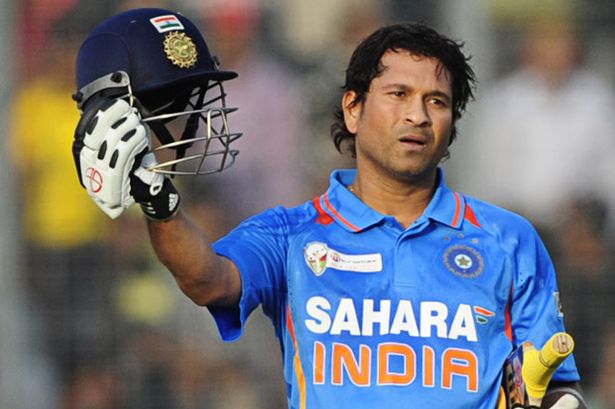 Sachin Ramesh Tendulkar ( born 24 April 1973) is an Indian cricketer widely regarded as one of the greatest batsmen in the history of cricket. He is the leading run-scorer and century maker in Test and one-day international cricket.He is the first male player to score a double century in ODI cricket and the first ever cricketer to score 100 centuries in his career.He made his 100th century in Mirpur against Bangladesh in Asia Cup 2012.In 2002, just 12 years into his career, Wisden ranked him the second greatest Test batsman of all time, behind Donald Bradman, and the second greatest one-day-international (ODI) batsman of all time, behind Viv Richards.Tendulkar was an integral part of the 2011 Cricket World Cup winning Indian team at the later part of his career, his first such win in six World Cup appearances for India.
Tendulkar is the first and the only player in Test Cricket history to score fifty centuries, and the first to score fifty centuries in all international cricket combined; he now has 99 centuries (48 ODI & 51 Test cricket) in international cricket.On 17 October 2008, when he surpassed Brian Lara's record for the most runs scored in Test cricket, he also became the first batsman to score 12,000, 13,000, 14,000 and 15,000 runs in that form of the game, having also been the third batsman and first Indian to pass 11,000 runs in Test cricket.He was also the first player to score 10,000 runs in one-day internationals, and also the first player to cross every subsequent 1000-run mark that has been crossed in ODI cricket history. In the fourth Test of the Border-Gavaskar Trophy against Australia, Tendulkar surpassed Australia's Allan Border to become the player to cross the 50-run mark the most number of times in Test cricket history, and also the second ever player to score 11 Test centuries against Australia, tying with Sir Jack Hobbs of England more than 70 years previously.Tendulkar passed 30,000 runs in international cricket on 20 November 2009. On 24 February 2010, Tendulkar became the first man to score a double century (200*) in an ODI against South Africa. On 8 November 2011, Tendulkar became the first batsman to score 15,000 runs in Test Cricket. He also holds the world record for playing highest number of Test and ODI matches.
Tendulkar has been honoured with the Padma Vibhushan award, India's second highest civilian award, and the Rajiv Gandhi Khel Ratna award, India's highest sporting honour. Tendulkar became the first sportsperson and the first person without an aviation background to be awarded the honorary rank of Group Captain by the Indian Air Force. He has received honorary doctorates from University of Mysore and Rajiv Gandhi University of Health Sciences.He won the 2010 Sir Garfield Sobers Trophy for cricketer of the year at the ICC awards.
Sachin Ramesh Tendulkar ( born 24 April 1973) is an Indian cricketer widely regarded as one of the greatest batsmen in the history of cricket. He is the leading run-scorer and century maker in Test and one-day international cricket.He is the first male player to score a double century in ODI cricket and the first ever cricketer to score 100 centuries in his career.He made his 100th century in Mirpur against Bangladesh in Asia Cup 2012.In 2002, just 12 years into his career, Wisden ranked him the second greatest Test batsman of all time, behind Donald Bradman, and the second greatest one-day-international (ODI) batsman of all time, behind Viv Richards.Tendulkar was an integral part of the 2011 Cricket World Cup winning Indian team at the later part of his career, his first such win in six World Cup appearances for India.
Tendulkar is the first and the only player in Test Cricket history to score fifty centuries, and the first to score fifty centuries in all international cricket combined; he now has 99 centuries (48 ODI & 51 Test cricket) in international cricket.On 17 October 2008, when he surpassed Brian Lara's record for the most runs scored in Test cricket, he also became the first batsman to score 12,000, 13,000, 14,000 and 15,000 runs in that form of the game, having also been the third batsman and first Indian to pass 11,000 runs in Test cricket.He was also the first player to score 10,000 runs in one-day internationals, and also the first player to cross every subsequent 1000-run mark that has been crossed in ODI cricket history. In the fourth Test of the Border-Gavaskar Trophy against Australia, Tendulkar surpassed Australia's Allan Border to become the player to cross the 50-run mark the most number of times in Test cricket history, and also the second ever player to score 11 Test centuries against Australia, tying with Sir Jack Hobbs of England more than 70 years previously.Tendulkar passed 30,000 runs in international cricket on 20 November 2009. On 24 February 2010, Tendulkar became the first man to score a double century (200*) in an ODI against South Africa. On 8 November 2011, Tendulkar became the first batsman to score 15,000 runs in Test Cricket. He also holds the world record for playing highest number of Test and ODI matches.
Tendulkar has been honoured with the Padma Vibhushan award, India's second highest civilian award, and the Rajiv Gandhi Khel Ratna award, India's highest sporting honour. Tendulkar became the first sportsperson and the first person without an aviation background to be awarded the honorary rank of Group Captain by the Indian Air Force. He has received honorary doctorates from University of Mysore and Rajiv Gandhi University of Health Sciences.He won the 2010 Sir Garfield Sobers Trophy for cricketer of the year at the ICC awards.