| Spousal Abuser Prosecution Program |
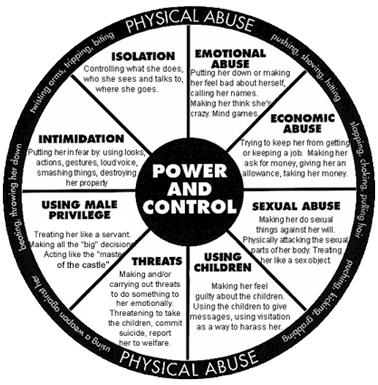
| Domestic Violence Warning Signs Most Obvious: Comes to work repeatedly with injuries Unusual number of calls from home and strong reaction to these calls Comes to work late, needs to leave early Secretive about home life Frequent absenteeism due to medical problems or concern about children Excessive emotionalism, tearful, angry, depressed, nervous, confused Not so obvious: Partner exerts unusual amount of control over her/his life Partner may have demands about her/his work schedule, may have a gripe with her supervisor Partner may attempt to limit her/his work or social contacts, may forbid her/him from attending company functions and/or working overtime Partner may ridicule her/him in public, treat her/him as a child May be changes in her/his behavior that are unexplainable; she/he may be easily upset or distracted She/He may be extremely passive or aggressive She/He may isolate themselves at work She/He may seem chronically depressed or depressed in cycles Remember: Domestic Violence is fundamentally a process of psychological intimidation. The threats and humiliations perpetrated by the batterer are often more significant than the beatings. It is extremely helpful to assist the victim in questioning the messages that isolate her/him. These include: You are exaggerating the abuse. You are not able to care for your children. You won't be able to support your children. You will not get custody. No one will believe you if you tell them. You make me hurt you. You deserve this. No one beside me will ever love you. Offering basic information about services is very helpful whether she/he uses them immediately or not. She/He needs a link to the larger community and she may be unaware that she/he needs/deserves these services because she probably minimizes the abuse. Pressuring her to leave immediately is NOT helpful. Violence usually escalates after a bungled attempt to leave. Leaving the situation is a step that should be carefully planned after support systems are mapped out. |
 |
| Spousal Abuser Prosecution Program No one is immune from domestic violence. It touches every ethnic group, every culture and every strata of society - whether rich, middle class or poor. While focusing on the Attorney General's Spousal Abuser Prosecution Program, this web site also provides facts on domestic violence, information on prevention and useful links to Internet resources. The Spousal Abuser Prosecution Program in the California Department of Justice seeks to help both victims and prosecutors of domestic violence offenses. Through program grants supporting "vertical prosecution," district attorneys and city attorneys are able to develop teams that specialize in the investigation and prosecution of domestic violence offenses. Victims are able to work with the same prosecutor and investigator from the time charges are filed through the sentencing of the offender. Trained counselors/advocates also work with the victim to make the trial process less traumatic and overwhelming. The Spousal Abuser Prosecution Program reflects a strong commitment of Attorney General Bill Lockyer, who states: "We need to stop the tragedy of domestic violence which victimizes women and ripples through so many families and communities. A civilized society should offer no less than a safe home and family environment." In 1999, his first year in office, Attorney General Lockyer secured the support of the California Governor and Legislature to increase program grants for the first time since the Department of Justice began operating the program in 1994. It is important to note that safety for victims of domestic violence is a first priority. There are real options to consider. Help is available. If you are in immediate danger: Call 911 or leave as soon as possible. If you believe you may be battered again: Call 9-1-1. Go to a neighbor's house or other safe place. Call a friend or relative to pick you up. Find a family violence shelter by calling your local police or sheriff's department. Information and assistance is a call away: Call the 24-hour National Domestic Violence Hotline at 1-800-799-SAFE (1-800-799-7233) or the Victims of Crime Resource Center at 1-800-VICTIMS (1-800-842-8467). These centers can help you locate a family shelter in your area or offer you other assistance. |
 |
| Home Page |