Orcs
|
Orcs |
Orogs |
|
Clima/Terreno |
Qualquer terreno |
Qualquer terreno |
|
Frequ�ncia |
Comum |
Incomum |
| Organiza��o |
Tribo |
Tribo |
| Ciclo de atividade |
Noturno |
Noturno |
| Dieta |
Carn�voro |
Carn�voro |
| Intelig�ncia |
Normal 8-9 |
Alta 10-12 |
| Tesouro |
L ( C,O,Qx10,S) |
L ( C,O,Qx10,S) |
| Alinhamento |
Lawful evil |
Lawful evil |
| N�mero encontrado |
30-300 |
20-80 |
| Armor Class |
6 |
4 |
| Movimento |
9 |
6 |
| Dados de vida |
1 |
3 |
| Thaco |
19 |
17 |
| N�m. de ataques |
1 |
1 |
| Dano/ataque |
1-8 arma |
1-10 arma |
| Ataque especial |
n�o |
+1 no dano |
| Defesa Especial |
n�o |
n�o |
| Resist�ncia a magia |
n�o |
n�o |
| Tamanho |
1,50 m |
1,80 m |
| Moral |
11-12 |
13-14 |
| Valor de XP |
15 |
65 |
|
Sub-L�der |
35 |
120 |
| Guardas |
35 |
|
| Chefe |
65 |
175 |
| Guarda Costas |
65 |
|
| Shaman 1 |
35 |
|
| Shaman 3 |
175 |
|
| Shaman 5 |
650 |
|
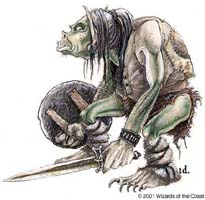
Orcs s�o uma esp�cie de mam�feros agressivos carn�voros que andam juntos em
tribos e sobrevivem de ca�a.Orcs acreditam que para sobreviver � preciso
constantemente expandir seus territ�rios, e constantemente est�o em guerra com
muitos inimigos: humanos, elfos, an�es, goblins, e outras tribos Orcs.
Orcs variam muito de apar�ncia, pelo fato de frequentemente cruzarem com outras
esp�cies.Em geral,eles se assemelham com humanos primitivos de pele cinza e
esverdeada com pouco cabelo. Orcs possuem uma postura muito corcunda e suas
fei��es as vezes se assemelham a porcos. Orcs possuem dentes caninos muito bem
desenvolvidos para comer carne e orelhas pontudas que lembram as orelhas de
lobos.Focinhos e orelhas de orcs possuem pigmenta��o cor de rosa. Seus olhos
s�o humanos mas refletem na escurid�o um vermelho brilhante.Esta colora��o
lhes permite enxergar no escuro com uma infravis�o.Orcs machos variam de 1,50 m
de altura a 1,70, j� as f�meas s�o menores que os machos.Orcs gostam de
vestir roupas com cores que os humanos jamais usariam : vermelho sangue,
vermelho r�stico, amarelo mostarda, marrom enegrecido e roxo..Suas armaduras
s�o totalmente r�sticas e sujas. Orcs falam Orcish, uma linguagem do dialeto
antigo dos humanos e elfos, mas os dialetos variam de tribo para tribo. Orcs
aprendem l�nguas comuns mas n�o se sentem bem com elas. Eles possuem dialetos
limitados tais qual: goblin, hobgoblin, e dialeto ogre.
Combate:
Orcs est�o constantemente em combate. Eles usam as seguintes armas.
| espada e mangual |
5% |
| espada e lan�a |
10% |
| machado e lan�a |
10% |
| machado e armas de haste |
10% |
| machado e besta |
10% |
| machado e arco |
10% |
| espada e machado |
5% |
| lan�a |
10% |
| machado |
10% |
| armas de haste |
20% |
Polearms are typically either halberds, pikes (set to receive charge), or
glaives. Leaders typically possess two weapons. If a subchief is present, there
is a 40% chance the orcs will be fighting around a standard. The presence of
this standard increases attack rolls and morale by +1 for all orcs within 60
yards. Orcs typically wear studded leather armor and a shield (AC 6).
Orcs hate direct sunlight and fight at -1 penalty to their attack rolls in
sunlight. Their morale decreases by 1 under these circumstances as well. Orcs
employ sniping and ambush tactics in the wild. They do not obey the "rules
of war" unless such is in their best interests; for example, they will
shoot at those who attempt to parlay with them under a white flag unless the orc
leader feels it is advantageous to hear what the enemy has to say. They abuse
human rules of engagement and chivalry to their best advantage. They have a
historic enmity against elves and dwarves; many tribes will kill these
demihumans on sight.
It is often believed that orcs are so bloodthirsty and cruel that they are
ineffective tacticians and that they would rather be vicious than victorious.
Like most stereotypes, this is highly misleading; it is true for some orc tribes
but not for all. Many orc tribes have waged wars for decades and have developed
a frightening efficiency with battle tactics.
Habitat/Society:
For every three orcs encountered, there will be a leader and three
assistants. These orcs will have 8 hit points each, being the meanest and
strongest in the group. If 150 orcs or more are encountered there will be the
following additional figures with the band: a subchief and 3-18 guards, each
with Armor Class 4, 11 hit points, and +1 damage due to Strength on all attacks.
They fight as monsters of 2 Hit Dice (THAC0 19). For every 100 orcs encountered,
there will be either a shaman (maximum 5th level priest) or a witch doctor (maximum
4th-level mage). Shamans and witch doctors gain an extra 1d4 hit points for each
level above 1st and fight as a monster of 1 Hit Die for every two levels (round
fractions up) of spell-casting ability (e.g., a 5th-level shaman has d8+4d4 hit
points and fights as a 3 Hit Dice monster.)
If the orcs are not in their lair, there is a 20% chance they will be escorting
a train of 1-6 carts and 10-60 slave bearers bringing supplies, loot, or ransom
and tribute to their orc chief or a stronger orc tribe. The total value of the
goods carried by all of the carts will vary between 10 and 1,000 silver pieces,
and each slave bearer will bear goods valued between 5 and 30 silver pieces. If
the orcs are escorting a treasure train, double the number of leaders and
assistants and add 10 orcs for each cart in the train; one subchief with 5-30
guards will always be in charge.
Orc lairs are underground 75% of the time, in a wilderness village 25% of the
time. Orc communities range from small forts with 100-400 orcs to mining
communities with 500-2,000 orcs to huge cities (partially underground and
partially above ground) with 2,000 to 20,000 orcs. There will always be
additional orcs when the encounter is in a creature's lair: a chief and 5-30
bodyguards (AC 4, 13-16 hit points, attack as monsters with 3 Hit Dice (THAC0
17) and inflict an extra +2 damage on all attacks due to Strength). If the lair
is underground, there is a 50% chance that 2-5 ogres
per 200 orcs will be living with them. Most lairs above ground are rude villages
of wooden huts protected by a ditch, log rampart and log palisade, or more
advanced constructions built by other races. The village will have 1-4 watch
towers and a single gate. There will be one ballista and one catapult for every
100 adult male orcs.
Orcs are aggressive. They believe other species are inferior to them and that
bullying and slavery is part of the natural order. They will cooperate with
other species but are not dependable: as slaves, they will rebel against all but
the most powerful masters; as allies they are quick to take offense and break
agreements. Orcs believe that battle is the ideal challenge, but some leaders
are pragmatic enough to recognize the value of peace, which they exact at a high
price. If great patience and care are used, orc tribes can be effective trading
partners and military allies.
Orcs value territory above all else; battle experience, wealth, and number of
offspring are other major sources of pride. Orcs are patriarchal; women are fit
only to bear children and nurse them. Orcs have a reputation for cruelty that is
deserved, but humans are just as capable of evil as orcs. Orcs have marriage
customs, but orc males are not noted for their faithfulness.
Orcs worship many deities (some who have different names among different tribes);
the chief deity is usually a giant, one-eyed orc. Orcish religion is extremely
hateful toward other species and urges violence and warfare. Orc shamans have
been noted for their ambition, and many tribes have suffered because of
political infighting between warriors and priests.
Ecology:
Orcs have an average lifespan of 40 years. They have a gestation period
of 10 months and produce two to three offspring per birth. Infant mortality is
high. Orcs are carnivores, but prefer game meats or livestock to demihumans and
humanoids.
It is said that orcs have no natural enemies, but they work hard to make up for
this lack. Orc tribes have fearsome names such as Vile Rune, Bloody Head, Broken
Bone, Evil Eye, and Dripping Blade.
Orcs are skilled miners who can spot new and unusual constructions 35% of the
time and sloping passages 25% of the time. They are also excellent weaponsmiths.
Orogs
Elite orcs, or orogs, are a race of great orcs, possibly mixed with
ogre blood. Orogs range between 6 and 6Ѕ feet tall. They are highly
disciplined warriors and have their own standards and banners which they display
prominently -- it is usually easy to tell when orogs are present among common
orcs. Orogs can be found at the vanguard of large orc armies, but rarely on
patrol. There is a 10% chance that an orc tribe will have orogs, whose number
equals 10% of the male population. (Thus a community of 3,000 male orcs has a
10% chance of having 300 additional orogs.) Small bands of elites (20-80 orogs)
will hire themselves out as mercenaries. Orogs have 3 Hit Dice, plate mail (AC
3), and have a +3 Strength bonus on damage dice. For every 20 orogs, there will
also be one leader with 4 Hit Dice (THAC0 17). There is but one orog chief, who
has 5 Hit Dice (THAC0 15). Orogs use weaponry common to orcs, but will typically
possess two weapons apiece.
Meio-Orcs
Orcs will crossbreed with virtually every humanoid and demihuman
species except elves, with whom they cannot. The mongrel offspring of orcs and
these other species are known as half-orcs. Orc-goblins, orc-hobgoblins, and
orc-humans are the most common. Half-orcs tend to favor the orcish strain
heavily, and as such are basically orcs, although 10% of these offspring can
pass as ugly humans. They are treated as humans with levels instead of Hit Dice.
If multi-classed, they have these maximums: priest, 4th level; fighter, 10th
level; thief, 8th level.
If half-orcs remain single-classed, these maximums increase to: priest, 7th
level (Wisdom 15 required for 5th, Wisdom 16 for 6th, Wisdom 17 for 7th);
fighter, 17th level (Strength 18/00 required for 11th, Strength 19 for 12th,
Strength 20 for 14th, and Strength 21 for 17th); thief, 11th level (Dexterity 15
required for 9th, Dexterity 16 for 10th, and Dexterity 17 for 11th).
Half-orcs are distrusted by both human and orc cultures because they remind each
of the other's racial stock. Half-orcs advance in orc culture by flaunting their
superior ability and in human culture by associating with people who don't care
about appearance. Most tend toward neutrality with slight lawful and evil
tendencies, but lawful good half-orcs are not unknown. Some half-orcs have split
from both cultures to form their own societies in remote areas. These half-orcs
worship their own gods and (like most hermits) are extremely suspicious of
strangers.
| Galeria
de fotos |
|
|
|
|