Ankheg
|
Clima/Terreno |
|
|
Frequ�ncia |
|
| Organiza��o | |
| Ciclo de atividade | |
| Dieta | |
| Intelig�ncia | |
| Tesouro | |
| Alinhamento | |
| N�mero encontrado | |
| Armor Class | |
| Movimento | |
| Dados de vida | |
| Thaco | |
| N�m. de ataques | |
| Dano/ataque | |
| Ataque especial | |
| Defesa Especial | |
| Resist�ncia a magia | |
| Tamanho | |
| Moral | |
| Valor de XP |
The ankheg is a burrowing monster usually found in forests or
choice agricultural land. Because of its fondness for fresh meat, the ankheg is
a threat to any creature unfortunate enough to encounter it.
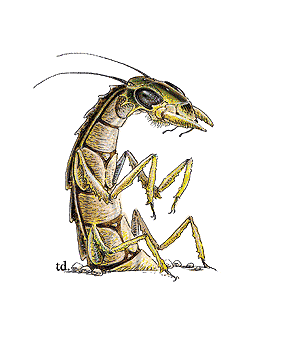
The ankheg resembles an enormous many-legged worm. Its six legs end in sharp
hooks suitable for burrowing and grasping, and its powerful mandibles are
capable of snapping a small tree in half with a single bite. A tough chitinous
shell, usually brown or yellow, covers its entire body except for its soft pink
belly. The ankheg has glistening black eyes, a small mouth lined with tiny rows
of chitinous teeth, and two sensitive antennae that can detect movement of
man-sized creatures up to 300 feet away.
Combat: The ankheg's
preferred attack method is to lie 5 to 10 feet below the surface of the ground
until its antennae detect the approach of a victim. It then burrows up beneath
the victim and attempts to grab him in its mandibles, crushing and grinding for
3d6 points of damage per round while secreting acidic digestive enzymes to cause
an additional 1d4 points of damage per round until the victim is dissolved. The
ankheg can squirt a stream of acidic enzymes once every six hours to a distance
of 30 feet. However, since it is unable to digest food for six hours after it
squirts enzymes, it uses this attack technique only when desperate. A victim
struck by the stream of acidic enzymes suffers 8d4 points of damage (half damage
if the victim rolls a successful saving throw vs. poison).
Habitat/Society: The
ankheg uses its mandibles to continuously dig winding tunnels 30-40 feet deep in
the rich soil of forests or farmlands. The hollowed end of a tunnel serves as a
temporary lair for sleeping, eating, or hibernating. When an ankheg exhausts the
food supply in a particular forest or field, it moves on to another.
Autumn is mating season for ankhegs. After the male fertilizes the female, the
female kills him and deposits 2d6 fertilized eggs in his body. Within a few
weeks, about 75% of the eggs hatch and begin feeding. In a year, the young
ankhegs resemble adults and can function independently. Young ankhegs have 2 Hit
Dice and an AC 2 overall and an AC 4 for their undersides; they bite for 1d4
points of damage (with an additional 1d4 points of damage from enzyme secretions),
and spit for 4d4 points of damage to a distance of 30 feet. In every year
thereafter, the ankheg functions with full adult capabilities and gains an
additional Hit Die until it reaches 8 Hit Dice.
Beginning in its second year of life, the ankheg sheds its chitinous shell just
before the onset of winter. It takes the ankheg two days to shed its old shell
and two weeks to grow a new one. During this time, the sluggish ankheg is
exceptionally vulnerable. Its overall AC is reduced to 5 and its underside AC is
reduced to 7. Additionally, it moves at only half its normal speed, its mandible
attack inflicts only 1d10 points of damage, and it is unable to squirt acidic
enzymes. While growing a new shell, it protects itself by hiding in a deep
tunnel and secreting a repulsive fluid that smells like rotten fruit. Though the
aroma discourages most creatures, it can also pinpoint the ankheg's location for
human hunters and desperately hungry predators.
Ankhegs living in cold climates hibernate during the winter. Within a month
after the first snowfall, the ankheg fashions a lair deep within the warm earth
where it remains dormant until spring. The hibernating ankheg requires no food,
subsisting instead on nutrients stored in its shell. The ankheg does not secrete
aromatic fluid during this time and is thus relatively safe from detection.
Though the ankheg's metabolism is reduced, its antennae remain functional, able
to alert it to the approach of an intruder. A disturbed ankheg fully awakens in
1d4 rounds, after which time it can attack and move normally.
The ankheg does not hoard treasure. Items that were not dissolved by the acidic
enzymes fall where they drop from the ankheg's mandibles and can be found
scattered throughout its tunnel system.
Ecology: Though a hungry ankheg can
be fatal to a farmer, it can be quite beneficial to the farmland. Its tunnel
system laces the soil with passages for air and water, while the ankheg's waste
products add rich nutrients. The ankheg will eat decayed organic matter in the
earth, but it prefers fresh meat. All but the fiercest predators avoid ankhegs.
Dried and cured ankheg shells can be made into armor with an AC of 2, and its
digestive enzymes can be used as regular acid.