|
|  |
REVIEWS |
|
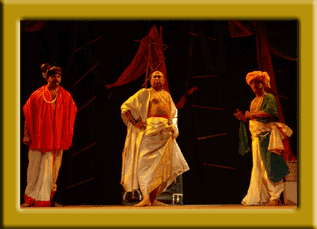
SANSAPTAK'S DEVANAMPIYA
(Originally written in Bengali by Sh. Bhismadev (pen-name of Debabrata Sarkar), in the June-July 2006 issue of Unmokta Uchchhash)
Dhammashoka was first and foremost an Emperor and then a Buddhist...Torit Mitra's play, Devanampiya, is the rendering of this unbridled aggressive trait of the Buddhist Asoka and his journey through life.
|
|
|
|
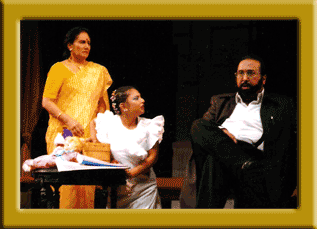
IBSEN IN INDIAN PSYCHE
The Pioneer, 21st November 2006, by Dr. Utpal Bannerjee
The Norwegian playwright might have become outdated in his country but his realistic plays are still relevant for other nations,...It is, therefore, like a whiff of fresh air that two of Ibsen's seminal plays are staged in Bengali in the Capital, produced by Sansaptak under Torit Mitra, Anik is the first play, based on Little Eyolf...The second play Bohubrihee is transcreation of The Master Builder.
|
 |
|
|
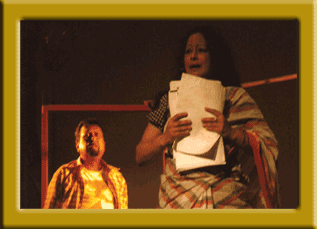
A STREETCAR NAME GOVINDPURI
The Pioneer, 21st August 2007, by Dr. Utpal Bannerjee
an adaptation of a famous English play written in 1947, Torit Mitra's "Hari Bhari Khwaish" has strains from the original , showing how the older generation reconciles with the new.
|
 |
|
|
SPOT LIGHT ON DESIRE OF THE DEPRIVED
Statesman, 24th August 2007, by Prithviraj Roy
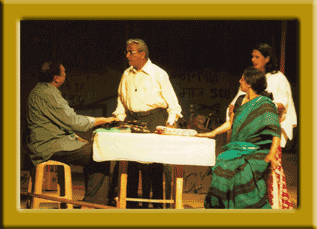
Based on "A streetcar named desire", Sansaptak's "Hari Bhari Khwaish" is a telling tale about the socially marginalized...The contemporaneity of the subject cannot be denied in as much as it gives a rugged exposure of the political venality and social inequities of our time
|
|
|
|
THINGS TO COME
The Hindu, 7th September 2007, by Romesh Chander
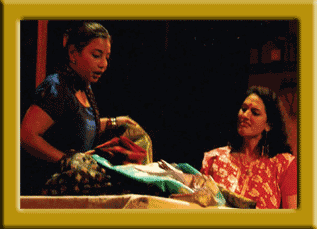
Keeping in line with Sansaptak's creed, "Hari Bhari Khwaish" is a strong comment on the socio-economic life around us... "Hari Bhari Khwaish" must be kept alive for it not only projects the present but also warns us of the future...
|
|
|
|
FOCUS ON...TORIT MITRA
Time Out Magazine, 10th August 2007
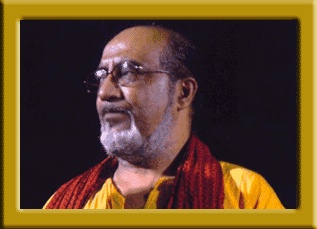
...Since 1992, Mitra and his group, Sansaptak has staged plays in Bengali. He spoke to Time Out about his first foray into Hindi theatre.
What is the play about?
It deals with migration- people who come to the city with great hopes, but often end up as criminals or beggars...
Did writing the play require a lot of research?
In some ways, no- it comes out of living in Delhi; it is document of modern urban problems...
You wrote the play in Bengali. What made you decide to stage it Hindi?
In Delhi there is a very limited audience for Bengali theatre...more over the play rings true in Hindi...
Why is the Hindi version named Hari Bhari Khwaish?
...In my play there are two buses- the one going to the city is called Hari Bhari Khwaish and the one which appears in the end is called Qayamat Se Qayamat Tak.
|
|
|
|
LIVING THE REVOLUTION
The Hindu, 18th April 2008, by Diwan Singh Bajeli
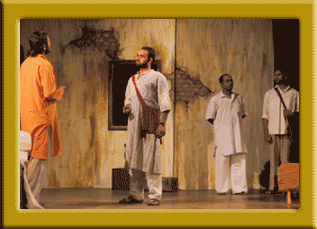
"Na Hanyate" presented by Sansaptak this past week at LTG auditorium probes the role of violence in a revolutionary movement that seeks to replace an oppressive socio-economic and political order with a free and just system...
|
|
|
|
FOCUS ON...TORIT MITRA
Time Out Magazine, 28th November 2008, Ishanee Sarkar
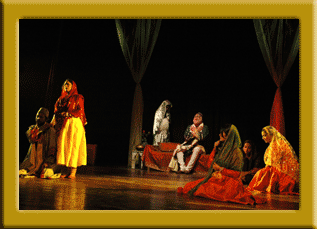
... Less than a month after M.S.Sathyu�s �Dara Shikoh� was staged in Delhi, Torit Mitra presents �Zawal-e-Azim�, a Bengali language play that also deals with the Mughal Empire and the factors that led to its downfall...
What is Zawal-e-Azim about?
My play is about the downfall of the colossal Mughal Empire...focussing on the people, emotions and relationships rather than the socio-political aspects...
Such as?
I have largely contrasted Aurangzeb�s politics against his brother Dara Shikoh...
What kind of research went into writing the play?
I studied books written by historians, especially, B.C.Lal and Sir Jadunath Sarkar...
Why choose a historical play though?
I wrote Zawal-e-Azim as a tribute to well-known Bengali playwright Dwijendranath Roy...
Are the sets designed to reflect the grandeur of that period?
I purposefully kept it simple since I did not want the sets to dominate the story...
Why did you choose to stage this play in Bengali?
Bengali theatre is highly marginalized in Delhi. I want more people to come and watch Bengali drama and appreciate it...
|
|
|
|
A FALLEN LEAF OF AUGUST HISTORY
The Hindu, 12th December 2008, by Romesh Chander
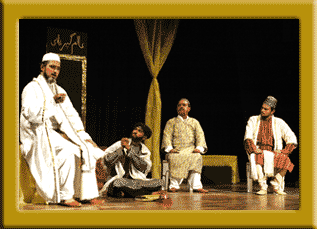
..Sansaptak�s �Zawal-e-Azim� made the Moghul Empire�s decline come alive with a rare ferocity...None of us knew Bengali and had doubts if we would sit through it. We not only sat through it but enjoyed every minute...
|
|
|
|
|
|
|
|