Since the last update quite some time passed. We were rather busy with work, holiday and relatives. In the meantime also quite some events have happened in Indonesia, among earthquakes and bus crashes in other places in the world.
The major item of course was the ballot on autonomy or independence for East Timor. However, a new security bill and the election of Indonesia's fourth president also needs attention.
In addition Aceh, Moluku (especially Ambon) and Irian Jaya remain important issues of course. Next time I will highlight these issues again. In Jakarta I only like to mention a group of activist occupied the front gate of the Dutch embassy for two days, on 4 August. They demanded independence from Indonesia for Aceh and urged the Dutch to lobby for them. This lead to some attention in the press and increased security measures in a lot of embassies.
East Timor
Finally the planned ballot for East Timor took place on 30 August. The East Timorese registered, faced two options: pro-autonomy or pro-independence.
Quite some people in Jakarta thought that the East Timorese would choose for pro-autonomy within the Republic Indonesia, since it would be difficult for such a small country to survive. And Indonesia provided quite some funds to develop the 27th 'province'.
Plenty of others though, were sure East Timor was 'fed up' with military repression for more than two decennia (like Aceh, Moluku and Irian Jaya). Or they feel is not worthwhile for Indonesia to put more money in East Timor, if they don't like to cooperate.
Unless the bloodshed before the ballot, probably by supporters from both sides and certainly the pro-autonomy 'militia' side, 95% of the eligible voters turned up.
And the answer was clear: 78,5% voted pro-independence and 21,5% voted pro-autonomy.
And what already was feared by many, after the first optimism about sporadic security disturbances during the ballot, bloodshed continued. Reason: the absence of strong commitment among the warring parties to reconciliation.
An important step however was Alexander 'Xanana' Gusmao was freed on 7 September. Xanana was captured by the military in 1992 for leading an armed rebellion on independence.
But still a lot of people were fleeing the territory and a lot of refugees suddenly had to be fed.
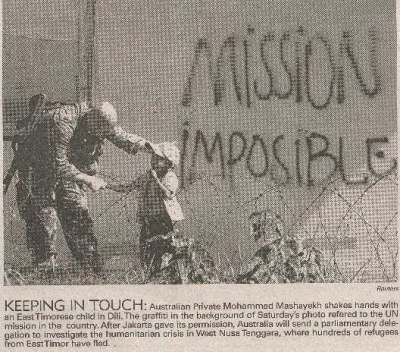
Under pressure of the international community an Australian lead UN force 'invaded' East Timor on 28 September, unless Indonesia's request to give them time to prove they were capable of restoring law and order themselves.
We know unacceptable things have happened in East Timor, (although some people deny it): suspected independence voters were tortured, journalists were killed (like Sander Thoenes, a friend of us), people with Portuguese sounding names were forbidden to travel out of the territory, etc.. Even Nobel price winner Bishop Carlos Filipe Ximenes Belo had to fly under a false name by helicopter.
But have 'mass killings' really taken place ? Was Australia not maybe a little bit too greedy to send its army people to East Timor, and even prepared to go there without Indonesia's approval ? This last is actually weird, because Australia is the only country who has a security pact with Indonesia. They could have offered Indonesia help with restoring order in co-operation.
UNAMET (United Nations Mission in East Timor), Australia and president Habibie came under fire as an answer to the questions stated above. The UN is accused of a non-neutral position; Australia is accused of causing embarrassment by the Indonesian army and the Indonesian people; and president Habibie is accused of causing the country to fall apart, by his impulsive decision to hold a ballot in East Timor.
Since the ballot almost every day demonstrations take place in front of the Australian embassy and the UN building. Flags are burned and luckily no violent actions took place. But…we can also look to it from a positive side: its now even allowed for Indonesians to express their non-agreement via the tool of demonstration. Before May 1998, when ex-president Soeharto was forced to step down, demonstrations would be impossible.
In East Timor, after the first food drops, step by step order is trying to be restored. After clashes at the border between Indonesian military and Interfet (International Force for East Timor) on 10 October, Indonesia invited Interfet to conduct joint patrols with Indonesian troops. And both the international and the national Human rights commission are investigating what precisely happened in East Timor.
Let's see what the future will bring for our new country.
Security bill
What we didn't realise in all commotion about East Timor, was the importance of the prepared security bill. This bill is handling the rules needed to guide the authorities in overcoming social disturbances. The current bill dates from 1959, and seems to be outdated. What however was a little suspicious, the 'old' MPR (House of Representatives) who are not democratically chosen, wanted to pass this bill on the last day of their term, 24 September. The newly chosen parliament members, based on the elections of 7 June (see also last update) were up to start on 1 October.
Students, but also other groups in society, started to protest heavily on 20 September. They state the new security bill is worse than the old one; and provides the military even more power after a 'state of emergency' is being announced.
The House members however state this new bill is better and a lot more democratic than the former one (since the 'state of emergency' is no longer only to be determined by the president, but also by other institutions like the House itself).
This communication gap caused fights, looting and a huge traffic jam.
The military decided on 24 September –on behalf of the government- to postpone the bill, due to the pressure. The protesters wanted to have the bill dropped, though the rest turned back into the streets.
Presidential election
The people of the MPR (=the People's Consultative Assembly), who are going to elect the new president, swore their oath on Friday 2 October. The first days were taken by arranging organisational matters. Amien Rais for example (PAN), was elected as MPR's chairman on 3 October. For the DPR (=the House of Representatives) Akbar Tandjung was elected as chairman (from the government's party Golkar) on 6 October.
The presidential elections are now scheduled on 20 October; and it is still very uncertain what is going to happen.(Is that democracy ?) Megawati's party PDI Perjanguan, who won the election with a majority, has no representation yet trough these important functions which are just mentioned. PDI-P admitted they had bargained to vote for Golkar's candidate to chair DPR in return of Golkar's support for PDI-P with the presidential election. But Golkar denies everything in that direction.
We have basically three candidates: Megawati Soekarnoputri (PDI-P), B.J. Habibie (Golkar) and Abdurrahman Wahid (alias 'Gus Dur' from PKB), with all of them reasonable chances. We are only wondering what will happen if for example Habibie wins. Megawati's supporters already announced they won't accept it; and more people can question themselves what the result is of the 'reformasi'. Habibie's candidature actually also still depends on the acceptance or rejection of his accountability speech, in which he has to explain to MPR what he did and why during this term of his presidency, on 15 October. Already 4 of the 11 fractions rejected the speech. The final decision is not made yet during the time of writing.
In addition to this it also not known yet what the rules of election of the president are going to be and how to re-distribute the power among president, vice-president, DPR, Supreme Court and the law, as an amendments on the 1945 Constitution.
Following 'good traditions' a street battle took place in Jakarta on 15 October, between police/military and demonstrators who want to force Habibie to turn down his candidature. On the same day around 8 demonstrations were organised in Jakarta, varying from Megawati supporters to anti-UN demonstrators.
So we keep it exiting in the city. Both in the sense what is going to happen security wise as politically, as an outcome of the newly started democracy in Republic Indonesia.
Until so far. Sandra C. van Hulsen, 17 October 1999