| Why
preserving this area is important
At its headwaters in northern San Marcos, Hedionda Creek runs through
a valley of undisturbed habitat, mostly coastal sage scrub and riparian
vegetation. The valley is surrounded by the San Marcos Mountains
and Owens Peak to the east and south, and unnamed hills and peaks
to the west and north. This complex of mountains and creek valley
is one of the few relatively large blocks of natural vegetation
remaining in the Multiple Habitat Conservation Plan (MHCP) study
area (Federal Register, 4/15/99, p. 18628) within the San Marcos
area. As such, it is a valuable area to conserve. It supports many
sensitive species of flora and fauna.
For almost ten years, the Friends of Hedionda Creek, a group
of concerned residents and environmentalists, has been fighting
to preserve the Hedionda Creek Valley in northern San Marcos. The
area is threatened by development
project is d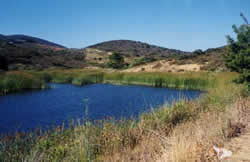 ue ue
Detail
background information on the environmental issues:
- The Hedionda Creek Valley has high biological value because
of its undisturbed coastal sage scrub (CSS) and riparian habitat.
The threatened coastal California gnatcatcher has been sighted
on and adjacent to the property to be developed. Also, the endangered
least Bell’s vireo has been observed adjacent to the property.
The valley teems with wildlife, including mule deer, bobcats,
coyotes, and a variety of amphibians, butterflies and birds, including
the Cooper’s hawk, a Species of Special Concern. Although
the Highlands developer is proposing mitigation measures for the
removal of over 40% of the CSS on the site, the fact remains that
the wildlife in this valley will be devastated if this project
goes through. (The mitigation will be offsite.)
- The Hedionda Creek Valley is the headwaters of Agua Hedionda
Creek, which flows westerly, until it discharges into Agua Hedionda
Lagoon. Agua Hedionda Creek is part of the Carlsbad Watershed,
which has recently been extensively studied, and a management
plan for the watershed has been developed. (Carlsbad Watershed
Management Plan, prepared by KTU & Associates) The management
plan calls for protection, restoration and enhancement of undeveloped
open space in the headwaters of the watershed that will provide
natural filtering capabilities for water runoff control and water
quality improvements. Also, it calls for the purchase or transfer
into public ownership or control of as many of these wetland resources
as possible. This includes the Hedionda Creek Valley.
The Highlands project will fill in over 5,000 liner feet of streambed. Although the developer
has proposed mitigation for the impacts, the mitigation measures
are vague. Therefore,
FHC calls for the acquisition of the wetlands and their watersheds.
- A an issue related to the wetlands impacts is the potential
for increased pollution of the Creek. Substituting impervious
surfaces such as streets, parking lots, driveways, etc. , for
native vegetation and its buffering and filtering capacities will
lead to increased pollution. Also, the introduction of non-native
vegetation in landscaping in the development will lead to increased
pollution because of the use of herbicides, insecticides, fertilizers,
etc. Agua Hedionda Creek is already highly polluted and is being
recommended for listing on the List of Impaired Waters for the
Region due to Diazinon and other pollutants. Agua Hedionda Lagoon
is already on the List of Impaired Waters. The Carlsbad Watershed
Management Plan states, “Waterbodies within the San Diego
region continue to be degraded and impaired at an alarming rate.”
- The Highlands development requires the extension of a major
road, Las Posas Road, along the wetlands. Roads and traffic are
devastating to wildlife. The mitigation proposed by the developer
in the draft EIR for the damage that this road will do to the
wildlife is one 48” culvert under Las Posas Road. A 48”
culvert would be totally inadequate for the wildlife in the area,
which includes mule deer. The guidelines for the North County
Multiple Habitat Conservation Program call for avoidance of roads
through wildlife corridors, and where roads must cross wildlife
corridors, they should have bridges of at least 20 feet in height
to allow deer to cross.
- Finally, and very importantly, the Hedionda Creek Valley is
a recognized wildlife corridor, connecting two of the important
remaining large blocks of habitat in the northern San Marcos/San
Diego County area. To the south and east of the Valley lie the
San Marcos Mountains, and to the north and west, an unnamed mountain
range. The Wildlife Agencies have pointed out that the Highlands
project is located at a “pinch point” of remaining natural
lands between the two mountain ranges. They have stated, “It
appears that the proposed development would completely block this
connection ...”
We know that fragmentation of habitat is one of the major environmental
concerns in North San Diego County. This proposed development will
cut a major open space area in two and prevent wildlife from accessing
the creek from the west. The impact on the wildlife will be devastating.
The Friends of Hedionda Creek is calling for a 1,000-foot wildlife
corridor along the north side of the Highlands property, from east
to west. This will allow the wildlife to continue to cross the Valley
to the mountains and will permit wildlife access to the creek. FHC
also calls for the elimination of roads through wildlife corridors.
These are the major environmental issues involving the Highlands
development. There are many other major issues, such as incompatible
land uses.
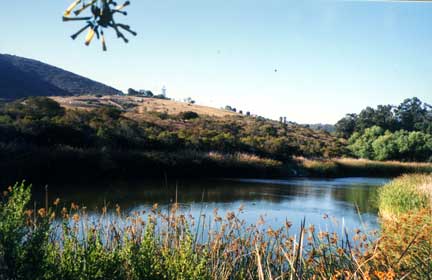
Map and Photos
|