David Beckham - My favourite footballer
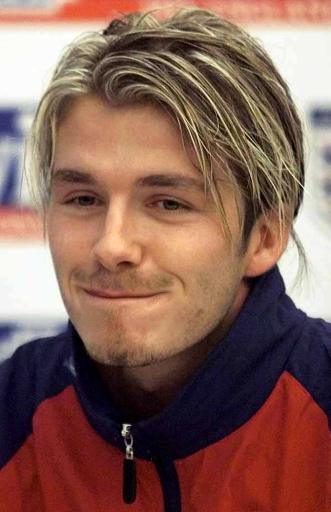
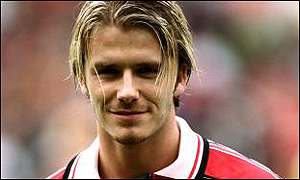
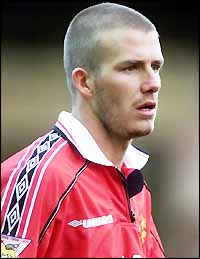
What do you think about every one of his hair-style? Which one do you like? Or none?
What does David Beckham look like?
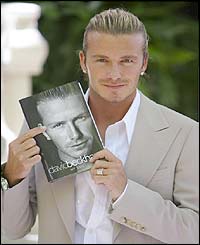
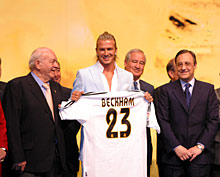
(from the official site of Real Madrid http://www.realmadrid.com )
Who's David Beckham?
(extracted from the official website of Manchester United Football Club - http://www.manutd.com)
Birthplace: |
Leytonstone, UK, 2 May 1975 |
Height: |
180cm - 5ft 11in |
Weight: |
67kg - 10st 8lb |
Full International: |
England (47 caps, 6 goals) |
Position: |
Midfield |
Club: |
Read Madrid (from July, 2003) |
Previous club: |
Manchester United (squad number: 7) |
Squad Number: |
23 |
Debut: |
23.09.1992 (for Manchester United) |
Appearances (1992-2001): |
314 |
Goals: |
66 |
As a schoolboy, David Beckham represented the county of Essex, had trials with Leyton Orient and attended Tottenham Hotspur's school of excellence.
After signing for Manchester United as a trainee on 8 July 1991, he helped the club to win the FA Youth Cup in May 1992, scoring in the second leg of the final against Crystal Palace.
Several months later, on 23 September 1992, David made his first team debut as a substitute in the Rumbelows Cup tie at Brighton and Hove Albion. However, he then had to wait a further two-and-a-half years to make his League debut.
During this time, he collected a runners-up medal in the 1993 FA Youth Cup (United lost to Leeds in the final) and a reserve team championship medal in 1994. He also played five matches on loan for Preston North End, scoring two goals for the Lancashire club.
David eventually made his Premier League debut at home to Leeds United on 2 April 1995, but it was in the following season, 1995/96, that he really established himself in the first team.
David played predominantly in the right midfield position that had been vacated by Andrei Kanchelskis, and started to show the knack for scoring great goals, including the winner in the FA Cup semi-final against Chelsea. The season ended with United winning their second Double.
David started the next campaign, 1996/97, by scoring his most famous goal - from the halfway line against Wimbledon at Selhurst Park. He went on to earn his first senior cap for England, on 1 September 1996 against Moldova in Kishinev. He had previously been capped at youth and Under-21 level.
David's match-winning performances during 1996/97 helped United to win another Premiership title and reach the semi-final of the UEFA Champions League. On a personal level, he was voted Young Player of the Year and second in the overall Player of the Year poll.
The 1997/98 season was a disappointing one for United as they finished second to Arsenal in the League, lost to Barnsley in the FA Cup and were knocked out of the Champions League quarter-finals by Monaco. There was some consolation for David, though, when he was selected for England's World Cup Finals squad.
The 1998 World Cup Finals provided mixed feelings for David, and were later seen as something of a turning point in his career. After being left out of the starting line-up for the first two matches, he then scored a stunning free-kick for England against Colombia and was hailed a national hero. He was later branded a villain, however, when he was sent off for a foul on Diego Simeone as England were knocked out in the second round by Argentina. It was the first red card of David's career.
Some experts predicted that his World Cup problems could lead to David's exit from English football, but he knuckled down to prove them all wrong. In the first League game of the 1998/99 season against Leicester City, he curled in one of his trademark free-kicks to prevent defeat.
In March 1999 he became a father to Brooklyn, whose name appeared on his boots when United completed the unprecedented Treble of Premiership, FA Cup and European Cup. In July 1999, David married Victoria Adams, better known as 'Posh', a member of the Spice Girls pop group.
The 1999/2000 season was another successful one for David, despite all the press hype caused by a new haircut and a high-profile argument with Sir Alex Ferguson.
The midfielder picked up his fourth Premiership winner's medal, and was voted second best player in Europe and the World. Rivaldo of Barcelona and Brazil pipped him to both awards. David also finished runner-up in the BBC Sports Personality of the Year, losing out to boxing champion Lennox Lewis.
The major highlights of David's 2000/01 season were on the international stage, although he again won the Premiership title with United, having scored in three matches in a row early in the campaign.
David proudly captained England for the first time in a friendly in Italy and then kept the armband for the friendly with Spain and the World Cup qualifiers against Albania and Finland, against whom he scored an important goal at Anfield, home of Liverpool FC.
David's next challenge will be to lead England in the 2002 World Cup Finals after his goal against Greece in the last minute of the Old Trafford match earned qualification, and help United reclaim their status as Europe's best club.
International stats correct at 11.11.01.
Did You Know?
When David Beckham was twelve years old, he won a Bobby Charlton Soccer Skills
award, which was presented to him at Old Trafford on a match day. The prize
included a trip to the Nou Camp stadium, Barcelona.
The speed of David Beckham's shot, which equalised for United against Chelsea on 22 February 1997, was measured at 97.9 mph.
One of David's idols as a boy was Glenn Hoddle, whom he later played for in the England team.
In the 1994/95 season, David scored in the UEFA Champions League (for United) and the Third Division (for Preston North End).
David has the name of his son, Brooklyn, tattooed on his back.
David is the subject of a University course which was started in 1999.
Interesting facts:
Do you know the tips of how to make another David Beckham? Here's what I found from a newspaper article (Manchester Metro of 16th Nov, 01):
'It's what every football mad dad needs to know - the six steps to turn your boy into a budding David Beckham. The first, though, takes careful planning - the boy has to be born in the autumn, preferably October, said Professor Michael Howe who studied 543 Premiership players. The psychologist said these children were the oldest in their years which put them ahead in physical development, giving them a better chance of being picked for school teams. The remaining steps are: encourage the child to kick a ball before they are five; make sure they play in a match before they are seven; urge them to play with their friends in a team; ensure ten years of practice; make sure of parental support. Prof. Howe, of Exeter University, said: 'Nobody is simply born to be an exceptional footballer. I've found successful players are bred rather than born, so there could be a top footballer on every street corner.'
Please also read http://www.bbc.co.uk/teens/lads/life/howtobe/becks.shtml for how to be David beckham.
Books about Beckham:
David Beckham My World (hardback & paperback), David Beckham My Story (paperback), David Beckham My Side (Sept, 2003)

This page was last updated on Friday, 26 December 2003.
Copyright © 2000 - 2003 - Sandy Lo has the "property rights" of this homepage. All rights reserved.