One Hundred Years of Amagran Cinema
Amagra's films had always been of exceptional quality.
The small country possessed an immense store of antique Soviet
film stock, and its borders were open to all filmmakers from elsewhere
who had broken the law either criminally, politically, or aesthetically.
Thus Amagra produced films based on Proust and porters' strikes,
put out bleak mysteries and sub-pornographic erotica, and screened
long, quiet narratives that resembled nothing more than cracking
window glass. The Amagran women were very beautiful, the men all
 handsome,
except for a small percentage of wicked-looking crones, grotesquely
fat people, and pop-eyed psychopaths suitable for character actors.
It was altogether an ideal country for making movies. handsome,
except for a small percentage of wicked-looking crones, grotesquely
fat people, and pop-eyed psychopaths suitable for character actors.
It was altogether an ideal country for making movies.
In honor of Queen Sofia's Jubilee, the Amagran Film Council
commissioned one hundred filmmakers to each produce a film exactly
one year in length. Each was assigned a piece of the most famous
Amagran novel, and when all the films were spliced together, it
comprised a hundred-year-long movie of the rise and fall of three
generations of a textile manufacturing family in the swamplands
of Tirov. On the Queen's anniversary, the Film Society set the
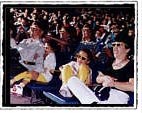
reels rolling, and all of Amagra crowded into the ancient, ornate
Royal Theater to watch a gray sun rise over the mucky flatland.
At night, the theatergoers drifted to sleep in their seats as
the film turned dark and the speakers broadcast the whine of cicadas
and the distant thud of the donkey engine dredging the swamp where
the textile factory was soon to stand.
The film went on, showing the vile temper of the powerful father,
who trampled the town fool at his eldest son's wedding. Years
passed, and a little girl who had entered the theater at six years
old now found herself seventeen, and in love with an older man
who had a seat several rows in front of her. Likewise small boys
who had dreamed of joining the army when they got older grew up
and became instead ushers and sandwich vendors, or stayed scrunched
in their seats, chewing their fingernails and gazing at the beauty
of the millworkers in the movie, who worked in the summer with
their blouses tied in a knot beneath their breasts. Couples married
and babies were born, the midwives hunkering down on the sticky
floor between the seats to ease the infants into the dim light.
A chemist continued his research into sheep diseases, working
with test tubes on his knees, while in the film the second son
killed his brother's pet bear with an axe, and Natalia, the wife
of the eldest, ran into the garden with her nightgown undone,
to find the hunchbacked cousin who loved her swinging from a noose
in the bathhouse. Old people died and were treated to elaborate
funerals, their wicker caskets borne up and down the sloping aisles.
The youngest son was bewitched by a prostitute at the Nizhny Fair;
the yardman became an itinerant mystic. He had the murder of his
child on his conscience.
Confectioners vended dozens of regional specialties in the lobby
and in the orchestra pit. But by the time the movie was halfway
over, the grandfather dead, the drought passed, the daughter disgraced
with the apothecary's son, half the bakers had been killed in
vendettas. The ones that survived formed a cartel, and raised
their prices markedly. The water in the drinking fountains turned
yellow, and many in the audience had their own hallucinated versions
of the school years of Yakov and Ilia, the lingering death of
the deaf stablehand, as they spent grueling months in the lavatory
retching into the sink and fouling the toilet with diarrhea. The
sound equipment suffered minor mechanical failures, so that whole
segments in the film were mimed, long conversations conveyed only
by glances and twitching cheeks. When the repairmen had thoroughly
overhauled the machines, many in the audience insisted that the
sound was still not as clear as it had been before. The actors
too seemed stiff, they said, not as expressive as the heroes of
the earlier parts of the epic. However, those who had grown up
during the latter years of the film disagreed vehemently.
Outside the theater, only a few nomads moved over the rocky,
sun-bitter soil. Trucks brought food from far away, though supply
routes were interrupted by the war in Pakistan, which spread west
and south until it abruptly ceased. Sometimes busloads of tourists
from Berlin came to stay at the Amagran Hilton. They watched the
movie for several days, making notes on pads with special lighted
pens. A few came alone in summer. One became obsessed with a woman
in the audience, a widow with an austere profile. Although they
had much in common, she rejected him and fled to the very back
row of the theater, where he could not sit behind her and observe
her. The men in the back row were very rough, and gave her a lewd
nickname for having slept with the foreigner. She protested that
all she had done was lay her head on his shoulder.
At the end of a hundred years, the film closed at last on the
rubble of the textile factory, burned in the Revolution. The camera
studied the bleary face of the drunken grandson and the pinched
cheeks of the orphaned, illegitimate heiress Constantina. The
audience hobbled out into Amagra's dusty streets. Strangers peered
at them from the tables of the caf� across from the theater. They
were refugees who had settled in some time ago, bringing with
them acrid buttered tea and peculiar red hats. They lived in all
the houses now and ran all the shops. None of the Amagrans could
remember how to manufacture so much as an umbrella or a chain
link fence. They had forgotten how to set a table for dinner,
and how to make up a bed. Moreover, the world looked small and
wrinkled, even as it stretched to the horizon, unbounded by the
edges of the screen. It had nothing to do with them. The light
stung them. They looked around stupefied, even their own hands
alien, the skin so pale, opaque, and meaningless. An old woman
looked down at a Daddy-long-legs crawling along a crack in the
cement. She studied its legs carrying the little spot of body
along. But truly it was going nowhere, it symbolized nothing,
it stood for no character or characteristic. It was not greed
or guilt, wilderness or ambiguity. It was a spider. The Amagrans
cried.
|
 |
|