 SPOTLIGHT ON HERESY: Modernism
January 2001 AD Volume 2.4
Sancta Sacrificia Illibata
Una Voce
- Houston|
In this Issue... . |
|
|
2 |
The Unity of Scientific & Revealed Truth. |
|
4 |
Food for Thought. | Spotlight on Heresy. |
|
5 |
UVH Editors Notes. | St. Agnes, Martyr. |
|
6 |
Spiritual Circumcision/S. Francis Sales. |
|
10 |
San Giovanni Bosco, v 2. |
|
11 |
Saint Genevieve, Virgin |
|
12 |
Vincent of Saragossa, Deacon. |
Some Thoughts on
Epiphany
"Three kings the King of kings three gifts did bring.
Myrrh, incense, gold as Man, God and King.
Three holy gifts be likewise given by thee
To Christ, even such as acceptable be:
For myrrh, tears; for frankincense, impart
Submissive prayers; for pure gold, a pure heart."

EPIPHANY, or "Little Christmas," as it is sometimes called, is to us "Gentiles" in one sense a greater religious feast than the Day itself; for as on Christmas the Savior long promised to the Jews was born to them, and was unrecognized by them, notwithstanding the fulfillment of the prophecies so exactly under their very eyes; so on this day the three Gentile kings, in obedience to the mysterious leading of the star, though professing no belief in the God of the Jews, knelt before the crib, and offered to the infant "wrapped in swaddling-clothes" tributes, acknowledging his divinity, humanity, and sovereignty.
It was long ago the custom for kings, queens, and other royal personages to offer at the altar gold, frankincense, and myrrh, in commemoration of these three kings; a custom which was still continued in some Catholic countries till the early 20th century.
At the time of our Savior's birth, there was an expectancy of his appearance. The celebrated prophecy of Balaam made an impression on the surrounding nations: "There shall come a star out of Jacob, and a scepter shall rise out of Israel, and shall smite the corners of Moab, and destroy all the children of Seth."
There are many histories of these three Magi (in Persian, signifying wise men) all agreeing that there were three, but differing as to the names. Melchior, Jasper, and Balthasar are the names given by Bede, and are preferable to Galagalath, Magalath, and Tharath. Venerable Bede describes Melchior as old, with gray hair and beard, offering gold to our Savior as king; Jasper was young, without any beard, and offered frankincense in recognition of the divinity; and Balthasar was of a dark complexion, a Moor, with large flowing beard, and he offered our Savior myrrh as man.
Tradition makes mention that after have presented Our Lord with their gifts, they received from Our Lady one of the treasured Infant's swaddling garment, which they treasured carefully.
In after years, they were baptized by St. Thomas. In the fourth century, St. Helena, mother of Constantine the Great, had their bodies moved to Constantinople; thence they were removed to Milan; when Emperor Frederick conquered the city their remains were moved to Cologne.
==============================================================================================================
The Unity of Scientific and Revealed Truth
A discourse pronounced by the archbishop of Louvain around the begining of the 20th century.
It is with joy that I address for the first time, as pastor of their souls, the children of this city, Louvain, twice blessed by the Church for the signal services she has rendered to the Christian world, both by her ancient university, and by the one which lives again in our time with so much luster.
Louvain bears a great title, because she symbolizes a great thing -- the unity of science and faith. How, then, my brethren, can I avoid speaking of her, and of that unity which men now strive to banish from the schools of learning? Everywhere it seems as if some invincible power had given the command to expel Christianity from our schools in the name of science. I gladly seize, therefore, the first opportunity which has been offered me to consider this question, because it deeply interests the living minds of the age, because it is one of the great cares of our social life, and because here the two interests are united in one place: the interests of science, because I speak of Louvain; the interests of religion, because I speak from this sacred pulpit.
Not always in their efforts against the unity of science and religion do we find our opponents frankly declaring war upon Christianity. No, its enemies prefer to extinguish it by stratagem. They wisely fear the love of parents for their offspring; and while they are eager to destroy the faith of the one, they hope to accomplish their task without the knowledge of the other. It is on this account that they have sought and found the proper word to conceal their design, and this word is neutrality in teaching. I wish, then, to show you two things:
First. That neutrality in teaching, as far as it regards the Christian religion, is evidently impossible; that a teacher must unavoidably declare himself for or against the Christian faith, even as Christ himself said, "He that is not for me is against me."
Second. Science cannot declare itself against the Christian faith without denying itself, without being unfaithful to its own principle, which is reason, and without renouncing the very conditions of a free, perfect, and progressive science. May the Mother of Science and Faith, Mater Agnitionis, obtain for us from the incarnated Wisdom the light, which we need!
PART I.
When I speak of instruction, I do not intend to designate certain branches of study in particular, but I refer to the whole course of teaching in each of its three degrees. I affirm, then, that neutrality in teaching is an evident impossibility, so far as it regards Christianity in each of these three degrees, and more especially in the highest grade of instruction. This could be demonstrated by running over a great number of the various branches of study; but in order to be more concise, though not less conclusive, I will speak of only two among them, history and morals, upon which no school can be silent. They will suffice to convince you that the school which is not Christian is necessarily anti-Christian, and that it will ever be impossible to be neutral.
Let us begin with history. If the Christian religion were a mythology, certainly we could separate it from the teaching of history, and banish it to the domain of fable; but Christianity before as well as after the Incarnation is a great historical fact; nay, it is the greatest fact of history. This fact is a living one in that religious society which embraces every nation. This living fact speaks and affirms itself divine; not divine in man who accepts it, but divine in that which constitutes its essence, in its doctrine, in its worship, and in its doctrinal and sanctifying power.
Christian teaching affirms that Christianity is a divine fact. Anti-Christian instruction denies it. What, then, can neutral instruction be? If it neither affirm nor deny, necessarily it doubts, and consequently it must teach doubt. But is not the teaching of doubt formally anti-Christian? The divine Author of Christianity teaches us that, in the presence of the proofs of his mission, doubt is inexcusable: "If had not come and spoken to them, they would not have sin. But now they have no excuse for their sin." (John XV 22.)
We will see, in a few moments, why this doubt is inexcusable; but we only affirm a self-evident truth when we declare neutrality to be impossible, because he who is not for the faith is necessarily against it, and to teach doubt is only another way to deny truth. But perhaps it will be said that neutral instruction will say nothing concerning this matter; that it will pass by the fact of the Christian religion in silence; and that, without relegating it to the do main of mythology, it will quietly ignore its existence. Now, the absurdity of this position is still more manifest, for Christianity is linked to everything in this world. We can not take a step in history without meeting with it; if you search the annals of antiquity, of the first centuries of the Christian era, of the middle ages, or of modern times, at every age alike you will see Christianity before you, and everywhere it governs all other things from its lofty height.

The pretence of silence in this matter is therefore one of two things: it is either nonsense or it is hypocrisy. It is nonsense when it is said, as I have recently been informed it is in a certain classic work adopted by our schools, that it will contain no question about sacred history, nor about the history of the church, whether of the old or the new alliance, because these questions are all beyond the scope of history. The chain of facts that a Bossuet has unrolled in his discourse upon universal history - that marvelous chain of facts beyond the scope of history! The expectation of redemption among all the people of the globe, which is proved by the universality of expiatory sacrifices, and by foreshadowing which redemption can alone make intelligible; the establishment of Christianity in its last and definite form, its civilizing influence, its trials, its long-continued struggles, its triumphant existence these are all beyond the scope of history! This pretended silence, then, is not nonsense, it is hypocrisy; it is only, like the neutrality which it defends, the hollow mask of infidelity.
Again, neutrality is not less impossible in the sphere of morals than in history. What is morality? It is the science of duty. By itself, it is the science of means furnished by reason to overcome our passions. Therefore to morals belong these absorbing questions: Why have the passions revolted against reason? Why does not the same beautiful harmony reign in the moral as in the physical order? Why are there, as it were, two men within us, and why do we know what we ought to do, and why do we follow the opposite?
What is the cause of this deep-seated evil, which is only too well known to us all? What is the remedy for it? Where shall we find the strength to conquer this interior revolt? Where are the arms with which we can triumph?
He who knows not this knows nothing. But faith has positive answers for these fundamental questions. It teaches us that the revolt of passions in human nature is the first result of the revolt of the human mind against God; that the soul, which did not wish to submit to its Creator and its Master, has rightly suffered the uprising of its own slaves, the senses and the appetites; that, if it would vanquish them, it must humiliate its pride, lament its evil deeds, implore the grace of God, pray to obtain again its lost strength. It teaches us that by prayer we seize familiarly the divine armor, "armaturam Dei orantes," and that only by its aid can we hope to combat and to triumph. This is Christian teaching. And will not that teaching be anti-Christian which denies what Christianity, in this respect, declares to be true? Certainly it must, because in the teaching of morals, to be silent concerning the necessity of grace and of prayer, by which man freely obtains grace, is to make an avowed profession of anti-Christianity. To say nothing of the grace which strengthens our nature; to say nothing of grace, which not only strengthens, but elevates nature above itself; to say nothing of the life of grace, as if, when compared with the physical and intellectual life, there was not a far more noble life, which all men have experienced, since no one is completely abandoned by its merciful inspirations-this is not a neutral course; it is anti-Christian, formally anti-Christian.
I might prove to you here that instruction upon morals is not only anti-Christian when it is silent concerning the means given us by faith to conquer these passions, but also when it refuses to recognize the great motives for fulfilling our duties, for these motives are so many Christian truths. I might show, or rather recall the fact, that these truths have transformed private and public morality, that they have begotten modern civilization; and those are indeed blind and ungrateful who enjoy the fruit of this civilization, while they would miserably tear the fair tree from the hearts of their Christian countrymen.
But I must be satisfied with placing these arguments before you; and I am the more readily contented with this sketch, because I know that it is not requisite to say everything, in order to be understood. I am convinced that I have said enough to make it clear, both to your reason and to your conscience, that instruction must be Christian, or it will become anti-Christian; that science is necessarily either for or against the holy faith; and that its pretended neutrality is only an unmeaning word. Hence it follows that the organization of public instruction on the basis of a deceitful neutrality is in reality the affirmation of anti-Christianity in the state.
DO NOT FAIL TO MISS THE CONTINUATION, PART TWO, IN THIS POWERFUL AND Prevalent DISCOURSE, TO BE INCLUDED IN THE NEXT ISSUE.
SPOTLIGHT ON HERESY: Modernism

Modernism
, denounced by Pope St. Pius X as the 'synthesis of all heresies', appeared in the beginning of the 20th century, growing insidiously among the clergy and laity (many of them of blameless life). Pope Saint Pius X showed admirable insight in detecting and condemning the errors of Modernism in his encyclical letter, Pascendi Dominici Gregis (Sept. 8, 1907). In this encyclical he writes on the Modernists characteristics and personality, "…Although they express their astonishment that We should number them among the enemies of the Church, no one will be reasonably surprised that We should do so, if, leaving out of account the internal disposition of the soul, of which God alone is the Judge, he considers their tenets, their manner of speech and their action. Nor indeed would he be wrong in regarding them as the most pernicious of all the adversaries of the Church. For, as We have said, they put into operation their designs for her undoing, not from without but from within. Hence, the danger is present almost in the very veins and heart of the Church, whose injury is the more certain from the very fact that their knowledge of her is more intimate. Moreover, they lay the ax not to the branches and shoots, but to the very root, that is, to the Faith and its deepest fibers. And once having struck at this root of immortality, they proceed to diffuse poison through the whole tree, so that there is no part of Catholic truth which they leave untouched, none that they do not strive to corrupt. …for they play the part of rationalist and Catholic, and this so craftily that they easily lead the unwary into error; and as audacity is their chief characteristic, there is no conclusion of any kind from which they shrink or which they do not thrust forward with pertinacity and assurance. … that the Modernist sustains and includes within himself a manifold personality; he is a philosopher, a believer, an historian, a critic, an apologist, a reformer. These must be clearly distinguished one from another by all who would accurately understand their system and thoroughly grasp the principles and the outcome of their doctrines." The heresy of Modernism contains three fundamental errors: (a) the existence of God, the immortality of the soul, the existence of revelation, in fact, all that is not matter of personal experience, cannot be known with certainty by our reason -- Agnosticism (the teaching that God can in no way be the object of certain knowledge); (b) Holy Scripture and Tradition do not contain revelations from God to men, but merely feelings and experiences of highly-gifted religious persons -- Immanence (the teaching that foundation of faith must be sought in an internal sense which arises from man's need of God); (c) Christ did not found a Church with a divine constitution and unchangeable dogmas and moral standards, but these are the result of a gradual evolution and must continue to develop and give place to others as times change -- Evolutionism. From these principles, Modernism tends to demolish dogmas (which it calls variable symbols), sacraments (which it reduces to faith-nourishing signs), the authenticity and genuineness of the Scripture, the Church, and ecclesiastical authority and discipline. It reduces Our Lord to human dimensions, and makes inspiration a common gift of mankind.FOOD FOR THOUGHT
Neglect of Thanksgiving.
Saint Philip Neri one day, to his sorrow, noticed that a person who had just received Communion was getting up and going away. He at once told two altar boys to take a taper each, and accompany the person home. Surprised at this, the young man asked what it could mean, and on the children referring to St. Philip, he went to inquire of the saint, who said: "When the priest carries the Blessed Sacrament, he is always accompanied by two acolytes bearing lighted candles: the same, it seems to me, is due to anyone who carries it in his heart!" Recognizing his fault, the young man returned to Church and made a due thanksgiving. How many nowadays might take this lesson to heart. ---Catechisme en Exemples.
The Young Mans Irreverence.

It is related that a certain young man, who once was present at Mass, neglected to genuflect at the words Homo factus est in the Creed, whereupon the devil appeared to him in a terrible form, and thus addressed him: "Ungrateful wretch, dost thou not thank and adore the God, who was made man for thee? Had He done for us what He had done for thee, we should be ever prostrate before Him in adoration and love: and thou dost not even make a sign of thankfulness." So saying, he struck him with his club and left him, like Heliodorus of old, half dead with pain and fear. ---St. Alphonsus Ligouri.
---------------------------------------------------------------------------------
The Traditional Latin Mass is celebrated each Sunday morning at 8 am at Annunciation Catholic Church in downtown Houston on the corner of Texas and Crawford
. Please come and invite friends and relatives. Deo Gratias.----------------------------------------------------------------
January
is the month of the HOLY NAME of Our Lord JESUS@
b @ b @ b @ b @ b @ b @ b @ b @ b @ b @ b @
Saint Agnes.
What will not human hearts endure
If thou, 0 Christ, giv'st help? A maid
Unarmed over comes what ever can lure,
And cruel anger, by Thine aid.
Earth's weakness Thou choose, in truth,
To crush the strong. Hence noble power
To Agnes comes, who scorned, in youth,
A thousand threats to make her cower.
Content her chosen Spouse to please
Herself she hid in secret nook,
Lest perishable beauty seize
In bondage eyes that on her look.
Yet fame the hidden one betrayed
And many wooers ardent glowed;
Whilst nurse and mother, too, essayed
To hold her back by cares bestowed.
But, firm in holy purpose, she
Rejected admirer's pleadings fond;
Wishing with Christ alone to be
United by perpetual bond.
Praise to the Father and the Son;
Praise equal to the Holy Ghost,
By whose inspiring breath upon
Men's hearts, love's flames
are kindled most.
-- Charles Coffen
Feastday Jan. 21 | Patroness of Children of Our Lady
I
t was during the bloody anti-Christian edicts of the Emperor Diocletian around 303 that St. Agnes died. St. Ambrose and St. Augustine tell us that she was only thirteen years of age. The young noblemen of Rome attracted by her wealth and beauty endeavored to have her hand in marriage, but she refused them, telling them that she had chosen a Spouse who could not be seen with mortal eyes. Her suitors, in hope of shaking her constancy, accused her of being a Christian. The kindness, as well as the threats of the judge had no effect upon her; fires were kindled, instruments of torture were placed before her eyes, but, immovable in her constancy, she surveyed them with heroic calmness. They decided to send her to a house of wickedness, but the sight of her inspired such awe that not one of the wicked youths dared to approach her. One, bolder than the rest, was suddenly struck with blindness and he fell trembling. The youthful saint came forth from this den of infamy uncontaminated in mind & body, still a pure spouse of Christ. The angry judge condemned her to be beheaded. She was buried a short distance from Rome,& Constantine erected a church there.
SPIRITUAL CIRCUMSICION…
This is an excerpt from the sermon of
St Francis de Sales for the Feast of the Circumcision of Our Lord, January 1, 1622, concerning Christian feast days, circumcision in the Old Law, Our Lord's Circumcision, the spiritual circumcision of the part of ourselves most affected by sin, complete spiritual circumcision vs. that which is only partial or a mere incision, observance of the entire Law of Cod as necessary for salvation, the greater obligation of priests, bishops and religious to practice complete spiritual circumcision, the never-ending struggle in this life against unruly passions and emotions, our inculpability in feeling spontaneous unruly emotions vs. culpability in those voluntarily encouraged or expressed in words, how it is far better to be "circumcised" by another than by oneself… (TAN: The Sermons of St. Francis de Sales)"When the eighth day arrived, on which the child was to be circumcised, he received the name of Jesus."
-Lk. 2:21he days, months, and years all belong to God, who made and created them. The ancients had so arranged these days and years that they named and identified them according to the phases of the moon and named them after their false gods, such as Mercury, Mars, Jupiter and the like. So widespread was this superstition that it was very difficult to uproot. To eradicate it, the Church dedicated feast days to the saints and has preferred for ordinary days, the word "ferial" in place of the names used by the ancient pagans. But although some of our feasts are dedicated to the saints, all are consecrated to Our Lord, who made them and to whom they all belong. This is why the Church dedicates to Him this feast which occurs on the first day of the year, and through it the entire year is dedicated to Him.

Today we are celebrating the Feast of the Circumcision of our divine Savior when, after His Circumcision, He received the sacred name of Jesus. The story of the Circumcision is wonderfully beautiful, and it is a figure of the spiritual circumcision' we all ought to undergo. Although the shortest of all those read during the year, today's Gospel [Lk. 2:21] is nevertheless lofty and very profound, for it mentions blood and the name of Jesus, and in these two words the whole story of the Circumcision is told. I will follow the structure of the Gospel... and we will talk about the nature of circumcision and our own spiritual circumcision...
Concerning the first point, circumcision was a kind of sacrament in the Old Law [Gen. 17:10-14; Lev. 12:3] and signified purification from the stain of Original Sin. It was like a profession of faith in the expectation of Our Lord's coming. Those circumcised became children and friends of God instead of His enemies, as they had been before.
Of course, our divine Savior had no need of circumcision. Not only was He the Law's Maker, but He had no stain or trace of sin whatsoever. He was the unspotted [I Ptr. 1:19] and all-holy Son of God. From the moment of His Incarnation, He was filled with every kind of grace and blessing of body and soul. Because of that strict union of the humanity with the Divinity, He not only overflowed with the fullness of grace, but His all-glorious soul enjoyed the clear vision of God continually. Thus, there was no need whatsoever to subject Himself to the Law of Circumcision. Nevertheless, He willed to submit Himself to it. Also, circumcision distinguished the people of God from other peoples. But Our Lord had no need of being marked with this sign of distinction since He Himself was the seal or very stamp of the eternal Father. [Heb. 1:3]. Innumerable are the interpretations and reasons demonstrating why the Savior was in no way subject to this law, but it would require a great deal of time to present them all. Let it suffice to say, then, that He was in no way obliged to submit to it and that He willingly submitted to it only in order to give us an outstanding example of the spiritual circumcision which we ought to undergo.
Circumcision is performed on the part of the body most damaged by Adam's sin. This is the first remark made by the early Fathers and, if I am not mistaken, by St. John Chrysostom. Their point is to show us that our spiritual circumcision ought to be done on that part of our person most damaged. Many, if not all, Christians are willing enough to undergo spiritual circumcision in order to take part in today's feast, but unfortunately they make this circumcision in that area which needs it the least! There are some who are imprisoned in sensual pleasures (I will use this example, although it is a little gross, until I can recall another). They are in constant pursuit of these brute pleasures. When they want to undergo a spiritual circumcision they take money and give alms. Now of course it is a good thing to circumcise one's wallet in this way and give alms. The Apostle assures us that almsgiving is a good thing. [Cf. I Tim. 6:18; Heb. 13:16]. It is always a good practice. But do you not see that that spiritual circumcision is not what is really needed in this case? Do not circumcise your wallet, you pleasure-seeking people, for your sickness is not there. Rather, circumcise your heart, by cutting off evil language, friendships and conversations; cut off this evil flirting and other such foolishness. Begin there if you want to undergo a good circumcision. But they do not do it. Instead, they continue to follow their animal instincts while congratulating themselves on giving alms, fully convinced that they have satisfied everything in that.
There are others greedy to amass and possess all sorts of riches, goods and comforts. Wanting to circumcise themselves, they keep vigils and observe great feasts and abstinences. They wear a hair shirt, belts, and all the rest. And in doing all this, they consider themselves almost saints! O God! What nonsense! Vigils and fasts are good, but you are not on target in this spiritual circumcision because you have not begun where it is most needed. The evil is in your heart, and you kill your body. You must circumcise your purse, distributing your goods to the poor. Uproot from your heart that unrestrained greed for riches, honors, and conveniences which is found there. Skillfully and ruthlessly apply the knife of circumcision to your heart and to those affections most damaged by sin.
Other people perform great penances and austerities, afflicting their bodies with all kinds of pains and hardships. These same people have no difficulty in drinking in the blood of their neighbor by a tongue which slanders and detracts? Oh, poor people, you think you are well circumcised by wearing the hair shirt, taking the discipline, and doing other such things; but do you not see that the part you must circumcise is your tongue, which laps up the blood of the innocent? [Ps. 63(64):4].
There are yet others who circumcise their tongues remarkably and are resolved to keep a deeply profound silence. But they continually go around growling and grumbling in their heart, and are full of murmurings and antipathies. Ah, my dear souls, what are you doing? The evil is hidden in your heart; so it is not enough to circumcise your tongue. You must circumcise that part in which are born these grumblings, murmurings and inner angers, because the circumcision ought to be performed in the place most affected by the sickness of sin.
This, then, is what spiritual circumcision means: to search into one's passions, affections, humors and inclinations in order to root out and cut off any excess in them. To do this a careful and serious examination of conscience is needed in order to recognize what is the most stricken part and what is our inordinate passion, inclination or humor, so that this interior circumcision can begin there.
The second point I wish to emphasize is that this was a circumcision and not an incision. There is a great difference between the two. An incision is required to remove any infection in a sick person's wound or sore. But this is not the same as circumcision, and most Christians make incisions instead of circumcisions. They may make some effort to deal with an infected member, but they do not use the knife to cut and root out from their heart what is superfluous. Now this must be said by way of preface: all are obliged to perform this circumcision, but in different ways, not equally. Priests, bishops and religious have a particular obligation to do it and in a manner completely different from those who live in the world, since they are more especially dedicated to Our Lord.
There are some Christians who cut off everything that keeps them from observing the Law of God. They are very happy indeed, and will reach Paradise in the end. For to attain it we have only to observe the divine commandments? [Matt. 19:17]. There are others who are content to correct and to uproot one passion or sinful habit, but who continue to wallow and revel in thousands of other sins against the Lord's Law. These do not perform a circumcision, but only an incision. They fail to penetrate to the corrupted part and to cut out what is needed for a true circumcision. Instead, they are content to strike at one affected member, and that is usually not the sickest. Still, they believe that they have performed a complete circumcision.
And so you will find people in the world who wallow in the vile filth of a thousand sins and who are enchained by many passions and depraved affections. If you question them about what they are doing or have done, they will answer that they have done nothing wrong whatsoever. "Oh!" they say: "We have not killed or stolen; we are not thieves or murderers." That may be true, but that is not enough. There may be other sins which you have committed which are as dangerous as those you have not committed. There are not just two precepts in God's Law; there are many others which one must observe to be saved. To seriously infract one of God's commandments is to judge and condemn oneself to the pains of Hell. When the Lord gave the Law to Moses, He did not say that only those who kill or steal would die; He promised the same threat and punishment with reference to the other commandments as well.
It is undeniably true that only those who have obeyed the Law of the Lord in its entirety will enter Paradise. [Matt. 5:19; Jas. 2:10]. The entire Law, not just a part of it. The person making only an incision will be condemned, as will be the one who is content to observe one or two commandments, struggling to uproot the evil that keeps one from their observance. To do this and not to be concerned with circumcising the habits of vice which render him rebellious to the other precepts of God will be the cause of his condemnation. It is obvious, then, that everyone must practice spiritual circumcision, though not all equally or in the same manner. But generally speaking, all of us ought to cut and drive the knife not only into one place, as do those who make an incision, but all around it, keeping and observing the Law in its entirety, omitting nothing. In doing this we will be very happy. Thus marked with this spiritual circumcision, we will be recognized as God's children and gathered into His glory at the end.
As for us bishops, priests and religious, dedicated and consecrated to divine service, we are more obliged than others to this spiritual circumcision. We ought to practice it not only as the laity do, but in an even deeper manner, to which they are not obliged inasmuch as they do not enjoy the same means as we; nor are they vowed to Our Lord as we are. Religious cannot be content with cutting out and combating a vice or an evil inclination; they must go all around the heart. Making use of a rigorous examination of conscience, they must take special care to scrutinize and note exactly their passions, moods, propensities, aversions and habits to circumcise them.
There are still some religious who make this examination twice daily in order to know well and understand the state of their heart. After this, they make use of the knife of circumcision to scrape away all that is superfluous and dangerous, excising both the sickness and anything which might cause the slightest disturbance or obstacle in the spiritual life. This knife is none other than a good and strong resolution, which permits them to ride over all the difficulties involved and to perform this interior circumcision generously. This is why religious life is often called a sanatorium or hospital where not only dangerous and terminal sicknesses are cured, but even minor ones as well. Indeed, one goes much further, purging the least little blemish, the slightest thing which can hinder the spiritual life and, ever so little, delay perfection. Even the sources of evil are removed, as the knife cuts all around the heart. For the heart is the part one must always cut open in this interior circumcision, careful to see and root out its evil thoughts, desires, passions and inclinations; its evil sentiments, repugnances and aversions. Those who do this are truly most happy.
But someone will surely say to me: "All this is true. I have often used the knife to cut out such and such passions and inclinations and such and such repugnances and aversions which I found in my uncircumcised heart waging a cruel war within me. Yet it seems that all that amounts to very little! Despite my great care and diligence, I still experience strong and powerful passions, aversions, disgusts, repugnances and many other movements which struggle and do battle with me." We reply: "Ah, my dear souls, we have come here not to enjoy ourselves, but to suffer. Be patient and one day you will be in Heaven, where there will be only peace and joy. There you will not feel any passion, or movements of envy, aversion, or repugnance, since you will possess an enduring tranquillity and rest. It is only there that we enjoy ourselves, not in this life, where one must suffer and be circumcised." If there existed someone here who had no passion, that person would not suffer but would be in absolute bliss. Such cannot be nor ought it to be, for as long as we live we will have passions. We will never be free of them until death, because it is precisely in the struggle with these passions and emotions that our victory and triumph lies. This is the universal opinion of the Doctors and the teaching of the Church.
I am well aware that in the past there were hermits and anchorites in Palestine who claimed that careful and frequent mortification would enable one to reach a state without passions or movements of anger, a state in which one would receive an affront without turning red, or be injured, mocked and beaten without feeling any emotion whatsoever. Their opinion has been condemned as false and rejected by the Church, which in response has declared--and it is true--that as long as we live upon this earth we will have passions, feel the stirrings of anger, revulsions, attachments, inclinations, repugnances, aversions and all other such things human.
We should not be surprised, then, if when someone tells us our faults or reprimands us we promptly feel these stirrings, or even suffer them for a long time. Nor should we be surprised if we dislike things which run counter to our inclinations--even less if we should like one thing more than another. Oh, certainly not! For these are natural passions and in no way sinful in themselves. There is no reason to think that in feeling these emotions and repugnances you have sinned and offended even in the slightest degree. Oh, not at all, for these stirrings are spontaneous and independent of us! These diverse emotions of the heart are in no way culpable, and it is not to these that we are to bring to bear the knife of circumcision.
Some people fool themselves into thinking that perfection consists in feeling nothing! So when they experience some stirring of the passions, it seems to them that all is lost. Oh, you poor people, do you not see that this is not the part of you that is most ill nor the part that needs circumcision, for these stirrings are beyond your power?
But what then should I circumcise? Circumcise the consequences of these emotions; cut off the words which result from them. Oh, worldly people! Circumcise those blasphemies, swearings, injurious words and detractions which are born of your anger and which are truly sinful and mortally sick. My dear souls, circumcise those murmurings reflected upon, weighed, and nurtured in your hearts for days, weeks and entire months, as well as those voluntarily encouraged repugnances against the things which obedience demands and which run counter to your tastes and fancies. Probe your heart, carefully scrutinize your passions, inclinations and affections; then root up and cut out all of this forthrightly and completely. Do not be content just to make incisions like the worldly, but perform good circumcisions which are spiritual and interior. This, then, is the second consideration which I want to make concerning today's Gospel.
The third is this: in the Old Law, those to be circumcised did not circumcise themselves, but were circumcised by the hand of another. Now our Savior willed to be like us in all things and subject Himself to the Law without any exception; therefore, He willed also to be circumcised not by His own hand but by the hand of another, no matter who it might be. I am well aware that the ancient Fathers and Doctors interpreted this in various ways, but I am not going to repeat them now. I will mention only one of them: Our Lord willed to be circumcised by another for our example, to show us that although it is a good thing to be circumcised by one's own hand, it is even better to be circumcised by someone else's. Surely those ancient solitaries--hermits and anchorites--who lived in the desert are to be admired. We ought to esteem the wonderfully triumphant victories they won by mortifying and circumcising their hearts and interior passions with the help of God's grace, inspired and prompted by the Holy Spirit, the saints and their good angels. Yet the circumcision which we endure from others far exceeds theirs, because it is more painful and therefore more meritorious.
All Christians are bound to be spiritually circumcised by one another. Beyond this there are always people in religious orders and communities who attentively and continually watch over their own heart so as to know what ought to be wrenched out and mortified. For this purpose they keep a knife continually at hand to circumcise themselves. This, however, does: not make them unwilling to be circumcised by others, and without doubt this latter circumcision is far more acutely painful than the former. We find arrogant, proud, haughty and coarse people who nevertheless are very cognizant that these passions are a major hindrance to God's grace and must be circumcised. They pray with hearts inflamed with this desire. In fact, turning inward, they begin to do it so fervently that it actually seems painless, and they experience such delight and consolation that they shed abundant tears of deep spiritual joy. In short, what comes from our own willing and effort costs almost nothing, so incredibly subtle is our self-love.
But if at this point someone were to tell them: "You are a lout, a bore," oh, surely their blood would begin to boil and they would immediately feel the on-rush of anger. This would be intolerable, and they would find clever words to justify themselves. Thus, you can see how necessary it is that someone else guide the knife which circumcises us. Others know much better than we precisely where the application is needed.
The preeminent Apostle, St. Peter, was seized with violent anger when, in the Garden of Olives, he saw the soldiers coming to take his good Master. He asked Our Lord whether he should strike with the sword. It is as if he meant: "I have only a small knife, but if You want I shall strike these scoundrels, making of them a veritable carnage." Too angry to wait for the answer, he struck one of the soldiers and cut off his right ear. But our divine Savior did not approve of this action and reprimanded him. He then took Malchus' ear and healed him. Turning to St. Peter, He said: "Put your sword back in its sheath." [Matt. 26:51-52; Lk. 22:49-51; Jn. 18:10-11]. By this He meant: "You have not used your knife to circumcise the part that most needed to be cut out. You have cut off the right ear, which is used to receive spiritual matters such as inspirations and good movements. But you have allowed the left ear, which listens to worldly and vain things, to remain. You ought to have removed the left, not the right ear. For the right ear is ready and eager to hear divine inspirations and heavenly words. By not severing the left ear, the circumcision is not rightly performed." You see, then, how necessary it is to bring the knife to bear on the part that is most sinful and sick.
Prayer in veneration of the Holy Name of Jesus
Composed by St. Bernardine of Sienna.
O glorious Name! Gracious Name! Name full of love and virtue! Through Thee, sins are forgiven, enemies overcome, the sick healed, and sufferers strengthened in adversity! Thou are the honor of believers, the master of preachers, the comfort of those who toil, the support of the weak. Holy desires are nourished by the ardor of Thine fire; and by it, necessary suffrages are obtained, contemplative souls are inebriated, and the triumphant are glorified in heavenly glory! By Thy most Holy Name, O sweet Jesus, Thou makest us reign with the Blessed, You, their glory, Thou who triumph gloriously with the Father and the Holy Ghost, in perfect Unity and Trinity, forever and ever.
O Name of Jesus O Name of Jesus, exalted above every other Name! O triumphant Name! O joy of Angels! O terror of hell! All hope of pardon, of grace and of glory is found in Thee! O sweetest Name, Thou pardon the guilty, Thou reform evil habits, Thou fill the timid with divine sweetness and drive away terrifying visions! O glorious Name! By Thee, the mysteries of eternal life are revealed, souls are inflamed with divine love, strengthened in time of struggle, and freed from all dangers. O desirable name! Delightful Name! Admirable Name! Venerable Name! Little by little Thou raise the souls of the faithful by Thy gifts and graces to the heights of heaven. All to whom Thou communicate Thy ineffable grandeur, by Thy power attain to salvation and glory!
St. Genevieve, Virgin
(Patroness of Paris) Jan. 3

St. Genevieve
was the daughter of Severus and Gerontia; tradition represents her parents as poor peasants, though it seems more likely that they were respectable townspeople. In 429, St. Germain of Auxerre and St. Lupus of Troyes were sent across from Gaul to Britain to combat Pelagianism. On their way, they stopped at Nanterre, a small village about eight miles from Paris. St. Germain preached to the flocked inhabitants who came to welcome them. The pious demeanor and thoughtfulness of a young girl among his hearers attracted his attention. After the sermon he caused the child to be brought to him, spoke to her with interest, and encouraged her to persevere in the path of virtue. Learning that she was anxious to devote herself to the service of God, he interviewed her parents, and foretold them that their child would lead a life of sanctity and by her example and instruction bring many virgins to consecrate themselves to God. Before leaving he saw her again, and on her renewing her consecration he blessed her and gave her a medal engraved with a cross, telling her to keep it in remembrance of her dedication to Christ. He exhorted her likewise to be content with the medal, and wear it instead of her ornaments. There seem to have been no convents near her village; and Genevieve, like so many others, who wished to practice religious virtue, remained at home, leading an innocent, prayerful life. It is uncertain when she formally received the religious veil. Some writers assert that it was on St. Gregory's return from his mission to Britain; others say she received it about her sixteenth year, along with two companions, from the hands of the Bishop of Paris. On the death of her parents she went to Paris, and lived with her godmother. She devoted herself to works of charity and practiced severe corporal austerities, abstaining completely from flesh meat and breaking her fast only twice in the week. These mortifications she continued for over thirty years, until her ecclesiastical superiors thought it their duty to make her diminish her austerities.Many of her neighbors, filled with jealousy and envy, accused Genevieve of being an impostor and a hypocrite. Like Blessed Joan of Arc, in later times, she had frequent communion with the other world, but her visions and prophecies were treated as frauds and deceits. Her enemies conspired to drown her; but, through the intervention of Germain of Auxerre, their animosity was finally overcome. The bishop of the city appointed her to look after the welfare of the virgins dedicated to God, and by her instruction and example she led them to a high degree of sanctity. When in 451, Attila and his Huns were sweeping over Gaul, the inhabitants of Paris prepared to flee. Genevieve encouraged them to hope and trust in God; she urged them to do works of penance, and added that if they did so the town would be spared. Her exhortations prevailed; the citizens recovered their calm, and Attila's hordes turned off towards Orléans, leaving Paris untouched. Some years later Merowig (Mérovée) took Paris; during the siege, Genevieve distinguished herself by her charity and self- sacrifice. Through her influence Merowig and his successors, Childeric and Clovis displayed unwonted clemency towards the citizens. It was she, too, who first formed the plan of erecting a church in Paris in honor of Saints Peter and Paul. It was begun by Clovis at Mont-lès-Paris, shortly before his death in 511. Genevieve died the following year, and when the church was completed, her body was interred within it. This fact, and the numerous miracles wrought at her tomb, caused the name of Sainte-Geneviève to be given to it. Kings, princes, and people enriched it with their gifts. In 847 it was plundered by the Normans and was partially rebuilt, but was completed only in 1177. Louis XV began the construction of a new church in 1764. The Revolution broke out before it was dedicated, and it was taken over in 1791, under the name of the Panthéon, by the Constituent Assembly, to be a burial place
for distinguished Frenchmen. It was restored to Catholic purposes in 1821 and 1852, having been secularized as a national mausoleum in 1831 and, finally, in l885. St. Genevieve's relics were preserved in her church, with great devotion, for centuries, and Paris received striking proof of the efficacy of her intercession. She saved the city from complete inundation in 834. In 1129, a violent plague, known as the mal des ardents, carried off over 14,000 victims, but it ceased suddenly during a procession in her honor. Innocent II, who had come to Paris to implore the king's help against the Antipope Anacletus in 1130, examined personally into the miracle and was so convinced of its authenticity that he ordered a feast to be kept annually in honor of the event on 26 November. The saint's relics were carried in procession yearly to the cathedral.
The revolutionaries of 1793 destroyed most of the relics preserved in St. Genevieve's church, and the rest were cast to the winds by the mob in 1871. Fortunately a large relic had been kept at Verneuil, Oise, in the eighteenth century.
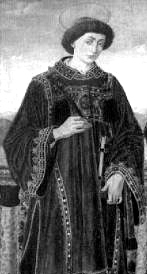
St. Vincent of Saragossa
St. Vincent, the protomartyr of Spain, was a deacon of Saragossa, Spain in the third century. He became a martyr under Diocletian, in 304; mentioned in the Roman Martyrology, Jan. 22, with St. Anastasius the Persian. This most renowned martyr of Spain is represented in the dalmatic of a deacon, and has as emblems a cross, a raven, a grate, or a fire- pile. He is honored as patron in Valencia, Saragossa, Portugal etc., is invoked by vintners, brick-makers, and sailors, and is in the Litany of the Saints. He was born at Saragossa; his father was Eutricius (Euthicius), and his mother, Enola, a native of Osca. Under the direction of Valerius, Bishop of Saragossa, Vincent made great progress in his studies. He was ordained deacon and commissioned to do the preaching in the diocese, the bishop having an impediment of speech. By order of the Governor Dacian he and his bishop were dragged in chains to Valencia and kept in prison for a long time. Then Valerius was banished, but Vincent was subjected to many cruel torments, the rack, the gridiron, and scourgings. Salt was rubbed into his wounds, but the constancy of the martyr yielded not, while the rage of his persecutor knew no bounds. He was again imprisoned, in a cell strewn with potsherds, reopening his wounds. The jailer, seeing the prison filled with light and the saint walking and praising God, was converted to Christianity. St. Vincent was next placed in a soft and luxurious bed, to shake his constancy, but here he expired.
His body was thrown to be devoured by vultures, but it was defended by a raven. Dacian had the body cast into the sea, but it came to shore and was buried by a pious widow. After peace was restored to the Church, a chapel was built over the remains outside the walls of Valencia. In 1175, the relics were brought to Lisbon; others claim that they came to Castres in 864. Cremona, Bari, and other cities claim to have relics. Childeric I brought the sole and dalmatic to Paris in 542, and built a church in honor of St. Vincent, later called St - Germain - des - Prés. Regimont, near Bezières, had a church of the saint as early as 455. Rome had three churches dedicated to St. Vincent; one near St. Peter's, another in Trastevere, and the one built by Honorius I.