Continued…
| The Seeds and Roots of Communism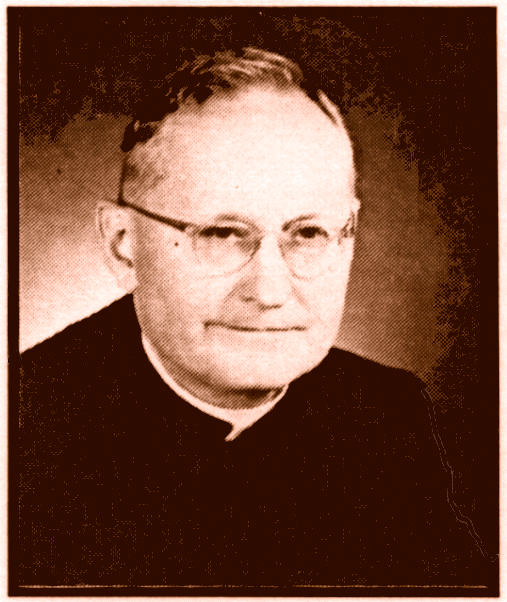
Continued…
| The Seeds and Roots of Communism
The Seeds and Roots of
Communism was a paper done by the lateReverend Monsignor Edward Kenyon Fulkerson,
a great priest in the Houston area, a true warrior for Christ the King,
who was born on Oct. 24, 1903, ordained March 24, 1928, & died on Jan. 10, 1992
Eternal Rest, Grant unto him O Lord, and may Thy perpetual light shine upon him
.
Luther died in 1546 having set the stage for the second period in modern philosophy. This begins with Rene Descartes who was born in 1596. Descartes marks the beginning of a new period in the development of the contemporary ideas of religion thanks to the new juxtaposition he introduced into the world of spiritual realities. As Luther placed side by side nature and grace, so Descartes placed side by side the intelligible and the sensible; as Luther distorted grace by making it something extrinsic to nature and not its perfections, so, too, Descartes distorted the intellect by making it extrinsic and independent of the sensible and not its perfection.
Two influences are found in the origins of the Cartesian system (The system and philosophy of Descartes), one belonging to the past, the other to Descartes’ own times. His relation to the past is not so marked, for he cared little for tradition or history. Nevertheless, it is true that the Protestant current did have some effect on him, for its doctrine of the immanence of spirit and experience, which was put in the place of the living word of the Mystic Body on the one hand, and the authority of Sacred Scripture on the other, naturally grew into a species of rationalism. Because when man’s inner experience grew cold it was only a matter of time when natural reason would be considered the inner light.
In the application of his method, Descartes carefully avoided the application of his method to Faith, Morals, and Religion. But his successors were not of the same opinion. Hence, Rationalism ultimately made its home in Protestantism. Descartes set out by doubting hypothetically of all truths. There is one truth, he says, of which it is not possible to doubt, namely the fact of my own thought and consequently of my own existence: "I think, therefore I am." ("Cogito, ergo sum.") The truth of this principle is due to its evidence; evidence, therefore, must be the criterion of all truth. He taught that thought is the essence of the human soul, extension the extension the essence of body. In failing to pass beyond these properties he opened the way to sensualism and positivism of Locke.
As a result of the teachings of Descartes, two currents followed: one, the denial of the extrinsic, which ends in a rationalized Christianity -- a Christianity without the supernatural. Two, the assertion of the immanent which corresponds to the sensible side of the Cartesian juxtaposition and ends in an exaltation of the fact of the sensible or material universe as the limit and apex of human knowledge. We do not mean to leave the impression that Descartes was directly responsible or event he principle inspiration of Philosophy and Theology which followed him, but merely this: Descartes, for the first time in modern thought, clearly expressed a principle of Rationalism. Although his followers did not all adhere to it in principle, they did adhere to it in spirit. In this sense Descartes is taken as the prophet of Rationalism.
The privilege of private interpretation of Sacred Scripture was, then, the first step in the emancipation of the modern mind. This immanence of authority, in the course of time, became the immanence of mystical revelation and pietism. With Descartes, immanence of justification without the authority of a Living Word, became immanence of knowledge without the determination of the sensible. followers of Descartes enlarged on this principle and freed the mind even from the determination of causality, necessity and transcendence.
There remained but one great spiritual reality untouched by the destroying hand of philosophers; once the idea of grace was distorted and twisted by making it extrinsic to nature, and once the true function of the intellect as the crown and perfection of the sensible was denied in favor innate ideas; there was only left the will, which in traditional thought received its goal and end from the intellect. There now appears on the scene one of the best known of the world philosophers, Immanuel Kant, who was born in 1724, at Konigsberg. Although endowed with every good intention, nevertheless he razed to the ground the last vestige of traditional thought by distorting the true nature of the will, the source of man’s noblest aspiration.
Kant’s philosophy consists of an examination into the origin, extent and limits of knowledge. This is called "Critique of Pure Reason." The first step, according to him, in philosophy must be Criticism, as opposed to Dogmatism, on the one side, and Skepticism on the other. By criticism Kant means an attempted scrutiny into the range and validity of our knowledge. Dogmatism, he maintains, assumes while Skepticism rejects, alike unwarrantably, the veracity of our faculties. Kant’s criticism results in the denial of everything transcending experience. The "Critique of Practical Reason" seeks to restore in the form of belief what he has previously demolished as rational cognition. Thought the existence of God, the immortality of the soul, and the freedom of the will, are incapable of proof if not replete with contradictions, yet their admission is exacted by the needs of our moral nature. In other words, expediency was to be the law of truth, good and evil. Nothing was good or evil in itself, only our thinking makes it so. Hence, we see that Kant is the father of the pantheistic school of Fichte and Hegel.
Hegel was born at Stuttgart in 1770. At the age of 18 he entered the theological seminary at Tubingen, where he devoted himself to the study of Kant. Not only did Fichte, but also Hegel endeavored to supply a single principle which would complete Kant’s analysis of speculative thought and afford a systematic and logical basis for the analysis of the data of ethics and aesthetics. Hence, Hegel developed a system opposed to Schelling’s philosophy of identity. Hegel’s philosophy was known as dialectical idealism: idealism because it was concerned with ideas, thoughts, spirit, mind, as the only reality, of the universe; dialectical, because it described the method by which thoughts or ideas developed, namely, by contradiction.
For Hegel there are no immutable truths or principles. Ideas are fluid and are arrived at by a debating process. First there is affirmation of an idea, then its negation by another idea, and finally a synthesis of the two, a joining of the two.
Karl Marx, who was born in Treves, 1818, was tremendously impressed with the dialectical side of Hegel, which denied that any truth was permanent or any principle immutable. The year Marx received his doctorate at the University of Jena, Ludwig Furbach in his book called "Essence of Christianity" tried to destroy philosophy with a full-fledged materialism. Marx read the book and his enthusiasm is recorded as "unbounded." Furbach had killed the idealism of Hegel, and destroyed all religion by showing that it was an illusion projected by the brain of man. Furbach did this by denying all thought, ideas, mind and spirit, by affirming that matter is the basic reality. "Man is only what he eats."
Marx decided that it would be wonderful to take the dialectical method which Hegel applied to ideas and apply it to matter. Thus was born dialectical materialism, the philosophy of communism. Marx saw contradiction at the very heart of reality. There was no need of a God to explain matter because matter itself is endowed with motion; it develops by shocks, oppositions, clashes, struggles, catastrophes. The whole universe was dialectical. Reality is revolutionary.
He was also tremendously impressed with a pamphlet in which the Frenchman Proudhon was trying to apply the dialectics of Hegel to economics. The big problem, said Proudhon, is economic, not political nor social. He suggested that perhaps capital was the affirmative side of dialectics, which in turn begot its contradiction, labor. Somewhere there ought to be a synthesis which would involve changes of property.
Where Proudhon led, Marx followed. Contradictory elements in matter become contradictory elements in economic society, which appear in the form of classes. The classes are basically twofold: exploiters and exploited, or in modern language, capital and labor. Between the two there can be nothing but irreconcilable hostility. According to Marx, the entire history of the human race has been the history of class struggle. Politics, religion, free will, art, science, philosophy and literature, inspirational leadership---all, the classless society is established, through liquidation of the exploiting class, then the literature, art, science, education and music will reflect the communist ideology.
But how will society undergo this basic revolutionary transformation? By a revolution in which the working class will use its political supremacy to wrest by degrees all capital from the bourgeoisie, the middle class, to centralize all instruments of production in the hands of the state. In the beginning, of course, this cannot be done except by means of despotic inroads on the rights of property. According to Marx, the arming of the workers with rifles and ammunition must be carried out at once and steps be taken to prevent the rising of the army which would be directed against the workers. The battle cry of the workers must be "the revolution in permanence!"
All moral standards grow out of certain economic condition, this is the communist theory of ethics. Again we find expediency as the law of truth, good and evil. The explanation of morality from the communists point of view is: the end justifies the means. The needs of the revolution determine morality. The communist therefore finds no contradiction in his moral law when, for example, he is friendly to religion one year, and persecutes it the next.
Man has been alienated from himself in two ways, by religion and private property. This is the basic principle underlying the writing of Marx. Religion alienates a man from himself by subordinating him to God; private property alienates a man from himself by subordinating him to an employer. It follows that, if a man is ever to be restored to himself, both religion and private property must be destroyed.
A close student of Karl Marx was Lenin (Vladimir Ilyrich Ulyanov). He was born in 1870, the third of a family of six. As a young man he entered the Kazan University to study law, but was sent down in December of 1887 for taking part in a gathering of students and was banished out of the country. It was not until the autumn of 1889 that he was allowed to return to Kazan, where he began the systematic study of Marx and met the members of the local Marxist club.
The best way to understand the distinctive character of Leninism is to begin by contrasting it with other varieties of Marxian Socialism. It decidedly rejects all these---which it regards as mere opportunism, treachery to the proletariat, the degradation of Marx’s doctrines into trivialities, servility to the bourgeoisie. Leninism presents itself with entire self-confidence as the one true interpretation of Marxism. What, then, does it regard as the essential doctrine of Marx, the deposit which it faithfully preserves and develops in contrast to the pseudo-Marxians of every description? Undoubtedly the doctrine known as dialectical materialism.
Dialectical materialism is the description of their philosophy given by the Bolsheviks themselves. It must be distinguished in the first place from every form of metaphysical materialism current in the 18th century and among bourgeois men of science in the 19th century. For it the world is not a static world at rest and without a history; it is an historical, moving and changing reality. The dialectic is the theory of these changes and movements, the principle which explains them. But it is not, as with Hegel, an idealist logic, for it is based on an objective materialism. It is the explanation of historical and social changes and developments as due to causes of a material nature; namely, the conditions of production and the class system founded upon these. It cannot be opposed as a spiritual force to this social and historical reality; for it is a statement of the origin and development of that reality. All idealism is therefore rejected as being simply the expression of a subjective attitude to the world divorced from the historical fact.
According to Lenin, dialectical materialism of Marx alone guaranteed the claim to be objective truth which both recognize and transformed the real world. Lenin, therefore, vigorously opposed all attempts to substitute for dialectical materialism---this combination of Hegelian logic with the Marxian analysis of society and its classes---a system of scientific and mechanical explanations, the so-called "scientificism."
Like the entire philosophical work of Marx himself, Lenin’s dialectical materialism is intended to lead from knowledge of the world to its social transformation. It applies to itself its thesis that all knowledge depends upon social and historical conditions---as the knowledge which is the instrument of revolution and of the class which is the organ of revolution, the proletariat. Its conclusions can never, therefore, be opposed to revolutionary practice. For if correct, that is, in conformity with its principles, they are themselves revolutionary deeds which proclaim and express the transformation of the world.
Thus, dialectical materialism develops its fundamental thesis, the unity of theory and practice. There is no philosophy formally true in isolation from historical and social reality. Everything serves that reality; even what claims to be pure theory. But pure practice independent of theory is equally non-existent. Every action expresses a distinctive conception of the historical and social facts. Lenin, from his youth, had insisted on this unity of theory and practice, and, we must admit, he carried it out in his life.
In conclusion, then, let us say that Communism is a complete philosophy of life. It has a theory and practice; it wishes to be not only a state but a church judging the consciences of men; it is a doctrine of salvation and as such claims the whole man, body and soul. In this sense it is totalitarian.
Certainly communism is not Russian in origin. There is not a single Russian idea in the whole philosophy of communism. It is Western, materialistic and capitalistic in its origin. How did it ever get into Russia? Obviously through the dissemination of ideas by those who became the apostles of Marx. Lenin was one of them.
As a matter of fact, there is a great deal in the philosophy of communism that is anti-Russian in the sense that the Russian people were never atheistic. The materialistic atheism of communism is an importation from Germany,
Thus we see the seeds and the roots of communism. The seeds were planted a long time ago. The roots were slow in their growth, but nourished by man’s false pride and rebellion, have dug deep into the falsehood of the material. Luther rebelled against the Mystic Body God’s external authority; Descartes rebelled against the external world by denying material and spiritual substances; Kant rebelled against the external reality of good and evil; Hegel’s philosophy was one of contradiction and rebellion, so to speak, of ideas; Marx said that reality is revolutionary. These were the conglomerated ideas that Lenin passed on to Russia. It may take a long time for Western Civilization to realize that communism is its product of rebellion given to Russia. It may take a long time to realize that the good it is seeking, is the good that it left in the sixteenth century. Many heartaches and long, sad experiences will be necessary before it realizes that the Catholic Church which it left was the only place where it could find peace and contentment. It will take a long time for Western Civilization to realize that the Church, which it believed was so restraining to liberty, is really the only one that makes us free, and that which was thought so much behind the times, is the only institution which will survive the times. W
