


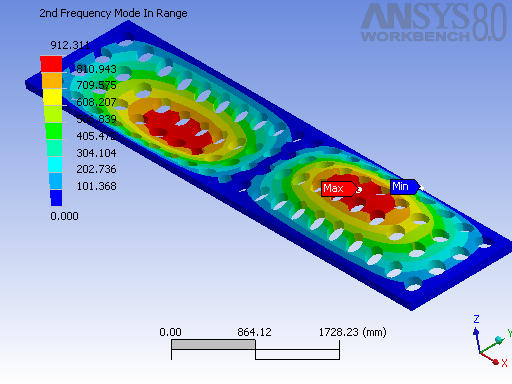
This is a first course at the graduate level in vibrations. It is intended to give you an introduction to basic skills. We will study the free and the forced response of single-degree-of-freedom systems, multiple-degree-of-freedom (or lumped mass) systems and distributed parameter systems. We will end with an introduction to dynamic finite element methods in vibration analysis and give a brief introduction to modal testing methods. You are expected to have access to and a working knowledge of MATLAB. (Mathcad can also be used).
Required Text:
. Engineering Vibration, D.J. Inman, 2nd Edition, 2001, Prentice Hall, ISBN 0-13-726142-X.
Selected References:
1. Introduction to Matlab 7 for Engineers, Palm, 2001, McGraw Hill, ISBN 0-07-292242-7.
2. Principles and Techniques of Vibrations, L. Meirovitch.
3. Vibration with Control, Measurement and Stability., D.J. Inman, 1989, Prentice Hall.
4. Analytical Methods in Vibration, by L. Meirovitch, MacMillan, 1967.
Prerequisite:
MER045 (Dynamics and Kinematics) and MER202 (Engineering analysis) or equivalent.
Grading:
There will be one class exam, a final exam, and graded homework.
Class Exam 30%
Final Exam 30%
Homework 40%
All of the work required for this course must be completed to pass this course.
Tentative Course Outline: Fall 2003
Period Date
1 Single Degree of Freedom systems (1.1-1.10)
Introduction to Mathcad/Matlab
2 Response to Harmonic Excitation (2.1-2.5,2.7-2.10)
3 General Forced Response (3.1-3.3,3.8-3.10)
4 Multi-degree of freedom Systems
MidTerm Exam
5 Design for Vibration Suppression
6 Distributed parameter Systems
7 Vibration Testing and experimental modal analysis
Final Exam
