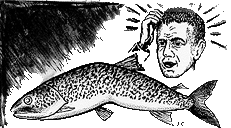
 The Fish with the Broken Back
 |
|
By Samuel Ciraulo - 1948.
On the road ahead and illuminated by my headlights was a six- teen foot run-a-bout boat, cradled snugly in its trailer, bouncing gently along. Towing the trailer was a pick-up truck and in its cab was the other half of our fishing party consisting of my good friend, Lee Payne, his Wife and two Children. Many thoughts flashed through my mind as we rolled steadily northward. I reminisced about the World War II years, the events, of which, were responsible for bringing together this group of varying interests and personalities. I was a young artist struggling to get a foothold in the commercial art field in Johnstown, Penna. My father-in-law was a civilian Engineer at Fort Custer, Michigan, where I had been stationed at for a short time during the war. Lee, a husky individual, was a farmer during the warm months and worked as a lumberjack during the winter. He made his home at Big Cedar Lake located twenty-one miles north of Battle Creek. I also thought of the largest fish that I had caught to date, a sixteen inch large mouth bass and I compared this with the vision of a tubful of large lake trout that Lee assured me we would, without a doubt, catch.

Before I realized it, dawn was breaking and we were approaching Mackinaw City. Everyone was awake as I drove aboard the ferry boat for the ride across the Straits-of-Mackinaw to St. Ignace on the Upper Peninsula of Michigan. Going ashore at St. Ignace, we pro- ceeded northward entering Canada at Sault Ste Marie. Driving up along Lake Superior, we penetrated the scenic Canadian countryside for approximately 50 miles to our destination, Batchawanna, where we rented two small, primitive but adequate cottages. After a hot meal and a period of relaxation, we began preparations for the next day's assault on Lake Superior's Trout. Long before daybreak. Lee, Dad, and I eagerly set out to get that tubful of lake trout. The anticipation of pulling in the big ones certainly had a warming effect on me as I scarcely noticed the intense chill of the lake air. We fished all day, trolling around the Batchawanna Bay area and at dusk when we called it quits, our catch totaled up to exactly zero. The next day was a sad repetition of the first. My friend, Lee, just couldn't understand it and I began to wonder if my record catch was going to remain at 16 inches. That night we talked to an Indian Guide who informed us that the trout were running late this year and that we should try our luck about 30 miles further up the lake. Early the next morning, four o'clock to be exact, Lee, Dad and I, loaded the boat on the trailer and headed north over a rough, curving dirt road that faithfully hugged the very irregular shoreline. About fifty torturous miles later the road came to an end at the mouth of the Montreal River where we immediately launched the boat and headed out for some determined fishing. But it was another day of frustration as we wound up again... empty handed. This would have been completely demoralizing except for the fact that we did have three or four strikes indicating that here, at least, were some fish. Upon deciding that we were tired of hunting for the elusive fish for that day, we left the boat in a small sheltered cove, climbed into our vehicle and headed back toward Batchawanna. When we arrived at the cottage tired and very hungry, the women, within minutes, had a warm, delicious meal ready for our devouring, which we proceeded to do with a vengeance. It had been a very long, long day. That night it started raining and continued raining for 3 days. The cold miserable rain plus the rough condition of the lake forced us to suspend fishing operations, and for the most part kept us indoors, We whiled away the time playing cards with the women, whom I suspect were secretly happy to see the rain. The rain finally stopped and the lake seemed to be returning to normal as we drove to the Montreal River and our boat for what we hoped would be a day of successful fishing. Late that afternoon, we finally hit pay dirt in the form of a fat 26" trout. Of course, our first fish had to be different. Its glistening streamlined body was oddly bent in what appeared to be a broken back. Broken back or not this trout certainly looked like a prizewinner to me. Now, with uplifted spirits, we continued trolling with anticipation but at the end of the day there was no companion for our fish.
Before driving back to Batchawanna that evening, we talked to
some commercial fishermen, who confirmed what an Indian Guide had
told us previously, that the trout were starting to come in thirty
miles up the lake near Cape Gargantua. We immediately started
making plans for a three day visit to that area. Upon arriving
back at the cottage, our prize catch was put on ice and then we went
to the Batchawanna Hotel to further our plans for the big trip.
Early in the morning. Lee and I drove the long, rough fifty miles to the Montreal River and our boat. Little time was wasted as Lee mounted and checked out the heavy outboard motor while I loaded the fishing tackle and extra fuel. A bright sun in a clear blue sky was just peering over the horizon as we took off with a roar and headed north over the relatively calm deep blue waters of this tremendous lake. We were cruising at approximately fifteen miles an hour about one mile out from the foreboding cliffs and rocky areas of the rugged, treacherous shoreline. Despite the warming efforts of the bright sun, the air on the lake was cold and penetrating. We were out a little over an hour when the water became noticeably choppy. Clouds moved rapidly across the sky and then in what seemed only a matter of minutes, we were in the midst of, what I can only describe as a windstorm. The going got rougher by the second and Lee decided to refill the fuel tank before it became impossible. I manned the oars in an effort to hold the boat in the best position possible while Lee performed the acrobatic job of refueling; Quite a bit of fuel sloshed on the outside of the tank as the boat pitched and bucked but finally Lee managed to complete the trying task. Responding reluctantly to Lee's persistent coaxing, the motor sputtered, then roared into action. We turned toward land with the hope that when we got there we would be lucky enough to find a suit- able spot to go ashore. But the now angry waves would not cooperate and proceeded to slam us around to the extent that we started taking on a lot of water. The weight of the heavy motor plus the enormous thrashing waves and the direction the waves were moving in placed us in the immediate danger of capsizing. We had no choice but to turn toward the center part of the lake, where in the distance we spotted some clumps of treetops indicating the possibility of a little island. We aimed the boat directly toward the treetops. Moving in this direction the elements now seemed to work in our favor and although we pitched considerably, we took on less water and moved right along. After an interminable amount of time, we approached the island through a treacherous area of large rocks which would appear, then disappear, under the charging, churning, frothing water. We made it safely to shore and with a sigh of relief pulled the boat out of the water. It was a small island covered with scrubby cedar, but the appearance of it was of little concern to us. We were wet, cold, and so our immediate problem was heat. Getting a fire started, fortunately was rather easy as my reliable friend. Lee, was carrying some matches in a waterproof container and our little island was covered with hundreds of pulpwood logs. These logs probably washed ashore after escaping from the large pulpwood rafts that are continually being towed across the lake from the lumber camps. They were about six feet long and averaged between six and eight inches in diameter. In a matter of minutes, we had a beautifully blazing fire going. We warmed up quickly, then busied ourselves stockpiling our ready-cut firewood. We stacked enough logs to last out the day and through the night.Tired but contented and thankful of our situation, we sat on a log, a respectful distance from our fire, with a small piece of can- vas over our heads to ward off the cold rain that was now falling. As we sat there looking like two pathetic figures, we calmly discussed our predicament and considered the options available for getting out of it. We figured that we were about fourteen miles from the mouth of the Montreal River. Our available food consisted of one lunch that my wife insisted that I carry. It contained two-bologna sand- wiches, two apples, three cookies and a chocolate bar. Lee had a quart thermos of hot coffee. As for drinking water, we had a whole lake full of it. Lee, insisted that I control the food rationing I carefully divided the food into very small portions and set up a tentative schedule. With this schedule, we would have something to nibble on for five days, which we hoped would be the maximum length of our stay on the island. We also hoped to supplement our food supply by catching a fish or two. Considering everything, we felt that we really were in good shape. My companion was physically conditioned for rough weather because of his farming and logging activities but my vocation as an artist contributed little towards conditioning my body to withstand extreme weather elements. As night came on, the temperature dropped, and despite our roaring bonfire, I was quite uncomfortable. While one side of me was broiling, the other side was freezing, so I sat on a log with my canvas umbrella and revolved with programmed regularity while Lee, propped against some logs, slept peacefully. As the night wore on I alternately watched the flames and the angry waves, only a few yards away. I thought of many things, especially the saying that Lake Superior never gives up its dead. I also thought about the tubful of fish that Lee boasted about that we would catch and I thought about the fish with the broken back, now lying on ice back in the cottage at Batchawanna. Periodically, I got up to throw logs on the fire and so the night passed. Shortly after the break of dawn the miserable rain stopped falling. We restocked the woodpile, had breakfast (a small piece of chocolate and a swallow of coffee) and then decided to try some fishing off the downwind side of the island. After two hours spent mostly avoiding the many rocks, we made our way back to shore empty- handed. Although it was no longer raining the sky was still filled with a thick layer of ominous looking dark grey clouds and the temperature seemed to be steadily dropping. A cold wind continued to blow and the waves thrashed around higher and angrier than ever. We decided to play it cool and take it easy for the rest of the day. Perhaps someone would fly over the area and spot our fire. In the meantime we spent the rest of the day lolling around the fire and talked at great lengths about many things. For the most part, the conversation was lighthearted, humorous and optimistically positive about our situation. Night came and it was spent very much like the first night with one exception...no rain. With the coming of daylight, our spirits lifted considerably when we thought that the lake was not as rough as it had been. So this got us thinking that perhaps this was the day that we would try to get back to the mainland. Shortly after noon, we foolishly decided to try to get back to the Montreal river. We prepared the boat for the rough trip, then cautiously worked our way out to open water where with a loud roar, we headed south. But once away from the protection of the island, the angry lake tossed us about so violently that we were in constant danger of capsizing. The only intelligent thing for us to do now was to try to get back to the island, which, with considerable difficulty, we finally accomplished. Safe again around our wonderful fire, we laughed and joked about our futile attempt. The sky remained overcast and the wind was brisk as the day wore on. Pacing another miserable night we got busy and with our ready-cut logs built a strong, comfortable lean-to. Cedar boughs were stacked along the sides and sloping back and held down with more logs. Inside, we laid a floor of cedar boughs about one foot deep and then we were ready for the night which was now upon us. Turning in early. Lee took the inner side of the lean-to and I settled down on the open side facing the fire. It wasn't long before we were both asleep. About two hours later, I woke up shivering from the cold that was penetrating my body from the ground beneath. The fire was down somewhat and of all things, it was snowing. I put some logs on the fire and the flames shot high with an eerie glow as they illuminated the flying snowflakes. I spent the rest of the night sitting on my log wondering about our next move. Lee. joined me a few times during the night but would end up back in the lean-to for more sleep. As dawn broke I noticed that the waves had diminished slightly and the wind, now coming from another direction, had calmed down somewhat. The snow had stopped falling but left the little island covered with a thin white blanket. As we ate our light breakfast, we discussed the possibility of leaving the island. Thinking that this change in the weather might be a lull before the really rough winter weather set in, we decided that now was the time to give it a try. Eager to get started, we carefully checked and prepared the boat for the trip. An hour later we were all set. Then with a silent prayer, a handshake and a "Let's go", we pushed off. I rowed as hard as I could until we got to where Lee could start the motor which fortunately turned over immediately. We were now on our way. In the matter of a few seconds we were again at the mercy of this mad Lake. The going was extremely rough with waves that seemed larger than those I experienced on the Atlantic Ocean during a stormy seventeen-day crossing. We were swept to the top of a wave and then abruptly thrown down into a hissing trough. There were times when the top of the waves seemed to be ten to fifteen feet higher than the boat. In the excitement of this jarring, flying, diving, bucking ride, we were oblivious to the cold or the chill of the icy spray that continually splashed over us. We were prepared for the worst as we had removed our boots before starting out. In the event that we capsized, our only chance for survival in the frigid water would be to swim toward the shore as best we could, hoping to maintain enough body heat until we got there. Fortunately it didn't come to this and after an hour and a half of a terrifying ride, I was able to make out our destination. As I was sitting at the front end of the boat, I was able to keep Lee posted so that we could continue to move in the right direction. Finally, with jubilant smiles on our faces, we entered the mouth of the Montreal River and fumed into the calm protective safety of the cove. Lee, had a difficult time opening the fingers of his right hand because, during the entire trip. he never once released his grip on the steering handle. About two hours later we arrived at the cottages in Batchawanna to join our loved ones. The reunion was a memorable and happy one. That night we celebrated with a feast. In the center of the table was the fish with the broken back. If had been cleaned. stuffed, baked and it now presented a beautiful sight as we thankfully gathered around it for a meal we would long remember. The following morning, Lee and I drove up to the Montreal River to get the boat. Instead of taking the boat out of the water, we decided to fish a while within the bay area. I hesitate to relate what happened...a sheared pin, swift current, jutting rocks, and a steep rocky shore combined to make things hectic for about 30 minutes. That was it::.' We loaded the boat on the trailer and headed back. The women were more than willing to call it quits so the next morning we headed south toward our homes and normalcy. My big dream of a tubful of fish was now only that of a lonely lake trout with a broken back.
|
 I was wide-awake and alert as I drove northward in Michigan,
during the wee hours of the morning, on that last week of September
of 1948. I was holding the steering wheel of a Jeep Station wagon
which was occupied by four sleeping passengers and enough equipment
and provisions for a two-week fishing vacation in Canada. My
sleeping companions included my Wife, my two-year-old daughter, and
my Father and Mother-in-law.
I was wide-awake and alert as I drove northward in Michigan,
during the wee hours of the morning, on that last week of September
of 1948. I was holding the steering wheel of a Jeep Station wagon
which was occupied by four sleeping passengers and enough equipment
and provisions for a two-week fishing vacation in Canada. My
sleeping companions included my Wife, my two-year-old daughter, and
my Father and Mother-in-law.


