SAVING PRIVATE RYAN
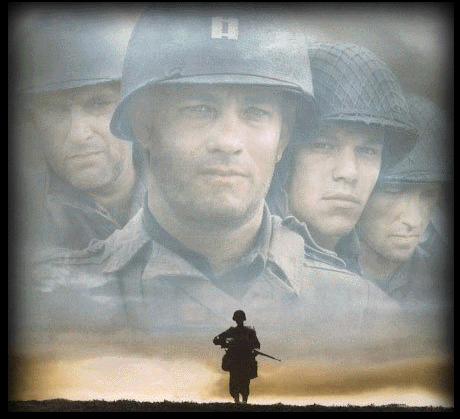 |
Captain Miller: Tom Hanks
Sergeant Horvath: Tom Sizemore
Private Reiben: Edward Burns
Private Jackson: Barry Pepper
Private Mellish: Adam Goldberg
Medic Wade: Giovanni Ribisi
Corporal Upham: Jeremy Davies
Private Ryan: Matt Damon
Directed by Steven Spielberg.
Written by Robert Rodat.
Running time: 170 minutes. Rated R (for war violence and language).
|
After my friend and I finished watching Saving Private Ryan, we discussed the film, mostly congratulating Steven Spielberg on doing an excellent job. We then went to dinner at one of the many fast food places in our area. We hanged out for awhile and then I went home. I was ready to go to sleep when it suddenly hit me. A sudden moment of clarity of what I had just seen five hours before. Images that had been stored suddenly were being replayed in my head, as if they were brand new. I sat on my bed in silence, as I watched it again. I began to feel disturbed and distraught, as I saw bodies being plugged with bullets. Arms and bodies cut in half, as soldiers become disoriented as to what was happening. Bodies flopped to the ground, as if they were suddenly turned into jello.
What my mind was showing me was the first half of Saving Private Ryan, the famous invasion of Normandy, D-Day. When my history teacher talked about the invasion, it seemed as if it was an easy task for our soldiers. The textbook never mentioned how hard and frightening it was for soldiers to survive the assault let alone conquer it.
On June 5, 1990, an armada of 3,000 landing craft, 2,500 other ships and 500 naval vessels left the English ports with one objective: storm the beach and take control by any means necessary. Meanwhile the Germans, well aware of an attack, had built a formidable defense. The waters and beaches were heavily mined and they built 12 strong points that were heavily armed with machine guns and grenades. Omaha beach turned into a killing field. When the battle was over, the United States alone would lose 2,400 troops.
In the opening scenes, we don't see a bunch of rowdy, confident soldiers that you might expect in a Hollywood movie, but instead we see young men who look as if they are going to their deaths. We see their pale white faces, as they stare long and hard at their objective. Some of them, filled with such fear, vomit as they get closer to the beach. When the doors open, they are greeted by an unrelenting hail of bullets that cut through their bodies like a hot knife through butter. Their blood and intestines coat the ocean and sand, as mortars finish the rest of their mangled corpses, not a pretty picture for anyone to go to sleep to.
The opening scene of Saving Private Ryan is a powerful and extremely graphic depiction of the invasion. It is the most accurate depiction of war that I have ever seen since Platoon and not to be taken likely.
Spielberg smartly decides to film the scene with a hand-held camera, making it more personal and putting us right in the field with the soldiers. We get close to the action, as it feels like we are seeing a newsreel. We desperately try to follow the soldiers as they try to weave through the machinegun fire of the Germans above. We try to make sense of what is happening, but we are not able to. The message is clear: It was a chaotic scene and you were an easy target for the Germans if you didn't know what you were doing. One scene showed a soldier picking up his decapitated arm unaware that bullets were sailing past him. Spielberg uses every technique in the book to film the sequence, from quick cuts to slow motion. All around we see, hear and even feel chaos. This must be what hell on earth feels like. The cinematographer, Janusz Kaminski, who shot Schindler's List, used colors that were so dull and grainy on the screen, that it reminded me of the pictures you see in the Time Life books. The colors were saturated, devoid of any life.
When the soldiers do take over the beach (notice the fading sounds of gunfire, as the soldiers begin to occupy each German gun post), Captain Miller gets an order to send his squad into German lines. Army Chief George C. Marshall (Harve Presnell) gave the order, after he found out that one mother was about to receive three telegrams that informed her that three out of her four sons were killed in action. Marshall not wanting a fourth telegram to be sent, ordered the return of her fourth son. An obvious publicity mission to show a good side of the invasion, Miller reluctantly takes the job to find and bring Private Ryan back home safely. What was the rational for the Army Chief, as all the soldiers that serve under him have parents, especially the eight men on the mission? Are they prepared to go on a rescue mission, after all they've been trained to kill Germans, not to risk their lives for a rescue operation? "This Ryan better be worth it," replies one of the soldiers.
This sets up the second act of the film, in which Miller and his men penetrate into French terrain still populated by the Germans, while they still complain about the mission. All of Miller's men have served with him before--except for Cpl. Upham (Jeremy Davies), the translator, who speaks German and French, but has never seen any military action. Upham represents the average person, who hasn't seen the horrors of war nor does he want to see it. That is why his reaction is justified when he does come face to face with it. It wouldn't be a movie if the squad found him right away, as they run into many obstacles including a confrontation with a sniper that shows how ugly war is to both sides and the innocent people who are in the middle. Unfortunately for Ryan, the arduous search and journey adds more reason for the group's hatred for him. The tension that builds in them causes even some to mutiny. When Private Ryan is found, there is even more conflict on what to do next.
Each actor is solid as no one performance sticks out of the ensemble. All of them look like they have seen alot. Before Spielberg started shooting the film, he sent all eight actors (not Damon) to a mini-boot camp. The realism of the actors can be thanked from their training.
None of the characters have any strange quirks or personalities about them. They are just normal and ordinary people like Capt. Miller, who is an English teacher. He has seen and survived events that are so unspeakable that he wonders if he has changed so much that his wife will even recognize him. While keeping the moral of his troops high, he struggles with his also, as he battles the insanity of what is happening to him. His hands tremble as he is on the brink of breakdown, but he keeps going, not of heroism, but that it is his duty.
Speilberg and screenwriter, Robert Rodat have come up with a smart film that doesn't justify war, but doesn't denounce it either. War if there ever was a reason to have it makes human beings aware how precious life is and how easy it is to take it away. War tests the limits of man to see what he really is. Does he have the courage to go kill a man and not go crazy afterwards? Images that I will always remember from the film are the color of the bloody shore, as the beach is filled with dead soldiers and fish. The arrival of the Panzier tanks as they get closer to us causing the ground to shake.
Steven Spielberg shows us the horror of war in an honest and uncompromising manner. His message is clear: War is a savagery act that humans should have never invented. It is in no way forgivable, as war gives the right for men and women have to kill one another with no reason or cause. There are no good wars. Hopefully the film will show that no person should ever experience the horrors that these characters had to go through. Maybe the public will see this film as a reason why we should stop it. Grade: A
MAIN MENU
MOVIES A-F
MOVIES G-M
MOVIES N-T
MOVIES U-Z
