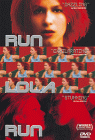
Manni: Moritz Bleibtreu
Lola's Father: Herbert Knaup
Mr. Schuster: Armin Rohde
Tramp: Joachim Krol
Written and Directed by Tom Tykwer.
Running time: 81 minutes. Rated R (for some violence and language).
|
|
Lola: Franka Potente Manni: Moritz Bleibtreu Lola's Father: Herbert Knaup Mr. Schuster: Armin Rohde Tramp: Joachim Krol Written and Directed by Tom Tykwer. Running time: 81 minutes. Rated R (for some violence and language). |
The premise of Run Lola Run sounds more like a videogame than a movie, which is great since it's pace and feel emulates it exactly. Run Lola Run is a fast, kinetic, "hold your breath as long as you possibly can" action movie. It literally makes your heart race, as you quickly jump into the action. It is so full of energy that you feel like you're running along side Lola. Actually in most scenes, you will be running right beside her.
The premise: Lola receives a call from Manni, her boyfriend, who informs her that he has botched his delivery by losing 100,000 deutsche marks on the subway. A homeless guy has taken the money leaving out any possibility of retrieving it. Manni is suppose to deliver the money to a gangster at noon and if he doesn't, he'll have to pay with his life. The form of pavement does not suit Manni, so his plan is to rob a nearby supermarket to come up with the cash.
Now when I heard this line, two thoughts suddenly jumped into my head. Numero uno is that I didn't know German supermarkets carried that much money (or maybe 100,000 deutsche marks is not as much as I think it is). And the second is, why doesn't Manni just rob a bank?
Lola pleads for him not to and offers a second alternative. Lola promises that she can come up with the money. Manni reluctantly gives Lola a chance to get the money before he acts on his desperate plan. Lola armed with nothing but her mission has twenty minutes to achieve her goal. Lola begins her run, thus the title.
Accompanied with a catchy and mood setting techno soundtrack, we follow Lola on her adventure, as she uses every possible resource she can find or think of to come up with the money. Now this may not sound like an original plot, but Tom Twyker, the director and writer, gives a new and fresh perspective of how to convey the action by giving us three possible scenarios of Lola's quest. It is almost like the director has asked us to pick out the version we like the best. Everyone then leaves the theatre happy unless of course you hated all three.
Each scenario is populated with the same people and takes place in the same locations, but with small differences that change the outcome. The idea creates involvement from the audience, as it draws them in analyzing how one scenario differs from the other and what has caused that difference. In all three, Lola basically follows the same route, meeting the same people, as her first stop is her father's bank. Meanwhile, Lola's father (Herbert Knaup) is having a dilemma of his own, as he is informed of some interesting news from one of his coworkers. Throughout each scenario we are treated with shoot-outs, robberies, car crashes and the classic scene of a vehicle and a plane of glass being carried across the street.
What we learn from each scenario is the power of our actions and how they can affect another so easily. A word or an action can change a person's life drastically from winning the lottery to going bankrupt and committing suicide. What is that chaos theory: A butterfly flaps its wings in New York, causing a typhoon in Japan.
Our heroine Lola, played by Franka Potente, is like the pink Energizer Bunny filled with an infinite amount of power and energy, as she sprints across the city blocks without a hint of fatigue. Her fiery red hair blows through the wind, as her athletic body weaves and hurtles through any obstacles. Like a superhero, she also has superpowers (how odd that may sound). Lola has the ability to give a yell that can deafen people temporarily and break glass. Manni (Moritz Bleibtreu) on the other hand, plays the damsel of distress for most of the movie, as he is powerless throughout the movie. He spends his time waiting for Lola and yelling at people who owe him money. Manni doesn't know what to do nor does he know how to stop his execution. Run Lola Run is a rare movie in which the roles are reversed. The woman is in charge, as she doesn't need anyone to tell her what to do. Instead of it being the man, it is actually the woman who has all the answers and is leading the way to safety.
In-between the three scenarios, we see the couple lying in bed talking about their life and love for each other. The purpose of these "intermissions" is to get a chance to catch our breath and to get the audience to see how the characters feel about each other. Despite these small scenes, we really don't get to know these characters at all, but we don't need to anyway.
Run Lola Run is a visual movie filled with animation, slow-mos, split-screens, black-white and every other aspect of technical film element they teach in school. Each shot is filled with life and energy. One of Tykwer's creative ideas is the segment titled "Now and Then," in which he singles out minor characters on the screen and uses just a few startling flash-frames to foresee their entire lifelines. It is interesting how their lives can be easily affected in each scenario.
The music of Run Lola Run not only serves as the pacing for the movie, but also conveys the theme of the movie. Life is repetitious, but very exciting and can change in an instant.
Run Lola Run is in a sense a true action movie as it doesn't slow down to explain the events that unfold. It is always moving as Lola keeps running. At 81 minutes, the movie runs at a perfect length. Grade: B
MAIN MENU
MOVIES A-F
MOVIES G-M
MOVIES N-T
MOVIES U-Z