Matsuji: Akira Takayama
Kana: Tamlyn Tomita
Kanzaki: Cary-Hiroyuki Tagawa
Directed by Kayo Hatta.
Written by Kayo Hatta and Mari Hatta.
Running time: 110 minutes. Rated PG-13 (for sensuality).
|
|
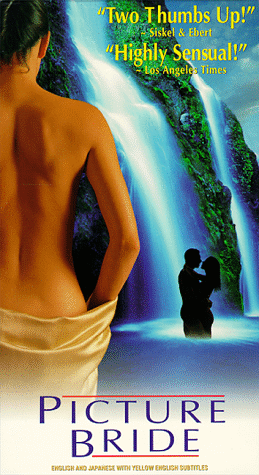
Riyo: Youki Kudoh Matsuji: Akira Takayama Kana: Tamlyn Tomita Kanzaki: Cary-Hiroyuki Tagawa Directed by Kayo Hatta. Written by Kayo Hatta and Mari Hatta. Running time: 110 minutes. Rated PG-13 (for sensuality). |
I can only imagine how it feels to marry a person you know nothing about. What feelings does a person go through? Fear. Wonder. Jubilation. Sadness. How does one feel when they are about to meet a person that they may love or hate? How does one cope that he or she will be living with their new spouse forever?
The Picture Bride gives us a glimpse of one woman's feelings, as she has been arranged to marry a man in Hawaii. Her grandmother sets up the marriage. The future bride is Riyo (Youki Kudoh), who is a sweet, innocent and young girl. Riyo has been forced to leave Yokohama, Japan, under a dark cloud, as both of her parents have died of tuberculosis.
She leaves Japan in the search of a better life, as everyone else shuns her. She has never meet nor have any knowledge of the man that she is going to wed, but she is filled with hope. Her conclusions of him can only be obtained from the photograph of himself and some letters describing him given to her by her grandmother. When she goes to Hawaii, Riyo becomes one of the more than 20,000 young women, who have made the same journey between 1907 and 1924, in hope for a better life with their new husbands.
When she arrives and meets her newfound husband, she is surprised and mortified at what she sees. The man in the picture is young and handsome, while the person standing in front of Riyo is old (about his 40s) and tired. He is much older than the man in the photograph. The man looks like the father of the person in the picture. The marriage is a huge contrast, as she is only 16, more than half his age. At first she thinks it is a mistake, but the man informs Riyo that he sent the only photograph he owned and couldn't afford to get a recent picture. Her shock runs through the whole scene, even after the wedding.
The man she marries is Matsuji (Akira Takayama). He is a sugar cane worker, as his hands are rough and dirty, his body looks worn and badly tanned and his face is bronzed by the sun. It seems he has worked in the sugar cane fields ever since he was born. He has saved for years to pay for his bride's passage. His eagerness in meeting his bride shows during his wedding night, as he moves too quickly and roughly. She bites his finger in defense and quickly hides under her blanket, only peeking out at him after he gives up and is asleep.
Riyo soon learns that life in Hawaii is centered on work, long and hard work. It doesn't take her long to find out that she hates the situation she is in and wants to go back. She decides to save enough money to reimburse Matsuji and buy her passage back home, but Riyo finds out it will be a long and arduous task. Her day of toiling in the fields nets her only 16 cents a day. It is hopeless for her, as it will take years to get back to Japan. He shows her the sea, visible over the tops of the young sugar cane plants, and tells her that they grow so quickly that soon they will be able to see only the sky. It is his way of telling her that she will eventually forget the notion of returning back to her home.
During her stay, Riyo makes a friend, Kana. Kana is played by Tamlyn Tomita, who's most famous role is from The Joy Luck Club. Kana is a beautiful woman, who is married to Kanzaki (Cary-Hiroyuki Tagawa). Kana informs how Riyo that she should be happy: "I thought I was lucky to get a handsome man for a husband, but he beats me. You are lucky to have a kind husband." Their relationship grows, as they do laundry in the evenings to make extra money.
Picture Bride was written and directed by Kayo Hatta, along with her sister, Mari. The idea for this movie was sparked from their grandmothers, who came to Hawaii from Japan. Unlike the film, they were not picture brides, but the idea came from the stories passed down through the generations by the descendants, who were picture brides.
The cinematography is wonderful, as we see the lush and beautiful landscape of Hawaii, including the water, which is clear and inviting. It was shot on location in Hawaii (in actual sugar cane fields). They got to film it just before it was plowed over by the owners, who wanted to make it into a golf course.
The relationship between Riyo and Matsuji grows when Matsuji takes Riyo to a hidden waterfall. During their trip, Matsuji shows the beauty of Hawaii. They grow more intimate, as Riyo finally sees Matsuji as her husband than a stranger. Slowly, Matsuji begins to win her friendship and trust.
Riyo and Matsuji relationship isn't the only event in this movie. Picture Bride takes time to show the culture and the bond that has developed between the workers. They past the time by singing songs as they continue their arduous work in the unrelenting hot sun. The film shows us the tension between the Japanese and their Filipino co-workers, all overseen by a Portuguese field boss, who in turn hates his Scottish overseer. The tension increases when the fields are on fire, as it destroys some fields and some lives too. In the end we realize, the film is not of sadness, but of hope.
Picture Bride is a film about how we became this melting pot that we call America. The film shows the hardship of those early generations, but we know that it happens to all settlers. We can take comfort though because we already know the end. We know what happened to their children and grandchildren, as they are the ones who are telling these tales. Grade: B-
MAIN MENU
MOVIES A-F
MOVIES G-M
MOVIES N-T
MOVIES U-Z