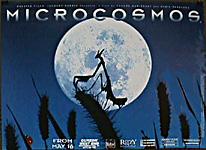
A Documentary Written and Directed by Claude Nuridsany and Marie Perennou.
Cinematography by Claude Nuridsany, Marie Perennou, Hughes Ryffel and Thierry Machado.
Running time: 77 minutes. Rated G.
|
|
Narrated by Kristin Scott Thomas
A Documentary Written and Directed by Claude Nuridsany and Marie Perennou. Cinematography by Claude Nuridsany, Marie Perennou, Hughes Ryffel and Thierry Machado. Running time: 77 minutes. Rated G. |
Microcosmos ventures into a world we may think we know. Microcosmos shows us a world that is really as cosmic and foreign to us, as the universe. It is a world not far from our eyes nor distant for our feet. The lucky inhabitants of this exotic world are insects. The world of insects is a vast and varied race, as there are more than one million species known worldwide and at least three million species that remain unknown to science. We can learn a thing or two about survival from these miniscule creatures for they have much to tell. Insects were here before we arrived and will probably remain long after we've gone. They continue to go about their daily routine without any knowledge to our existence or the world above them. Do they even care?
The only people who seem to be fascinated with insects, besides biologists, are children. Actually, if you think about it, biologists are the "grown-up" version of children. Children are much more curious and apt to experiment than adults. They are like explorers, as they spend their time on their hands and knees watching these "alien" creatures. They are close observers of insects than adults, who find them more of nuiscane. When was the last time you saw an ant and admired its ability to carry three times its weight despite having such a fragile body.
Microcosmos tries to help put back that wonder we had with them, when we were kids. The makers behind Microcosmos are two French biologists, Claude Nuridsany and Marie Perennou, a husband and wife team. The making of this film was a long and tedious process that took fifthteen years researching the material, two years constructing the equipment, three years filming over fifty miles of footage and another six months of editing. As a result of their hard work, they have allowed us to peer deeply into the insect's world and marvel at the creatures we casually ignore or kill.
They set their film in an "inconspicuous and ordinary" place: a field on their farm in the Averyron, located in Southwestern France. After selecting their cast, some were more dependable performers than others, they filmed either on location or in indoor studios. They wanted to film the insects at their level, in their own environment. Unfortunately, they found their plan caused some problems, as existing technology could not help fulfill their vision.
One of their main problems was motion. How do you follow the movement of a flying insect or follow it into small holes? In order to solve their problem, they had to enlist the help of engineers with experience in weaponry to achieve their goals. Their new technology helped the film win the grand prize for technical achievement at the Cannes Film Festival.
Microcosmos is a visual movie, as the documentary uses a brief narration in the start of the movie and relies on music and sound effects to dramatize what is on the screen. The sequences in the 77-minute film do not relate either, as the directors choose images that only create wonder and curiosity. "We wanted a balance between violence, sex and sympathetic characters." said Nuridsany to a journalist. The enthralling documentary shows us a quick tour of events that can easily happen in your own backyard.
If you think about it, what is below us is like another world. I ask you to take the perspective of an insect and you'll see wonders that you never thought of. It must look like a jungle as grass and weeds cover the sun. Plants must look like redwoods to them. Rain drops look like the size of a basketball and have the destructive power of a bomb.
The documentary feels more like a PBS nature film, as its purpose is to not only entertain, but to provide an introduction to the world of insects. The documentary invites the participant to learn more information on their own, as it gives us only a taste of the experience. The documentary does not provide any factual information as we watch the sequences like voyeurs invading on their privacy. Where did these creature come from? How do they know what to do? Why does one have four legs and another has a thousand?
What I also found fascinating is how they portray the insects' behavior as humans. The resemblance is remarkable, as they show the many similarities. There is one scene where we see a train of caterpillars. The convoy reminds me of the settlers who set up a parade of wagons going west of the frontier. Unfortunately their fate doesn't turn out so well as they get into a minor problem. Microcosmos also includes scene stealing characters like the dung beetle, who tirelessly moving his treasure up a hill only to hit a snag. It is also fascinating to see how ladybugs have no sense of flight, as they clumsily fall off the leaves when a raindrop hits it.
Insects have gotten a bad rap from humans over the last couple of decades. Horror and science-fiction have often portrayed these creature, as vile and disgusting beings that are always killing humans when they aren't killing each other. The best example I can think of is the classic 1954 movie THEM, where giant mutated ants terrorize the human race. Microcosmos denounces those generalizations and shows us what insects really are like. The film does get slow and boring at times, but maybe there was a reason. Besides, not all of the creatures in the documentary have to interest me. Microcosmos is a wonderful piece of art that takes us in the daily acts of dining, loving, fighting, being born and dying. In the end, we have two conclusions: we are either a god to these creatures or a big inefficient piece of matter. Grade: B-
MAIN MENU
MOVIES A-F
MOVIES G-M
MOVIES N-T
MOVIES U-Z