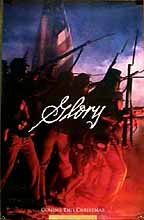
GLORY
 |
Colonel Robert Gould Shaw: Matthew Broderick
Trip: Denzel Washington
Lieutenant Cabot Forbes: Cary Elwes
John Rawlins: Morgan Freeman
Sharts: Jihmi Kennedy
Thomas Searles: Andre Braugher
Sergeant Mulcahy: John Finn
Directed by Edward Zwick.
Written by Kevin Jarre, based on the books "Lay this Laurel" by Lincoln Kirstein and "One Gallant Rush" by Peter Burchard and the letters of Robert Gould Shaw.
Running time: 122 minutes. Rated R (for violence).
|
The Fifty-fourth did well and nobly...They moved up as gallantly as any troops could, and with their enthusiasm they deserved a better fate.
-Edward L. Pierce, correspondent for the New York Tribune, to Governor John A. Andrew, July 22, 1863
The 54th Regiment of Massachusetts Volunteer Infantry, comprised of Northern freeman and escaped slaves, was the first black regiment to be recruited in the North. The man who would lead them in battle was Robert Gould Shaw, a young white officer from an affluent family in Boston. On July 18, 1863, the 54th Regiment led a frontal assault on Fort Wagner, as part of operations to capture the Confederate city of Charleston, South Carolina. The mission was a suicide, as the Confederates picked apart the regiment with their cannons and rifles. Their heroic bravery and discipline, caused both sides to realize that black men can also be viable as soldiers too. The historic battle encouraged the North to recruit other blacks to join the ranks. By the end, there were a total of 180,000 black soldiers who fought in the Civil War.
Their story is prominently portrayed in the film Glory. The idea came from Kevin Jarre, the screenwriter of Glory, noticing a Civil War Memorial featuring black soldiers in the Hyde Park neighborhood of Boston. The film is narrated through the words of Robert Shaw (Matthew Broderick), who has already witnessed the sights and sounds of the battlefield in the Battle of Antietam in Antietam Creek, Maryland.
After the battle, he is recruited to lead a newly formed black regiment. His feelings about the new regiment is skeptical, as he doesn't know if they will become the kind of soldiers he expects them to be. The volunteer's lack of training is more than made up by their enthusiasm, as they have more reason to fight in the war than anyone else. The experience becomes an education for both Shaw and his men. The new enlisted men learn the ways of becoming a Union soldier, while Shaw gains some insights into a race that he has never seen, filled with culture and pride.
Among the men who stand out of the 54th are two men opposite in behavior. One of them is Trip (Denzel Washington), an escaped slave, and the other is John Rawlins (Morgan Freeman), a gravedigger, who encounters Shaw on the field of battle. Rawlins exhibits qualities of a true leader, while Trip acts on his instincts, wild and irrational. Their reasons for joining the Union are different too. While Trip fights to get revenge on his former master, Rawlins is fighting for his children, so they can be brought up in a better world.
As the training goes on, Shaw is surprised to see how well the men react to the hardship. Their bravery is tested, as they receive a proclamation that states that any black soldier caught wearing a Union uniform will be killed. They do not flee, as the proclamation only makes them grow stronger. These men are proud to be soldiers and proud to wear the uniform. They function as a unit and even tackle the issue of racism together, as they do not receive equal pay. Why should they be paid less than their white counterparts when they do the same work? Shaw and his second in command, Lt. Cabot Forbes (Cary Elwes), see the logic in their argument and join the men in refusing their paychecks. Their action is a turning point for the 54th, as the officers and the men become one unit, trusting one another.
One of the more interesting subplots in the film is the tension between Thomas Searles (Andre Braugher) and Trip. Each represents the two different lifestyles that a black man can live. One is a freeman while the other is a runaway slave. Thomas, who was raised in the North and is a good friend of both Shaw and Forbes, experienced a good life with opportunities that any free man could have like education and friendship. Trip being a slave for most of his life did not enjoy that kind of luxury, as has spent his days in the fields. Trip has a contempt for both sides, North and South, as he believes they are both racist to people of color. His resentment also applies to Thomas. Trip calls Thomas by the nickname "Snowflake," for his betrayal of his black heritage and his attempt of trying to become more white, so he can be accepted.
Maybe Trip is correct on his assumption about the prejudice of slaves, as the movie does not hide the fact that neither side was fighting for the abolishment of slavery. The issue of state power originally caused the Civil War not slavery. The other white Union soldiers did not greet the regiment with open arms, as they laughed at their attempt to become soldiers. Their first assignment led to them being used as manual labor in South Carolina, wasting their military training.
Glory, directed by Edward Zwick, paid enormous attention to period detail, as we witnessed soldiers even playing baseball in a cut-away scene, before a battle. The battle scenes are also down well, as we witness how awkward the battle was fought. They used unconventional British tactics, as they marched slowly into the guns of the opposing army. In the middle of battle, one would find it silent, as we see both sides stop to reload their rifles.
The film's group of actors are strong, especially Matthew Broderick. I found his performance to be a surprise since I'm use to seeing him in teenage films like Biloxi Blues or Wargames. He plays a person that admits his weakness about his leadership abilities, as he blames his youth and inexperience. The film even brings up the subject of how fast Shaw is climbing up the ranks. When asked about it, Shaw amusingly jokes, "No choice. All the officers are dead." I imagine that it wasn't so far fetched from the truth.
We should not remember the 54th's fate in the Civil War, but their bravery and their story. They were looked upon as soldiers, as men. They have earned their respect and much more from their peers. Grade: B+
MAIN MENU
MOVIES A-F
MOVIES G-M
MOVIES N-T
MOVIES U-Z
