Jia-Jen: Kuei-Mei-Yang
Jia-Chien: Chien-Lien Wu
Jia-Ning: Yu-Wen Wang
Li Kai: Winston Chao
Guo Lun: Chao-Jung Chen
Directed by Ang Lee.
Written by Ang Lee, James Schamus and Hui-Ling Wang.
Running time: 123 minutes. No MPAA Rating (Mature themes).
|
|
Tao Chu: Sihung Lung Jia-Jen: Kuei-Mei-Yang Jia-Chien: Chien-Lien Wu Jia-Ning: Yu-Wen Wang Li Kai: Winston Chao Guo Lun: Chao-Jung Chen Directed by Ang Lee. Written by Ang Lee, James Schamus and Hui-Ling Wang. Running time: 123 minutes. No MPAA Rating (Mature themes). |
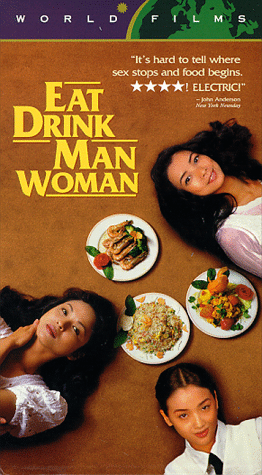
Eat Drink Man Woman is simply about relationships. Relationships with our spouses, our lovers, our family members and our friends. The film focuses on two Taiwanese families, who are very close to each other and how their lives about to change.
However, it's not the only theme in the film, as food becomes a very important role to the film. Food is viewed the same way as Tampopo or Like Water for Chocolate, where it becomes an entity itself, having mystical powers and how it can be just more than filling our stomachs. Food can be used to express our emotions if we can't express them in words or just too scared. It can even state the role of society. For instance, what can you deduce about a family or a population who constantly eats fast food?
Food in the film plays the role of the initiator. The characters can't express themselves unless they're around food. The announcements are always made at the dinner table instead of the living room or on the phone. It is almost like a catalyst.
The movie begins with a retired master chef, Tao Chu (Sihung Lung). He is preparing what looks like a banquet, as we witness dish after dish being prepared from scratch. Regardless of their complexity, Chef Chu creates them with artistry, grace and efficiency, as if he could do it with his eyes closed. Such a craft takes years to learn and unfortunately, is taken for granted nowadays. There is one interesting sequence in the montage where he prepares a chicken dish and uses that soup as the next ingredient for the next dish. Another crowd-pleaser is where he shows us how to make the small dumplings that we all come to know and love. The display is truly dazzling and appetizing. It leaves the viewers, who stay to watch and not go out to a restaurant, hungry and wondering when their last meal was.
It turns out that all that food is really not meant for a party, but a small dinner consisting of four people. It is Sunday and it is time for the customary Sunday dinner with his three daughters. Unfortunately, the daughters do not seem to be enthusiastic and eager about it as we are.
The oldest, Jia-Jen (Kuei-Mei-Yang), is unmarried, religious and a chemistry teacher in her late twenties. The middle daughter, Jia-Chen (Chien-Lien Wu), is a beautiful thriving and successful corporate airline executive whose career comes before all else. The youngest, Jia-Ning (Yu-Wen Wang), is a twenty-year-old student who works at a Wendy's fast food joint. All three daughters are single and trying to find companionship.
All four of them live in the same house, though we get the feeling that they hardly see much of each other. The Sunday dinner is a way for all of them to meet and reacquaint themselves, but that seems to have worn out its welcome also. His daughters are independent and seem to enjoy their lives when they are not home, well most of them.
Chu on the other hand is left with an empty house. He is a widow and spends his time keeping busy with day to day chores, including washing the families' clothes. Once the provider of the family, he has inherited the role of the nagging parent that wakes them up in the morning and reminds them what is good for their health. He looks as if he has nothing to do. He seems so lonely that he has no trouble taking calls from his old workplace. From time to time he arrives and like Superman, saves the day by fixing any problems that arise. Chu is also facing the daily grind of being old. He has lost his sense of taste and suffers from a bad back. His health becomes one of the main concerns during the film.
Eat Drink Man Woman examines their lives and how no one really knows each other. Everyone seems to be living in a lie, yet nobody knows because of their lack of communication. They seem to find more comfort with their friends than their family, especially Jia-Chen, who confides most of her problems to her ex-boyfriend. Despite the dreary description of the plot, Eat Drink Man Woman is really humorous and uplifting. What makes it so enjoyable is the many twists and turns we witness from each family member, as they change their lives completely. Each character goes through a complete reversal from what we witnessed in the beginning.
The last point I want to mention is the social critique the film examines on the modernism of Taiwan. Chu's style of cooking and craftsmanship has been forgotten. His skills in the kitchen and reputation is not respected either, as the younger chefs pay no attention to him. As long as it tastes good, it doesn't matter how it is prepared. This is one of the reasons for his departure from the business. Jia-Ning's job at Wendy's is another point of how Western society has become part of Taiwan's culture.
For those people who saw Lee's previous film The Wedding Banquet, you will see some familiar faces. The role of Chu was written for veteran performer Sihung Lung in mind, who played the father in The Wedding Banquet. Also returning from The Wedding Banquet are Winston Chao (a co-worker who draws an interest from Jia-Chen) and Ah-Leh Gua (the obnoxious Mrs. Liang who comes by the house to converse with Chu).
The film really takes a life of its own as we are quickly sucked into their lives. We really feel like a part of the family, as we are an active participant and not a passive witness. Our reactions to certain events are the same as the ones the characters give in the film. Ang Lee wields the film the same way Chu cooks, with experience and heart. Grade: A-
MAIN MENU
MOVIES A-F
MOVIES G-M
MOVIES N-T
MOVIES U-Z