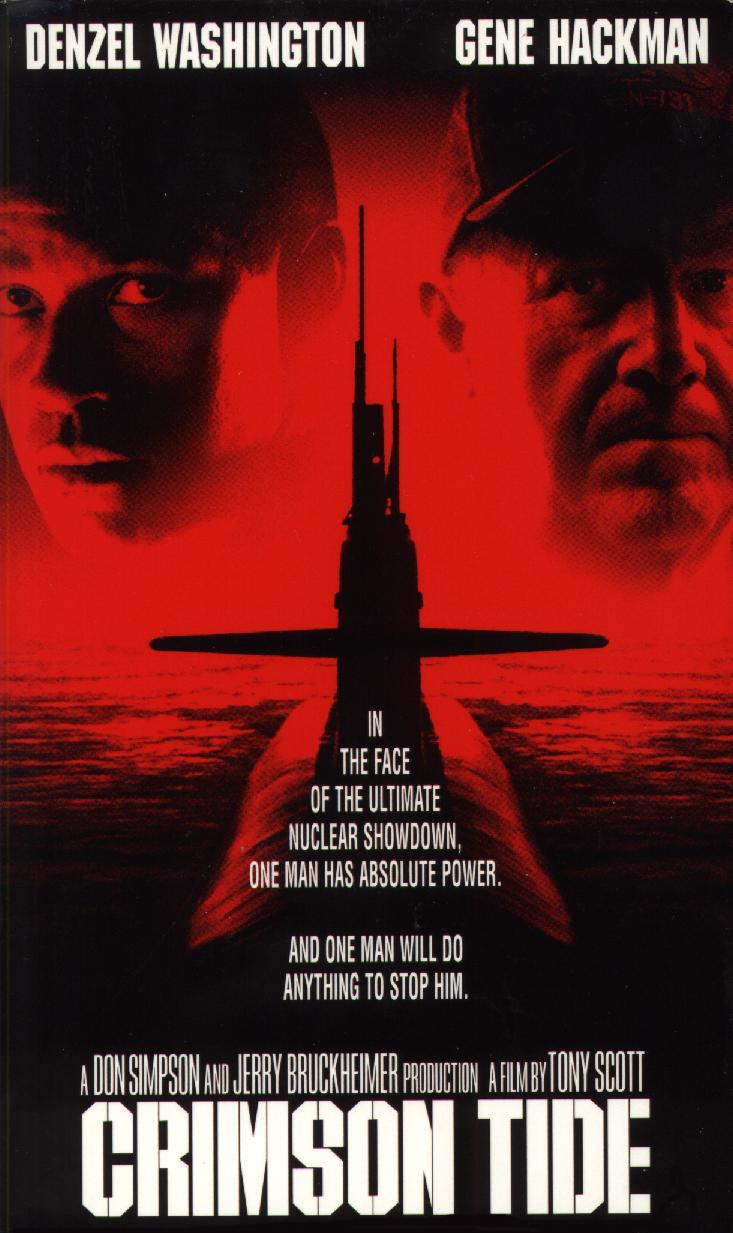
Captain Frank Ramsey: Gene Hackman
Lieutenant Zimmer: Matt Craven
Cob: George Dzundza
Directed by Tony Scott.
Written by Michael Schiffer.
Running time: 116 minutes. Rated R (for strong language).
|
|
Lieutenant Commander Hunter: Denzel Washington Captain Frank Ramsey: Gene Hackman Lieutenant Zimmer: Matt Craven Cob: George Dzundza Directed by Tony Scott. Written by Michael Schiffer. Running time: 116 minutes. Rated R (for strong language). |
What is intriguing about Crimson Tide is that it operates on two extremely opposite levels. It is a clever script by Michael Schiffer that substitutes as both an action adventure submarine movie and an intellectual battle between the captain and his second-in-command.
The two primary adversaries are Lieutenant Commander Hunter (Denzel Washington) and Captain Frank Ramsey (Gene Hackman) both intelligent men who believe they know how to handle the situation that arises. What is that situation? Stay tuned.
Captain Ramsey is an old-school, strong but stubborn captain and has made the sea part of his whole life. He has trained under Admiral Hyman Rickover, who is coincidentally the father of the nuclear submarine, and is nearing the end of his active duty. Ramsey, known for being harsh on subordinates, is also famous for his Jack Russell terrier that is allowed to go to the bathroom wherever he pleases.
Then there is Hunter (Denzel Washington), a family man who is being interviewed for Lt. Cmd. He is sharp and intelligent, and strikes a good impression on Ramsey. His impression lands him the job of second-in-command of the powerful nuclear sub, the Alabama.
In the beginning, we learn that Ramsey is a master of deception, as he comes off friendly, while masking deeper darker suspicions. We find out that he runs a tight ship and does not tolerate insubordination. Does that make him the villain of the picture?
The crew of Alabama has been called to action to quell a situation in the former USSR. A nuclear threat has been discovered and the safety of world has been jeopardized. The threat of nuclear war has always frightened the public, as there is new true winner. It is a war that can end in a second, causing nothing but mass destruction and death. The threat arises in Crimson Tide, as a group of Russian rebels are trying to take over a base that stores nuclear missiles. The United States retaliates by sending their nuclear submarines, ready to launch their warheads at a moments notice, as Ramsey stated during a briefing "We are the first and last line of defense."
During their journey across the ocean, a discussion around the dinner table arises about the subject; Hunter strongly voices his opinion by saying, "In my humble opinion, in the nuclear world the true enemy is war itself."
These words intensify the relationship between Ramsey and Hunter, as they form the basis of their disagreement. During a fire in the submarine's galley, Ramsey chooses that moment to order an onboard drill. Ramsey asks Hunter if he made the right decision. Hunter disagrees and said he would have attended to the fire first, before calling a drill. Ramsey says he saw the fire as an opportunity to test the ability of his men to function under chaotic conditions. He then adds, while Hunter is free to disagree with him, Hunter should never do so in front of the enlisted men: "We're here to preserve democracy, not to practice it."
A coded message arrives confirming the Rebels capturing the base. The Alabama has no choice but to go on full-alert and has received orders to launch a pre-emptive strike with their missiles. Being a submarine movie, the Alabama is suddenly engaged in a battle with an enemy sub. Between the exchange of missiles, the Alabama is hit and its radio is temporarily disabled, but not before an incomplete message has been received. Now a question is asked, what did that message contain? Was it the orders to stop the launch? Have the rebels been captured?
The Alabama, cut off from its chain of command, has to assume that they are the only deterrent to the Russian attack. The captain decides to seize the initiative and order the launch as scheduled. Unfortunately, he can do that only if his second-in-command agrees, and Hunter does not. Hunter wants to fix the communications system and reacquire the last incomplete message before he agrees with Ramsey.
This is the set-up of Crimson Tide, which observes the dangers of nuclear warfare. Despite the usual events we come to expect in a submarine movie (emergency flooding, danger of sinking below a safe depth), the movie really focuses on the conflict between these two men. Ramsey and Hunter, who are both absolutely convinced they're right, end up in a battle of wills as each man attempts to gain control of the submarine. The movie stops focusing on the Russian threat and shifts to the danger of its enemies, namely ourselves. Who is right? Is Ramsey guilty of violating protocol or is Hunter guilty of mutiny?
Ramsey and Hunter are well-matched, as each of their opinions can be justified. Ramsey is not so much a lunatic, but a man driven by orders and following the chain of command. Hunter is afraid of the implications of their actions and wants to be absolutely sure of their decision. Personally, I side with Washington's Hunter, starting a nuclear holocaust and being responsible for the deaths of a billion deaths is not something I want to do. Although, I understand Hackman's Ramsey decision as he doesn't want to leave his country unprotected.
In the end, we are left with an unclear answer, as the ending gives no clear-cut answer to who was right. It is the kind of movie where it leaves us entertained, but also allows us to ask the question ourselves and discuss it over a cup of coffee. Grade: B+
MAIN MENU
MOVIES A-F
MOVIES G-M
MOVIES N-T
MOVIES U-Z