THE CELLULOID CLOSET
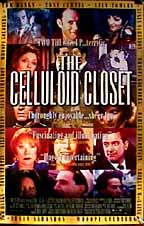 |
Narrated by Lily Tomlin and featuring Tony Curtis, Whoopi Goldberg, Harvey Fierstein, Gore Vidal, Paul Rudnick, and Shirley MacLaine.
A Documentary Directed by Rob Epstein and Jeffrey Friedman.
Written by Rob Epstein, Jeffrey Friedman and Sharon Wood, based on the book by Vito Russo.
Cinematography by Nancy Schreiber.
Running time: 102 minutes. No MPAA rating (for talks on sexuality).
|
The Celluloid Closet informs us that homosexuality has been a theme in movies since its birth. The reason why we don't realize it was that the writers did a great job masking it from the audience. If you didn't specifically look for it, it would never occur to you that the character on the screen was gay. The Celluloid Closet shows us how many times we were fooled and how many times the executives of the studios were too.
Many themes, such as homosexuality, were not welcomed in the movie industry thanks to the Hays Code and the groups that enforced them like The PCA (Production Code Administration) and The Legion Of Doom. The Hays Code, created by Will Hays, who was head of the MPAA (Motion Picture Association of America), was the first formal production code that listed the do's and don'ts. The Hays Code banned a variety of topics including sex perversion, miscegenation, explicit violence, alternative social behavior, unpunished criminal activity, and even the depiction of men and women in bed together. The Code also excluded the use of words like "damn," "hell," and "nuts."
Hays found heavy support from the Church and formed two enforcement bodies, the PCA and The Legion Of Doom. The PCA appointed Joseph Breen, who was a colorful character, an ultra-conservative anti-Semitic Irish Catholic, who observed that "lousy Jews, the scum of the earth", ran Hollywood. The Legion of Decency was founded in 1934 by the Episcopal Committee on Motion Pictures, a group of Catholic bishops and influential laymen. The Legion Office in New York rated films for acceptability, ranging from A1 (Unobjectionable for all) to C (Condemned). In many churches, the titles of condemned films were read out from the pulpit.
Yet despite the efforts of Hays, gays were present in the movies, right from the beginning, in plain view or hidden, as the documentary shows two men dancing together in a Thomas Edison short named The Gay Brothers, from 1895. Hollywood also knew who was gay and who was not, which produced many in-jokes that the audience could never understand, like John Ireland's line to Montgomery Clift in Red River: "There are only two things more beautiful than a good gun--a Swiss watch, or a woman from anywhere. You ever had a Swiss watch?"
Vito Russo conceived the idea for his book, in the early 70's, while working as an archivist in the film department of the Museum Of Modern Art in New York. He continued his research at other museums and films institutes including, the American Film Institute, the British Film Institute, the Library of Congress, and the National Archive. His book, The Celluloid Closet, chronicled the depiction of gay and lesbian characters in popular films. The book and the documentary showed Hollywood's view on gays, as they wanted to benefit from the splendor that gays added, but wanted to keep their sexuality a secret.
In those Hollywood films, gays were never depicted in a favorable way. They were either strange, evil and dangerous people or just plain wimps, a.k.a. sissies. In the documentary, playwright and actor Harvey Fierstein recalls that when he was young he always liked the "sissies." Hollywood also liked the concept of the sissy, as the documentary shows us a montage of how many sissies there were (from Peter Lorre to Anthony Perkins) and informs us that sissies made the other characters seem "more manly or more womanly, by filling the space in between." When they weren't depicted as sissies, they were shown, as confused and dangerous people. The films always showed their downfall and how their only purpose was to suffer in life. Their lives almost always ended in tragedy (madness or death), as we witness another montage of gays dying onscreen.
The Celluloid Closet surveys movies throughout its existence, showing characters, who were obviously gay, even though the movies and the audience pretended not to know. In Gentlemen Prefer Blondes, we see a musical number named sings "Ain't There Anyone Here for Love?" and shows a sultry Jane Russell dance around the gym, where the body-builders curiously ignore her, despite her efforts.
Hollywood's portrayal of homosexuals caused people, who were gay in real life, to be sucked into a desperate whirlwind of confusion. How were they supposed to feel good, when their models always seemed so confused and distraught? They became the victims. It also solidified the public's perception of how morally wrong being a homosexual was. In the end, Hollywood fueled the fire into the hate of homosexuals than help them.
The documentary also includes great interviews from people of that era, including one from Gore Vidal, as he tells a back-story to Ben-Hur. He recalls how director William Wyler hired him to do rewrites on the film. One of the film's problems was the explanation for the hatred between the two characters played by Charlton Heston and Stephen Boyd. Vidal's suggestion: They were lovers when they were teenagers, but now Ben-Hur (Heston) denies that time, and Boyd is resentful. Wyler agreed with Vidal, but decided to tell only Boyd, and not Heston, who "wouldn't be able to handle it." When we see the scene again, we see it in a different light, as we playfully enjoy what is really happening between the two actors.
Another interesting game Hollywood played was having gay men playing straight people. There's a scene from Pillow Talk in which Rock Hudson plays a straight man pretending to be gay in order to avoid an entanglement with Doris Day. Is Hudson amused by the twist?
In some way, Hollywood is still practicing this portrayal. In Philadelphia, we find a gay man, who has AIDS and has to fight for his right to exist. When will we see homosexuals in a favorable light? When will we see them as people than just plot points that drive the story?
One of the first films that I saw that dealt with homosexuality was the great Billy Wilder film Some Like It Hot. On the surface it seemed like a harmless comedy that dealt with two men, who dressed up as women to get away from some mobsters, but hidden, it contained the greatest philosophy on homosexuality. In the end, Jack Lemmon's character is trying to break up with his male lover without revealing his identity. All of them are refused. When he finally admits that he is a man, his lover replies "Nobody's perfect." It could be the greatest gay joke known to man. Grade: B+
MAIN MENU
MOVIES A-F
MOVIES G-M
MOVIES N-T
MOVIES U-Z
