Our Western society has embarked upon the 21st century of its existence. One of the facets upon which its
existence was based is equality for all. This society is the product of freedom fought hard for by the
founders who died for that freedom that should be enjoyed by all today. Like that hard fought freedom,
equality for all is another foundation for this society�s existence. Equality is yet still an area in our society
that is currently being fought for in many different areas of life. The disparity of wages for the citizens in
our society has been and is still a controversial area of imbalance. There is a gap in most areas of society
and one specifically focused on in this collaborative report is the disparity of women�s wages due to their
socioeconomic background. This report gives information about this issue and sites several cases as well
as a personal account of the pervading disparity.
Does a woman�s living environment and educational opportunities have an effect on her wage potential?
For the majority this is true and across gender lines this is definitely true. More often than not, the reward
of an education past high school is job opportunities with higher wages compared to those jobs afforded to
those without a secondary education. In the case studies examined for this report, many women from
living environments where an education was not affordable were only able to access jobs with low paying
wages. Those low wages often not enough to allow a means to pay for more than the basic necessities for
their lives. This creates a cycle with apparently �no outlet� for women from those types of socioeconomic
backgrounds. This is still a �stagnant wage cycle� dilemma in this 21st century of our society�s progress.
How does our society resolve this disparity? Can there be no resolution if there is little change in the
socioeconomic background from which many working women come from? This essay gives some case studies
of women who have dealt with this issue in varying ways and by utilizing different avenues to do so.
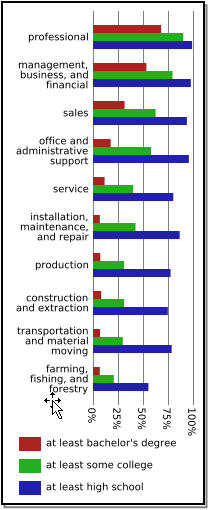
Statistical information from many different studies show that women with secondary education benefit more
compared to those women not able to get more than a high school education. The caveat to this is, in both
cases, men with the same educational background still are afforded higher wages than those women.