samizhdat organza
Fundamentalism stops a mind from thinking and invariably leads to genocide.
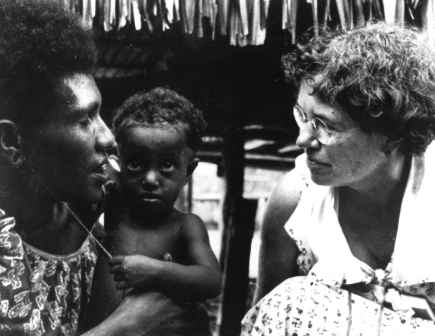
"Never believe that a few caring people can't change the world. For indeed, that's all who ever have."
- Margaret Mead
The Civil Rights Movement |
||
 |
||
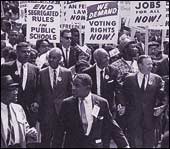
| For the 15 percent of Americans who were black, living in an American version of Apartheid meant being treated as an inferior species of humanity. Despite the prosperous economic times, black people were being denied the same economic opportunities that whites had. Add to that discrimintaion in education, housing, and social inequality it is no wonder tempers were beginning to boil. Civil Rights Acts were passed in 1960, 1964, 1965, and 1968, but blacks were still a long way from achieving any sort of equality. In August 1963 200,000 people marched to Washington D.C. demanding Civil Rights. Rev. Martin Luther King Jr. addressed the crowd with his "I have a dream..." speech, where he saw an equal and united America. | 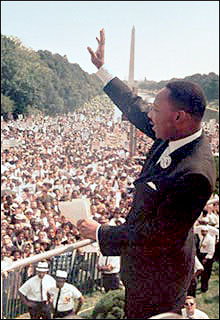 |
|
The 60's Anti-War Movement |
||
 |
 |
|
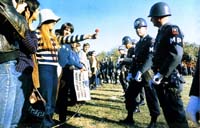
| The Vietnam war divided the country into hawks and doves. Thousands of young men fled to Canada rather than allow themselves to be drafted and sent to Vietnam. Those who remained took to the streets to protest in ever growing numbers. Protesters used many non-violent tactics to convey their message. These included teach-ins, which explained what exactly was going on in Vietnam. Also marches which drew as many as 500,000 people at one time. Draft card burnings which indicated non-cooperation with the war machine. Protests at induction centers, where attempts were made to stop people from signing up for the war. Protestors were met with police, National Guard, military police and even the army. It was not always peaceful. Many non-violent protestors were greeted with force and brutality. On May 4th, 1970, four students were shot dead by National Guard troops during an anti-war protest at Kent State University. This galvanized the student community even further, leading many to protest who had not previously. | |
|
Women's Rights Movement |
 |
|
| Tired of being treated like second class citizens, exploited economically, sexually, and wihout equal rights, they decided to break from the other protest movements and get politically active. In 1966, NOW, the National Organization of Women was founded. By 1968 women groups had multiplied, demanding the right to abortion, childcare, and an end to economic, political, educational and sexual discrimination. Women faced a daunting task, but one which absolutely needed to be taken on. It was vital to raise the consciousness of Americans taught to see them only as sex objects or mothers. | ||
Gay Rights Movement |
||
 |
||
| The gay and lesbian people of the world saw the many social changes going on in the world. Frustrated and unwilling to be treated as sub-human many gay and lesbian people rallied together to challenge homophobia. Many heroic and tragic stories would generate as a result of trying to gain equality. As with other minority groups the struggle for equality remains but some very important strides have been made toward acceptance and equality. Some important dates and historical figures include:
1948 Alfred Kinsey publishes Sexual Behavior in the Human Male, revealing to the public that homosexuality is far more widespread than was commonly believed. 1951 The Mattachine Society, the first national gay rights organization, is formed by Harry Hay, considered by many to be the founder of the gay rights movement. 1956 The Daughters of Bilitis, a pioneering national lesbian organization, is founded. 1962 Illinois becomes the first state in the U.S. to decriminalize homosexual acts between consenting adults in private. 1969 The Stonewall riots transform the gay rights movement from one limited to a small number of activists into a widespread protest for equal rights and acceptance. Patrons of a gay bar in New York's Greenwich Village, the Stonewall Inn, fight back during a police raid on June 27, sparking three days of riots. 1973 The American Psychiatric Association removes homosexuality from its official list of mental disorders. 1982 Wisconsin becomes the first state to outlaw discrimination on the basis of sexual orientation. 1993 The �Don't Ask, Don't Tell� policy is instituted for the U.S. military, permitting gays to serve in the military but banning homosexual activity. President Clinton's original intention to revoke the prohibition against gays in the military was met with stiff opposition; this compromise, which has led to the discharge of thousands of men and women in the armed forces, was the result. 1996 In Romer v. Evans, the Supreme Court strikes down Colorado's Amendment 2, which denied gays and lesbians protections against discrimination, calling them �special rights.� According to Justice Anthony Kennedy, �We find nothing special in the protections Amendment 2 withholds. These protections . . . constitute ordinary civil life in a free society.� 2000 Vermont becomes the first state in the country to legally recognize civil unions between gay or lesbian couples. The law states that these �couples would be entitled to the same benefits, privileges, and responsibilities as spouses.� It stops short of referring to same-sex unions as marriage, which the state defines as heterosexual.1 2003 The U.S. Supreme Court rules in Lawrence v. Texas that sodomy laws in the U.S. are unconstitutional. Justice Anthony Kennedy wrote, �Liberty presumes an autonomy of self that includes freedom of thought, belief, expression, and certain intimate conduct.� In November, the Massachusetts Supreme Judicial Court ruled that barring gays and lesbians from marrying violates the state constitution. The Massachusetts Chief Justice concluded that to �deny the protections, benefits, and obligations conferred by civil marriage� to gay couples was unconstitutional because it denied �the dignity and equality of all individuals� and made them �second-class citizens.� Strong opposition followed the ruling. 2004 On May 17, same-sex marriages become legal in Massachusetts. 2005 Civil unions become legal in Connecticut in Oct. 2005. 2006 Civil unions become legal in New Jersey in December. |
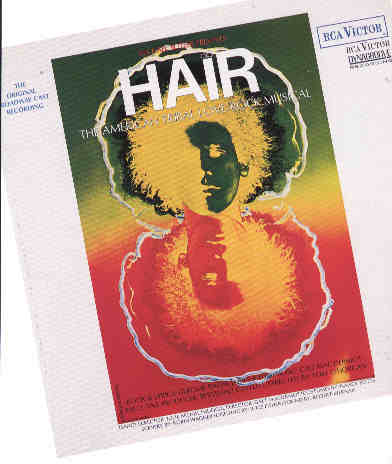
Hair New York 1968: Art Imitates Life |
|
 |
| |
| "Hair" is one of the most popular, most innovative and most controversial stage attractions of the 20th century. It has been described as a landmark musical for its power to unite and speak to, and on behalf of, so many. From its controversial opening night in New York in 1968, "Hair" has been the world-wide phenomenon, over 26 million teartergoers have seen it. Gerome Ragni and James Rado responsible for the book and lyrics and a pulsating rock musical score by Galt Macdermot, "Hair" has been revolutionary in its far social reaching influence. The musical presents a vision of a time and a place and of a restless defiant youth that burned all over the U.S. and Europe in the late 1960's. These were the years of peace marches, posters and banners against the Vietnam War, draft-card burnigns and campus uproars. Hair is one great "happening" in which a tribe of rebellious youth criticize the standards and moralities of America. The audience follows the tribe of young people celebrating their brave, heroic spirit and virtue through rituals in song and dance. It is a transforming experience. | ||
| A delightful, "hairy" experience! This musical is about what makes America great. Not war, not greed, not fascism nor out-moded religiosity and fundamentalism, but rather the freedom to go against the grain and challenge the status quo. One size does not fit all.
For those of us who enjoy freedom and democracy, it is important to remain vigilant and ask some difficult and vital questions regarding our civil liberties and freedoms. Especially if they are threatened or if there exist imposed infringements upoon them regardless of the reason. Questions must be asked, in order to safeguard and protect our civil liberties and freedom. To question authority, and have the courage and intellectual latitude to make an honest inventory and assesment of ourselves and our nation and culture is key in a free society and democracy. Fundamentalism does not allow for this nor any thought processes that run counter to the preordained dogma and one dimensional view of the universe. Those who may oppose this system face grave consequences and are succinctly rejected and become the "new enemy". Fundamentalism is an effective tool in the game of conquest. It is this very point which explains why it is used, given its ability to divide and conquer people. It takes advantage of people's prejudices, fears and hatred. It is easier to rule a divided group than a unified one. It is very easy to manipulate people who do not ask critical questions about the dogma they so fervently believe in and those that do question, are quickly punished and discredited and regarded as heretical, "the voice of the Devil..." and other such nonesense. This serves as an example to others who would risk any similar dissention and face being ostracized. Free from scrutiny or criticism this internal mechanism which might imply, "Do not challege authority" or "It is so because I say so" or "We will go to war because 'God' wants us to" allows such a system to run roughshod over peoples rights and freedoms. This quality is inherent in a fundamentalist system and helps to perpetuate and police the system's structure for liabilities as Franz Fannon discusses in Wretched of the Earth- a very clever machine. Any power structure, be it a government or an organized religion, utilize such tactics, merely to serve its own selfish ends. Ironically, people are ensnared by their own prejudices and fears, which in the end, give power over to the fundamentalist structure at the expense of their own freedoms. Often finding out that it is too late that they too become victimized in the final analysis. A dramatic example of this can be evidenced in the mass suicide of the members of Jonestown Massacre or in Nazi Germany. It is vital to understand and to acknowlege the possibility that people in power, want more power and certainly their methodology must be scrutinized if, in fact, they do represent the people they govern. The corner stone of critical thinking is to question authority and to call in to question those in power. Fundamentalism is a threat to personal freedom and democracy, an invidious tool which helps to divide and weaken our civil freedoms. After all, a theocracy does not need to bother with an election process. "God" is making the decisions in a theocracy so says the rulers in a theocracy who are ultimately making the decisions. It is for this reason that those who seek absolute power desire and embrace this rhetoric and methodology. We are promised a country, "By the people, for the people...", not for the wealthiest, the most powerful, the most influential corporation, nor is it for an exclusive caste of "high born oil-barons" lords of great manors. No! Neither is it tyranny of majority, but a place where the minority feels safe and enjoys the same freedoms and privilege as the majority it lives in. At the very least, one should have equal access to opportunity. We have the unique gift of freedom, that too easily can be taken from us unless we remain vigiliant and question the powers that be and are mindful of their tactics and motives. How soon they forget. Many of the freedoms we enjoy today, regardless of party affiliation, exist not because they were issued from above, but because many brave untraditional, non-conformist Americans fought for them; not with guns and bombs, but with peaceful, non-violent methods. Now more than ever, we need this spirit of determination and courage to rage against those who would steal our freedoms in the name of "security" or "religion". They are meant to frighten us and appeal to an emotional, non-intellectual place of thinking. It is dangerous to be ruled by passions without critical rational thought. There are those who would like nothing more than to revert to a rigid and controlling form of government. There are elements in our society that would be delighted to enslave the world if given the chance. Do not give it to them! It seems they are often quoting our founding fathers to influence us. Well to quote one of our founding fathers, Benjamin Franklyn says regarding home security, "Those who give up freedom for security deserve neither". It is now, as it was then. They do not want you to have freedom. They gain through your loss. They trick the foolish sheep among us, through double-speak, sound-bytes and by way of smoke and mirrors. It is incumbent to those who can see, "What's really going on" to make the right move, the right action and educate others. We have an enourmous resource to draw from to counter them. As renowned sociologist Margaret Mead said, "Never believe that a few caring people can't change the world. For indeed, that's all who ever have.". The action of a few people, however small the action may seem, can have a lasting and profound effect. Please visit some of the sites below. Viktor Frankl an incredible human being, survivor of the Holocaust, who despite everything maintained his humanity and dedicated his life to helping people and educating about the dangers and potentials of man's cruelty to man. An excellent web-site which provides the key elements of Frankls vision and social exploration. The Joseph Campbell Foundation is another source of great inspiration and conveys a unique perspective on what it means to be a human being in modern times. Both are worth checking out. |
 |
|
 |
Human Rights Campaign: Get Involved Now!