Interesting Engineering Problems
Created : February 2nd 2004, Monday, 15:15, Ankara
Introduction
Here I put engineering problems that are interesting. It also serves as a
database of essential knowledge (that I usually forget).
Click here to see how to peroform unit vector differentiation in spherical coordinates.
Polar Coordinates
Source: Engineering Mechanics Volum 2
Dynamics SI Version, Third Edition, J.L.Meriam, L.G.Kraige, 1993, John Wiley
& Sons, p.67-68
In polar coordinates the particle is
located by the radial distance r from a fixed pole and by an angular measurement  to the radial line. Polar coordinates are
particularly useful when a motion is constrained through the control of a radial
distance and an angular position or when an unconstrained motion is observed by
measurements of a radial distance and an angular position.
to the radial line. Polar coordinates are
particularly useful when a motion is constrained through the control of a radial
distance and an angular position or when an unconstrained motion is observed by
measurements of a radial distance and an angular position.
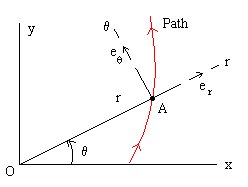
We express the location of the
particle at A by the vector
r = r er
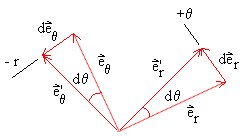
---to be continued---
Spring-Mass Pendulum Problem
Related Field: Dynamics
---coming soon---
Bomber Problem
Related field: probability
Source: Mathematical Modeling Second
Edition, Mark M. Meershaert, Academic Press 1999, page 268, problem 11
Problem statement: A squadron of 16
bombers needs to penetrate air defenses to reach its target. They can either fly
low and expose themselves to the air defense guns, or fly high and expose
themselves to surface-to-air missiles. In either case, the air defense firing
sequence proceeds in three stages. First they must detect the target, then they
must acquire the target (lock on target), and finally they must hit the target.
Each of these stages may or may not succeed. The probabilities are as follows:
Air Defense Type Pdetect
Pacquire Phit
Low
0.90
0.80 0.05
High
0.75
0.95 0.70
The guns can fire 20 shells per
minute, and the missile installation can fire 3 per minute. The proposed flight
path will expose the planes for one minute if they fly low, and five minutes if
they fly high.
(a) Determine the optimal flight
path: low or high. The objective is to maximize the number of bombers that
survive to strike the target.
(b) Each individual bomber has a 70%
chance to destroy the target. Use the results from part (a) to determine the
chances of success (target destroyed) for this mission.
(c) Determine the minimum number of
bombers necessary to guarantee a 95% chance of mission success.
(d) Perform a sensitivity analysis
with respect to the probability p=0.7 that an individual bomber can destroy the
target. Consider the number of bombers that must be sent to guarantee a 95%
chance of mission success.
(e) Bad weather reduces both Pdetect
and p, the probability that a bomber can destroy the target. If all of these
probabilities are reduced in the same proportion, which side gains an advantage
in bad weather?
Delphi 5 code to find solution via
simulation coming soon...
Rotation Matrices
---coming soon---
Quaternions
---coming soon---
Solution of 2nd Order, Linear
Ordinary Differential Equations
---coming soon---
Properties of the Differential
Operator
---coming soon---