Collaborative
Ethnography
Jennifer Bridges, Samantha Beaman,
Mary Higgins
Anthropology 120-02H
Our collaborative ethnography project is about
the piano. We are focusing on learning to play tha piano, as well
as it's importance in education.
~~PIANO~~
So lovely, so ethereal
It takes over peoples' lives.
It is Latin you know,
and this is no
surprise.
It is the very height
of
Western
Civilization,
and its beauty, subtlety, and complexity
are
unequalled in time.
Time, time, time,
It is all in the timing,
and the relationship
between notes,
the great wonder
of the notes.
The mechanical
and creative wonder of The Instrument.
by Gabe Della Fave
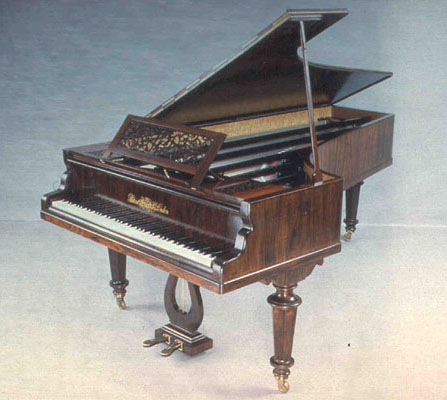
I. History of the Piano
refer to picture link
II. Importance of the Piano in
Education
Article Evaluations
III. Participant-Observation
Fieldwork
Pictures/Sheet Music
Culture
IV. Statement of Reciprocity
V. Links to other Student Pages
Article Evaluation
The Importance of Music Education
Music is a vital part of education. In today’s society, people are
often unaware of the huge influence that it has, considering music as only
fun and entertaining. In recent research, music has been found to
increase one’s potential for learning in a variety of areas. Even
subjects like math and science have shown a definite connection to music.
Some scientists have believed for quite some time that music can somehow
train the brain to a higher form of thinking (Hancock 58). In a recent
study, however, Dr. Fran Rauscher and Gordon Shaw, from the university
of California at Irvine, worked together to prove this idea. The
main focus of their research was the connection between music and “spatial
intelligence” (Pouliot 146). “Spatial intelligence” is the ability
to visualize objects or see the relationships between many different objects.
This kind of thinking has been linked to success in higher math and sciences,
such as physics or engineering (Hancock 58). Rauscher and Shaw first
began testing this theory on a group of preschoolers to see the effect
music might have on the young mind. The group consisted of forty-two
boys and thirty-six girls, ranging from ages three to five. They
were all classified as “normal” kids (Pouliot 146).
They first divided the children into four group called the “keyboard group,”
the "singing group,” the “computer group,” and the “control group” (Pouliot
146). The keyboard group was given weekly piano lessons. The
piano was chosen because it gives a visual picture of the music, and also
while playing, both physical movements and listening to music is involved,
which provides a greater understanding of music (Baney). In the piano
lessons, they concentrated on learning and understanding many different
music components: pitch intervals, coordination, finger techniques,
reading music, and playing by memory. After six months the children
were able to play many beginner-level tunes. The singing group was
taught many different popular children’s songs and also some older folk
melodies. The computer group learned how to use some software that
was made to teach children reading and math skills. The last group
was the control group, where the children were given no extra lessons outside
of preschool and was used to compare to the other groups for a conclusion
(Pouliot 146).
After six months, all of the children were tested to see if there was any
sign of connection between music and intelligence. Before any training
they were each given a test called the “Wechsler Preschool and Primary
Scale of Intelligence Revised.” The pre-training score was an average
of 9.79. On the second test, the keyboard group showed the largest
increase with an average of 13.41; the other groups scored about two points
less than this. The area in which most of the improvement was found
was in parts pertaining to spatial reasoning, like puzzles and shapes.
Also to make sure not to cause confusion about whether the effects were
long-term or short term, some children were tested right after their lessons
and others were tested days later. The group tested later did not
show any significant difference in their scores (Pouliot 146).
By using these tests, Rauscher and Shaw proved that there was a connection
between music and spatial intelligence, but why is this? Shaw created
a model of the brain on a computer to explain this that showed the patterns
that the brain uses to send messages and think. Using a music synthesizer
Rauscher and Shaw were able to map the patterns the brain used to process
music. They also mapped the patterns used for spatial reasoning skills.
The model showed them that the patterns of music and spatial reasoning
in the brain are very similar or even exactly the same. Because the
brain uses the same patterns for music and spatial reasoning, by learning
music the brain exercises the same skills that are used in spatial reasoning.
This will later help a person to understand math and science (Rauscher).
However, Rauscher and Shaw’s discovery of a connection between spatial
reasoning and music is not the only advantage of music education.
Music has proven to be a great way for people to express their emotions
and feelings. Often music, whether instrumental or by voice, is used
by people to release what is called “inner-speech". This is what
one thinks or feels deep down inside, but often can’t express into words
(Baney). By playing the piano, whether it is your own composed music
or someone else’s, it is a great way to release tension and stress, by
releasing all your creativity and energy into the music.
Another very common term today among students is the “Mozart Effect.”
In research. Gordon Shaw showed findings that proved that when people listen
to classical music, they are using the same muscles in the brain that are
used for mathematics and objective reasoning. By using
these muscles in the brain, they are exercising them, therefore, strengthening
them so that they will improve in mathematics (Begley 51). So far
the “Mozart Effect” is found to be only temporary. Dr. Fran Rauscher
and Gordon Shaw tested its effects on college students. They tested
thirty-six undergraduate students with a spatial IQ test immediately after
they had listened to ten minutes of Mozart’s Sonata for Two Pianos.
The students scored an average of 8 to 9 points higher on the test, compare
to groups who took the test without listening to music. However,
a group tested only hours after listening to the music showed almost no
improvement (Pouliot 146).
Music is proven to be one of the biggest influences on society today.
Entire cultures can be defined by the music they listen to. With
these facts, why do people today in America put such little emphasis on
music in their on education? The ancient Greek philosopher, Plato
said, “Music is a more potent instrument than any other for education”
(Hancock 58). Perhaps more people need to take a step back in time
to realize how important it is for everyone to have music in their lives.
Works Cited
Baney, Cynthia Ensign.
“Wired for Sound: The Essential Connection Between Music and Development.”
Early Childhood News. July/Aug. 1997. 17 Feb. 2000 http://www.earlychildhoodnews.com/archive/wired.html
Begley, Sharon.
“Your Child’s Brain.” Newsweek. 19 Feb. 1996: 55+
Hancock, LynNell.
“Why do Schools Flunk Biology?” Newsweek. 19 February 1996:
58-59
Pouliot, Janine.
“The Power of Music.” World and I. 13.3 (1998): 146-153
Rauscher, Dr. Frances
H. “Music Training and Spatial-Temporal Reasoning.” Artsedge
Virtual Conference: Music and Intelligence. 1997. 9 February
2000. <http://arsedge.kennedy-center.org/vc/musintel/rauspap.html>
Participant-Observation/ Fieldwork
We
went to the piano rooms in Coulter and learned/taught how to play the piano
along with a brief review of how to read music. Samantha already
knew how to read music from past experiences but needed a refresher course
in it.
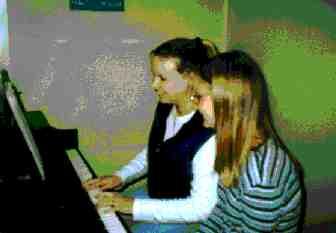 (Piano room in Coulter.
Mary teaches Samantha the beginning of the
Waltz)
(Piano room in Coulter.
Mary teaches Samantha the beginning of the
Waltz)
(Piano room in Coulter.
Jennifer explains a hard part to Samantha)
We worked on the
following piece of music:
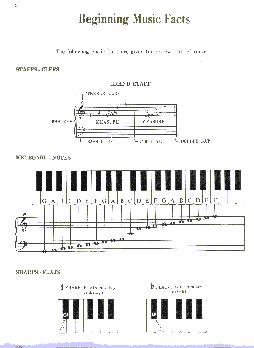
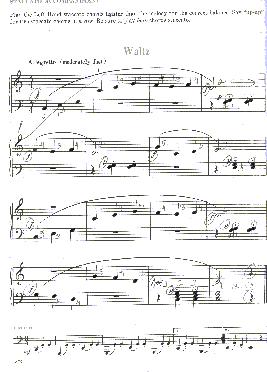
(Lesson
#1 Beginning Facts....Samantha's Review)
(Lesson #2 Waltz....song Samantha learned)
The keyboard on a piano has 88 keys. There is a treble and bass clef.
There are eleven octaves. The basic octave is a set of keys from
C to C. The basic scale of notes is from A to G. The Waltz
that Samantha was taught only consisted of quarter notes, which get one
beat per measure and dotted half notes, which get three beats per measure.
The C Major Five Finger Position for playing the
Waltz is to place
your right thumb on middle C and your left pinky finger on the C key one
octave down.
This is the Lesson #1 Mary and Jennifer had to teach Samantha because she
had forgot the basics from her early exposure to music (she took piano
lessons as a child).
There is a large number of children in our society who are introduced to
the basics of playing the piano. Many parents feel that music is
such an important part of our culture that they force their children to
take the lessons. Although significantly fewer children stay with
the lessons and carry it on throughout their adulthood, they are at some
point in their life exposed to it.
Reciprocity
Samantha was the"learner"
of the group. Jennifer and Mary taught me how to play the piano,
specifically the Waltz. We met several times and
worked on the construction of the web site, the "book report" and the actual
fieldwork. I feel that everyone contributed fairly on this project.
Jennifer and Mary knew how to play the piano very well and did an excellent
job teaching me.
Jennifer and Mary were the
teachers of the group. Together we both took turns teaching Samantha
how to play the piano. She was familiar with reading music, so the
song we taught was not a difficult task.
We three decided that this
collaborative project was most related to balanced reciprocity, meaning
an exchange took place with the expectaion of an equivalent value of goods
or services within a period of time. Jennifer and Mary gave Samantha
the knowledge of how to play the piano with the expectation of her learning
this talent and being able to put it to use.
Links to Other Student's Pages
To Christina Berry
and Courtney Friedell's web page about composing music.
To Jenny Elliot and Aaron
Anglin's web page about playing the guitar.
Created by: Samantha Beaman, Jennifer Bridges, Mary Higgins
Presented to: Dr. Philip Coyle on December 14, 2000
Last updated on: December 12, 2000