|
|
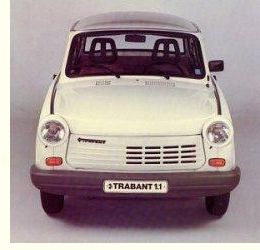
 Remember the Trabant? It was the national automobile of East-Germany. After
World War II, the existing factories of car manufacturers were forced to
make Trabants. In line with communist ideology, the car had to be cheap and
not too extravagant, so it came equipped with a two-stroke engine. Moreover,
as a showcase of futuristic design and ingenuity, its light weight allowed
it to come with a plastic body! Eventually, the engine was replaced with a
four-stroke 1.1 VW Polo, but it remained the epitome of what's wrong with
socialism: poor performance; simplistic design that has contempt for any
style, beauty, quality or class; fabricated with wasteful, inflexible,
inefficient and polluting production methods; not responding to customer
demand; etc, etc. Production finally stopped after over three million
Trabants had been produced. Demand collapsed when Germany's reunification
finally allowed people to buy other cars.
Remember the Trabant? It was the national automobile of East-Germany. After
World War II, the existing factories of car manufacturers were forced to
make Trabants. In line with communist ideology, the car had to be cheap and
not too extravagant, so it came equipped with a two-stroke engine. Moreover,
as a showcase of futuristic design and ingenuity, its light weight allowed
it to come with a plastic body! Eventually, the engine was replaced with a
four-stroke 1.1 VW Polo, but it remained the epitome of what's wrong with
socialism: poor performance; simplistic design that has contempt for any
style, beauty, quality or class; fabricated with wasteful, inflexible,
inefficient and polluting production methods; not responding to customer
demand; etc, etc. Production finally stopped after over three million
Trabants had been produced. Demand collapsed when Germany's reunification
finally allowed people to buy other cars.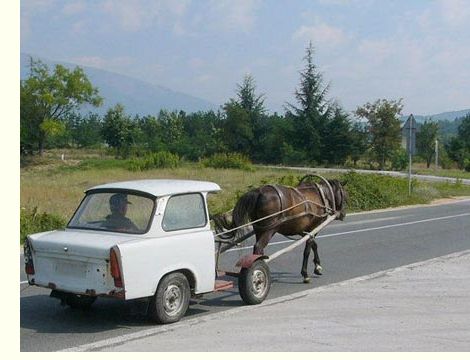 Between World War II and Germany's reunification, people who worked in the
car industry in East Germany had no choice but to work on the Trabant
project. Not walking in line with the communist doctrine not only meant
risking one's job, political dissidents were deported all the way to
Siberia.
Between World War II and Germany's reunification, people who worked in the
car industry in East Germany had no choice but to work on the Trabant
project. Not walking in line with the communist doctrine not only meant
risking one's job, political dissidents were deported all the way to
Siberia.|
|
| What's wrong with Science? |
|
FAQ 1: What's wrong with the way science is currently organized?
The question I raised is whether it's healthy for science to be funded by one single source. It looks like the Trabant model and thus raises the question whether bias is built into this model. After all, some things do get funding and other things don't. Does the way funding takes place favor any specific views? Does that influence the way science is given at school? [source] Government funds science and in the process imposes the Trabant model upon science. This model is subsequently imposed by military might and sustained by indoctrinating children from an impressionable age at school with this doctrine. [source] |
|
FAQ 2: Is this some kind of conspiracy theory?
Using the term conspiracy gave the false impression that I had said that some small and obscure group was planning illegal acts under the cloak of secrecy, to achieve some sinister goals. What I said instead is that science in the current system is intertwined with a military-industrial complex that operates on a monopoly basis. There's no secret about this, it takes place quite openly and it occurs with the support of our current legal system. [source] It's no secret at all that the military has a huge budget. It's no secret at all that government controls public school. And it's not illegal at all. That's the very problem! This situation is imposed upon us with the full force of the law. [source] |
|
FAQ 3: What made you think that science followed the Trabant model? Isn't private education and research funded privately? Isn't science independent from government? The independence of science is a myth. Facts are the huge government budgets for education and the military, that most scientists end up working in education or the military, etc. Those are the facts! There's a huge educational-military-industrial complex operating as a cartel along the lines of the Trabant model. Private schools and educational institutions work within this model to comply with its accreditation schemes, tests, qualifications, selection criteria and reference requirements for students seeking to work in specific professions. Private enterprise is to a large extent financially dependent, given the huge size of the government budgets for the military and education, as well as further government grants, subsidies, regulatory privileges, etc. Many private manufactureres and research labs supply to the military and are therefore restricted in their dealings with other parties. [source: new]
|
 Science as it's currently structured, fits into the
monopoly model, whether you seek to close your eyes for that or not. Science
is funded largely by an organization that operates on a monopoly basis:
government. Government controls huge budgets for education and the military,
where mosts scientists work. Government controls many private institutions,
such as schools and colleges, through accreditation, and many private
suppliers of military technology.
Science as it's currently structured, fits into the
monopoly model, whether you seek to close your eyes for that or not. Science
is funded largely by an organization that operates on a monopoly basis:
government. Government controls huge budgets for education and the military,
where mosts scientists work. Government controls many private institutions,
such as schools and colleges, through accreditation, and many private
suppliers of military technology.
|
FAQ 4: Shouldn't scientists be free to study, teach and research what they want?
Shouldn't educational institutions decide who to employ and train, and what to focus on?
What about academic and entrepreneurial freedom?
Isn't creativity and innovation of the essence for science? Indeed, that is the problem, the Trabant model restricts freedom, creativity and innovation. You cannot force children into a classroom and expect them to be more creative, innovative and independent thinkers as a result of such indoctrination. You cannot buy people and demand them to make discoveries on command. The command and control approach is an inferior approach. That's why the Trabant model is inappropriate. Yet, few scientists seem to object against the huge amounts of government control over their activities and against the way science is organized along the lines of the Trabant model. [source] Government determines what kind of funding goes where and will fund projects that are in line with what the politicians want. Funding isn't the only thing, there's more. Professional qualifications are recognized only if they are granted by certain institutions, so to enter certain professions, you have to speak a certain political language. It's hard to escape all this, given the compulsory nature of the education system as it's designed and enforced by government to indoctrinate children from a young impressionable age with certain ideas about politics, education, research and science. [source] |
|
FAQ 5: Aren't scientists objective and politically-neutral? Does politics have anything to do with science? It has everything to do with science. Scientists work hand in hand with government, typically supporting its every move and getting a nice paycheck in the process (talking about monetary interests), which makes it even harder if not impossible for other organizations to offer security services in competition with the military. It's time that we recognize the political view behind this for what it is. And it's time for scientists to speak out when they're being used as a mouthpiece for this kind of politics. It's time for scientists to respect the importance of this issue. [source] The education system and the industrial-military complex form a cartel that hides behind scientific independence, commercial and military secrecy to escape public accountibility. Scientists have a key role in all three areas, playing the same card all the time, i.e. that their supposed access to "secrets" of nature justified their taking of decisions without public scrutiny. It's just like the old religious elite who claimed exclusive access to god's word to justify their sole rule over society. These scientists hold the world to ransom in order to increase their power and increase the share of public funding going to education and the military without allowing people to look into what happens with this money, even worse, while claiming indemnity for the terror these weapons they develop are intended to impose on society. [source] |
|
FAQ 6: What's wrong with the military? And does this have anything to do with science?
|
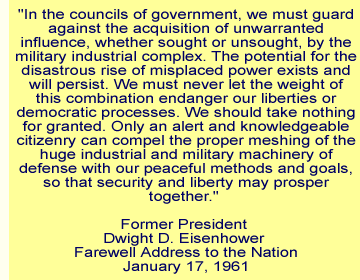 The term military-industrial complex is usually attributed to former
President Eisenhower who coined the phrase back in 1961.
The term military-industrial complex is usually attributed to former
President Eisenhower who coined the phrase back in 1961.
|
FAQ 7: Why focus on the link between the military-industrial complex and education? What do you mean with security services? What about the monopoly of money and the Federal Reserve Bank? Huge government funding also goes into the legislature and judiciary... The military operate on a monopoly basis as a conglomorate. The police, coast guards, customs and border control officers operate in the same way. There's no competition between service providers, which means security services are provided less efficiently and with less innovation that what people are entitled to. [source] I advocate that the Fed Res be phased out gradually and that instead, stock will replace money as a facilitator of trade. The fed res should gradually increase interest rates. The fed res should also widen the organizations it lends to. At the same time the fed res should increase the conditions under which organizations can borrow money from the government, looking at asset backing rather than banking licences. This will loosen the stranglehold the cartel of banks currently has over financial services. More competition will improve financial services. It will also make it more interesting for companies to offer financial services (in competition with banks), which should be supported by deregulation of banking. Eventually, the fed res will price itself out of the market, while companies and individuals will use their assets to back up developments their want to invest in, in return for stock, rather than money. Money itself will gradually loose value in comparison to stock, so people will replace their (dollar-denominated) bank accounts for "stock" accounts (either with stockbrokers or directly with companies) that allow them to make payments in shares of, say, IBM, SONY or whatever stock they feel comfortable with. [source] As globalization continues, an ever larger proportion of trade will involve multiple currencies and all the associated volatility and speculation. Instead of making deals in currency, it makes ever more sense to agree on shares of a reputable company to facilitate trade. Shares typically outperform other forms of investment, so it makes more sense to have an account in shares than in currency. For small amounts of money, it may still make sense to keep using coins, but any company should be allowed to mint its own coins, just like casinos already use their own tokens, the Post Office issues stamps, etc. Bus and rail tickets, in theory anything that's easily transferable could be used instead of government-issued coins. In the end, the assets and the prospects of the company issuing the coins constitute the back-up, just like they constitute the back-up for shares such a company may issue. In the case of coins, anti-trust and cartel legislation should be imposed to ensure that no such company (nor any government agency) will be able to unfairly exploit a monopoly. [source] Fact is that billions of dollars go into education and government raises taxes to fund a huge educational budget. So, it makes sense to look into the way tax and providers of educational services are organized from time to time, to see whether reform is appropriate. [source] I added education to this here because most scientists end up working in either education or the military-industrial complex. Thus, the way education and the military-industry complex are intertwined is an interesting issue from an epistemological perspective. From a political perspective, the complex could indeed be widened to a legislature-judiciary-education-military-industrial complex. That would of course raise even more protests that discussions here were too political, so it's better to start with bringing up the link between education and the military-industrial complex. [source] |
| The Proposed Reform |
|
FAQ 8: What do you propose should be done? I propose a Pledge for Scientists. I also propose the military to be split up into numerous parts, so that each of them competes for security services provided to and paid for directly by customers. This way, customers can choose directly what security services they want, without putting this huge political bureaucracy in the middle to patronizingly decide for people what kind of security was best for them. [source]
|
 My proposal is structural separation. That's a method that has proven to
work where unhealthy monopolies abuse their dominant position.
My proposal is structural separation. That's a method that has proven to
work where unhealthy monopolies abuse their dominant position.
|
FAQ 9: Do you want to privatize everything? Isn't commercial pressure
inappropriate in education and military matters? How can we keep the system honest? Private versus public ownership is another discussion. This here is a discussion about a split-up and more direct choice. That is inherently more in line with our rights. Furthermore, there's plenty of indications in economics that a monopoly is not the best way to go. [source] The military is currently owned by government, so if it's split up, the resulting pieces will still remain government-owned. Whether government should continue to such ownership is another discussion and I'm happy to debate that as well, but I never proposed to privatize the military and then to split things up. The fact that the military is government-owned makes it easier to split things up, compared to the scenario in which the military was privatized in its current shape. As said, I oppose the military to be privatized in its current shape. Instead, I propose a split-up. Whether the resulting pieces should remain entirely owned by government is another discussion. Perhaps some or all shares of some or all of these pieces could be sold, perhaps new shares could be issued that could be bought by investors, there are many different scenarios, but that's another discussion. [source] Ownership is not the main issue of this debate. The military could be split up and each of those pieces could still remain government-owned. Similarly, large public schools could be split up into multiple smaller ones, each remaining in the hands of the goverment. The debate is which is the best way to go. Two arguments in favor of a split up are that, when there are multiple organizations, people have choice, which is more in line with our rights, while economics also tells us this works better. Initially, tax deductions could be given to those who directly pay for the services they want, while the poor can make choices by means of vouchers. But that's a matter of implementation - right now we're discussing the virtues of the proposal in general. [source] A corporation can be either publicly or privately owned. Incorporation means that it becomes a separate entity with its own accountancy. Splitting up the military into multiple corporations provides better accountancy and accountibility. If a corporation behaves badly, it will go broke. If a corporation does a good job, rewards will come its way. Nobody was suggesting that government should NOT keep full ownership of the military before a split-up was completed. Let me repeat again, I am NOT proposing for the military in its present state to be sold off to the highest bidder. Instead, I clearly stated that the fact that the military is government-owned makes it easier to implement such a split-up. My proposal is for the military to be split up into multiple corporations that are to compete with each other for customers in all areas. Whether such corporations should issue stock and offer such shares for sale to the public, that is another discussion. [source] A split-up of the educational-military-industrial complex could start with a simple majority vote in Congress to go ahead with a restructure of existing government-owned entities into a multitude of corporations, in such a way that they can start competing for customers in all areas. Initially, government (at various levels) will continue to be the sole customer, but these corporations should gradually be allowed to offer their services to new customers, i.e. taxpayers who want to pay for their security services directly and families who want to pay for the education of their children directly. In such cases, they can deduct such costs from tax, since government no longer needs to collect taxes and pass on payments to the respective service providers - this effectively cuts out the middle-man. The poor could be given vouchers to ensure that they can also benefit from choice in the provision of such services. Anti-racketeering laws and anti-trust and cartel legislation will need to be extended to those new service providers. All this reform can take place without necessarily privatizing any of these corporations. [source] A pledge for scientists has been discussed in another thread here, but it part of the greater need for accountibility of service providers. The above legislative reform is one part of this, a second part is that indemnity provisions against liability and litigation will need to be removed (and possibly replaced by insurance coverage). Thirdly, scientists could be working on projects where weapons are developed that have as yet unknown impact (and are therefore harder to cover with insurance and prohibitive legislation), which warrents a Pledge for Scientists. [source] |
|
FAQ 10: Tell us more about this Pledge for Scientists... Should there be something like an Oath of Hippocrates for scientists? Something like: "I will work for the greater good of people, without intentionally causing harm where this can be avoided." [source] I see the Pledge for Scientists as merely a step in the right direction, since it may help scientists speak out more openly. But more fundamentally, we should look at the way science is intertwined with the way the military is currently structured. My proposal is to split up the military, so that security services are offered on a more competitive basis, with providers of security services negotiating more directly with their customers as to the services their customers want. If others see other alternatives, then at least let put them on the table and let's discuss things. BTW, here's another thing to contemplate in regard to a Pledge for Scientists. To what extent should openness be a motto of scientists? When should scientists comply with their employer's demands for secrecy, and when should they speak out? Are scientists in a special position, given that they may work on projects that could result in yet unforseen dangers to society? Personally, I think that scientists have a duty to speak out. It may be difficult to speak out for scientists who are closely involved in a specific case, as they may face heavy litigation, loss of career prospects, etc. But this is the more reason for scientists as a group to jointly speak out, against a specific political choice being made without proper discussion, under the pretence that there was scientific backing for that particular choice when in fact there isn't. The way the military is currently structured is such a choice. Scientists shouldn't act as if it wasn't. [source] Employers must become aware in advance that scientists cannot be expected to keep something secret that violated the Pledge for Scientists. If all scientists were known to abide by a certain pledge, then employers will not be able to force them to sign secrecy oaths in violation with such a pledge. [source] The pledge is one little step in the right direction and we do have a long way to go. Indeed, we need structural reform across all sectors of society. Most urgently, the military needs to be split up into multiple pieces, each of which is to compete in all areas for clients seeking security services. Clients should choose and pay for the security services they want directly. Security firms that seek to develop weapons in secrecy should be exposed by the media and by whistleblowers, which is where the pledge comes in. It's a step in the right direction, because it makes scientists think about what they're doing. The system currently selects the nerds, those who have been deprived of social contact. The system deliberately keeps children occupied from a young age with maths exercizes, to prevent them from developing social and ethical conscience. [source] [ For more discussions, see the thread: A Pledge for Scientists ] [ and Biggest issues in epistemology? ] [ For more discussions on education, see also this thread on Independent Thinking ] |
| Dealing with Public Concerns |
|
FAQ 11: Wouldn't this turn the military into mercenaries selected by popular vote? I did NOT propose for the US to tender out its defence. I did NOT propose for people to select any winner of such tendering process by vote. I DO propose a split-up of the military, resulting in structurally separate corporations to offer security services, competing for customers in all areas. Initially, government will be the main customer of these corporations. Government should spread out its need for security services over a wide range of corporations, to ensure the viability of this plurality of service providers. Progressively, tax deductions and vouchers will enable more direct provision of security services by such corporations to a variety of customers. Government as a customer will thus gradually decrease in importance, as other customers (including companies, non-profit organizations, families and individuals) proportionally take an ever-larger share of the market in security services. [source] Is an army based on compulsory conscription better than security services provided by professionals who get paid what they deserve? There's no evidence that a conscription army was superior or that compulsory conscription was beneficial. Instead, this merely seems to be a political position. Some people may prefer things one way or the other, depending on their political orientation, but that just means it could be an argument on both sides of the debate. If so, then the fact that professionalism in security services is more in line with our rights tips the balance and makes it an argument in favor of a split up. [source] Customers should decide the security services they want. My proposal is for gradual reform of the existing military, rather than instantly replacing them by mercenaries. People should decide what security services they want. If they have doubts, then they should indeed question their current service provider and consider switching to a better one. [source] |
|
FAQ 12: What if a provider of security services started becoming dictatorial and
robbed all its customers? What if a
security guard or a contractor started shooting people because that was
just what he wanted? We have anti-trust and cartel legislation to ensure that this contractor doesn't engage in unfair trade practices. We have anti-racketeering laws and more legislation like that to prevent that the contractor just did what he wanted. Shouldn't we wonder why such principles of fair trade are not applied to science and to security services? After all, we the people are the ones who provide the funding, thus in line with your reasoning, we should decide whether we wanted the Trabant model. Researchers and the education system in general don't even ask that question, they simply take it for granted that the Trabant model is the way to go. This makes it even more important for epistemologists to ask that question. [source]
|
 Competition will ensure that providers of services will have less
opportunity to deceive customers. When there's more competition, customers
can and will demand that suppliers make their offers on clear terms.
Competition will ensure that providers of services will have less
opportunity to deceive customers. When there's more competition, customers
can and will demand that suppliers make their offers on clear terms.
|
FAQ 13: Wouldn't such reform be an invitation for an invasion from abroad? An Invasion? Again, if one such organization is prone to fail in regard to the security services customers want, then those customers will switch to another organization. That is the best guarantee against inferior services. [source] The US itself faces little or no threat of invasion. Even if there was such a threat (which is a very unlikely scenario), there's no reason to believe it wouldn't be countered more effectively by a number of separate organizations, each working in the interest of their customers. A monopoly is typically less capable of responding in a timely manner, compared to organizations who are keen to show what they're worth, in an effort to gain further trust and respect of their (prospective) customers. [source] [Individually, each of these] different forces can effectively defeat a single opponent. In the very unlikely case of an invasion of the US mainland by a foreign force, a single small force (in most cases, a few airplanes and guided missiles) will suffice. [source] The revenues of some of the larger US companies dwarf the combined revenues of many nations. Any such company on its own is technically capable of putting together an army that could wipe out the military forces of smaller nations in a matter of weeks. An individual like Bill Gates has sufficient funds to, on his own, put together a military operation that could successfully take out the military forces of many countries, without the need for any national army. [source] The defense of even larger nations can be taken out in a matter of weeks, as shown twice in the case of Iraq, without any need for nuclear missiles and with minimal human casualties. While Saddam Hussein was able to put up some missile threat in the first Iraq war, all missiles were intercepted and destroyed in the air during the second Iraq war. [source] There are only two nations with the stamina to withstand a war with the US for more than a few weeks, i.e. Russia and China, and neither of them have any interest in invading the US mainland. [source] |
|
FAQ 14: What about the risk of a foreign take-over of the military? A foreign take-over is an unlikely scenario. It's like a foreign government buying up Microsoft and forcing all Microsoft staff to suddenly sell strawberries instead of software, with the unlikely agenda of subsequently jumping into the gap and capturing the US software market with their own inferior products. Would existing Microsoft customers play along with such an unlikely scheme? Most likely, they would instantly switch to another company for their software. [source] What is most likely to happen? Will there be some kind of 007-scenario, where some sinister bad guy builds an island fortress with numerous paid guards and missiles he threatens to launch against US cities, unless he gets a ransom of.., yes, one million dollars (sic) from the president? To some extent, we already have such scenarios right now. The question is how best to tackle such situations. Economics suggest that when a monopoly is split up, the entire industry grows, people get better services at lower prices, service levels, quality, innovation and overall customer satisfaction increases. In other words, security services will be provided more accurately and effectively and a split-up is the best way to go. [source] |
|
FAQ 15: What's the risk of civil unrest, street gangs and dictatorship, and generals contemplating a coup-d'etat and taking over control? Civil unrest? That's why these organizations should negotiate more directly with their customers. Who would want to pay their security service for instigating "civil unrest"? That's not in line with how people would want such an organization to act. [source] The situation we have now is that there is a single organisation with sufficient military control to prohibit other organizations to offer security services in competition. If that's your concern and if you associate that with civil unrest, then the more reason to support my proposal for structural separation. [source] |
|
FAQ 16: What if one of these corporations became so successful that it gained a monopoly position?
What if the most successful corporation merged with one or more of the largest companies?
How could we prevent such a company from holding the world at ransom? The key is indeed to prevent monopolies and cartels, hence the urgency in splitting up the military. There's no need to use force to implement such a split-up, because the military is fully owned by government. Once the military is split up and competition is established, the majority of people and organizations will acknowledge the benefits and support it, so even in the unlikely case that one company went astray and desired a monopoly position, public condemnation would suffice to make such a company go broke. It's an unlikely scenario, because a company is controlled by shareholders who will typically be convinced that, rather than exploiting a monopoly, it makes more sense to split up the company into structurally-separated pieces, resulting in a combined growth of their wealth. [source] Rumors of a merger will push up the price of shares, which initially may make it look as if the merger itself was a success. But long-term, a number of competing companies will result in more growth, compared to an industry monopolized by a single company. Informed shareholders are aware of this and will favor a split-up of a company, long before it evolved into a monopoly. Companies seek growth. A monopoly stagnates an entire industry. If a company gains so much market share that it reaches a dominant position in that market, it makes economic sense to split up that company into competing pieces, which will result in more growth of the industry in total. Overall, shareholders will support such a split-up, on economic arguments alone. The argument that it's more in line with our rights will lead to public condemnation of a monopoly, which is another argument for such a company to split up. [source] As I said, monopolies are typically creations of government. From the perspective of private enterprise, monopolies do not make sense. From the perspective of customers and the public in general, monopolies don't make sense either. Initially, regulatory pressure will assist the establishment of more competition. Once established, there will be few people who will want to go back. Those who do will typically go broke or lose in other respects. Defending a monopoly is a loser's strategy. If an industry stagnates, a company dominating a market will stagnate as well. Shareholders will therefore support a split-up, which will make the industry grow as a whole, as well as the combined value of their shares. [source] |
|
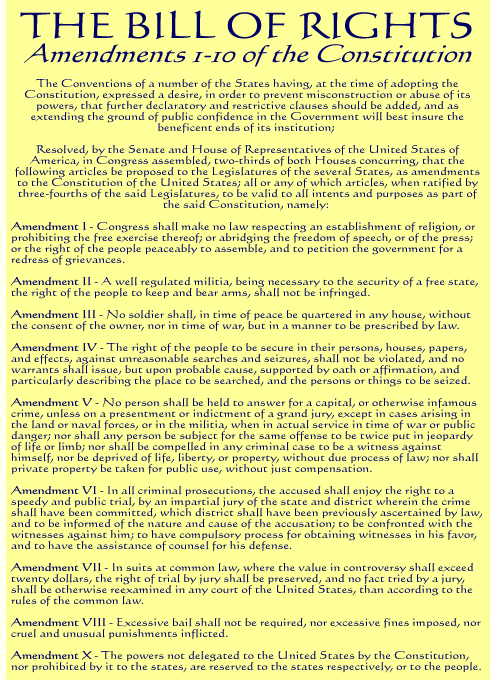
FAQ 17: Won't the only ones better off be those who are rich and can live in a nice gated community with an expensive private school and hand-picked neighbours? How can one measure whether one provider of security services is better than another one? One such measure will be the amount of compensation they offer to someone they let down. When security services are provided on a contractual basis, those who provided bad services had to pay huge amounts of money in compensation - they will eventually go broke. Other measures will be their track record, the quality and amount of equipment and staff, their presence in your area, their preparedness, the financial back-up they can count on, etc. In many respects, it's much like buying a car. You look at the price, features, technical specifications, the support, the name and reputation of the supplier, etc. If you become aware that there is something wrong with the car you own, you demand your money back and switch to another car, hopefully before you get involved in an accident yourself. A supplier of faulty cars will not survive very long; with the ability to switch to another supplier, those who provide good services will be rewarded. Perhaps this will lead to "nice gated communities with hand-picked neighbours". More likely, there will be less need for gates and fences, because people will have better security. This is more in line with our rights, specifically with the second amendment which calls for a well regulated militia - a militia that operates above the law or outside the law in disrespect of civil rights isn't well regulated, is it? [source] A well regulated militia, i.e. with competition without collusion, will result in ever better and cheaper services. The same with education services. Over time, we all benefit from that and as services become both better and more affordable. Your suggestion that the rich benefitted at the cost of the poor is wrong. It's a win-win situation for both! The best quality service will be offered to both the rich and the poor, while bad-quality service will disappear. [source] I disagree with government funding the education of kids from rich families. If that money was used instead to fund vouchers, public schools would benefit. As said before, large public schools should be split up into multiple smaller ones, so that they become more responsive to the educational needs of their students. Then, poor families should be given vouchers. Initially, vouchers could be made applicable only to public schools, in which case private schools wouldn't benefit at all. Vouchers can be used in many ways, they do not inherently benefit public or private schools. Ownership is not the issue. The quality of education is and our rights are! [source] |
| Why bother? |
|
FAQ 18: If this was such a big issue, why then haven't scientists spoken out about
this yet? Why not leave politics up to politicians and let scientists sort out
what was the objective reality? What has reform of this educational-military-industrial
complex to do with science?
|
 It has everything to do with science. Scientists work hand in hand with
government, typically supporting its every move and getting a nice paycheck
in the process (talking about monetary interests), which makes it even
harder if not impossible for other organizations to offer security services
in competition with the military. It's time that we recognize the political
view behind this for what it is. And it's time for scientists to speak out
when they're being used as a mouthpiece for this kind of politics. It's time
for scientists to respect the importance of this issue.
It has everything to do with science. Scientists work hand in hand with
government, typically supporting its every move and getting a nice paycheck
in the process (talking about monetary interests), which makes it even
harder if not impossible for other organizations to offer security services
in competition with the military. It's time that we recognize the political
view behind this for what it is. And it's time for scientists to speak out
when they're being used as a mouthpiece for this kind of politics. It's time
for scientists to respect the importance of this issue.
|
FAQ 19: Isn't this pure politics? What's the epistemological relevance? Doesn't science look at facts only? The facts are hard to deny. In both cases, there's a large amount of government control, specifically regarding funding. Government spends huge amounts on the education system and controls a huge military budget, while most scientists are employed either directly or indirectly by the government. This government control applies both to the way the car industry was organized in East-Germany and to the way science is currently organized. The similarities are so striking that the observation that science follows the Trabant-model is not only warrented, but that anyone who studies knowledge, its nature, presuppositions, foundations, extent and validity should take interest. Does all this government control have only superficial impact on science and knowledge in general? Or, is it part of one specific political agenda? Is all this government control the best way to go? Those are the epistemological questions before us! [source] Epistemologically, the question is why scientists appear to condone the current system, instead of speaking out in favor of reform. I advocate reform and, as said, there are at least two arguments in favor of such reform. Firstly, the economic argument that services are better provided by a number of suppliers operating in competition, than by a monopoly. Secondly, that it is in line with our rights to select the security servies we want more directly. I have yet to see any valid arguments against such reform. One would expect scientists to be able to counter suspicions of bias. Is the active collaboration of scientists with this system the result of specific political bias, of greed, self-interest or lust for power? Why are scientists so reluctant to speak out? Does the way in which scientists are trained perhaps precondition them to favor a military monopoly? [source] Epistemologically, we can question what a split-up of the educational-military-industrial complex will mean for science. Will science continue to be taught in the same way as it is now at public schools? Will science and knowledge change their shapes as a result of more competition? Will science continue to exist at all? [source] |
|
FAQ 20: So, will science itself change? Will such reform change what's science?
The question is whether science will change once society is structured differently. Some believed the Trabant was the perfect car and that no other cars needed to be sold. Would "science" stand any chance if funding patterns changed? Would there still be "science", or would its fate be similar to the Trabant? [source] That's the question before us. Is science merely a product of the Trabant model? What will happen if things were organized along better lines? Just like the Trabant itself disappeared from the German roads after the Trabant model of manufacturing and controlling the car industry was abandoned, science itself might await a similar fate. But while the Trabant disappeared, sales of cars flourished and the East-German roads were populated by many types of great cars. There's no question in my mind that people will continue to be involved in research and development of new products, wonder how they could make improvements. Also, there's no question in my mind that they will achieve more and better results. [source] If there was no "science" as we know it today, i.e. with funding dominated by government, what would society look like. There are of course many different scenarios. For reasons of simplicity (i.e. the scientists' pet), I'll divide them into three categories: 1. Inferior: In one such scenario, control was exercized over society by one single organization - called the Church - ensuring that all ideas being contemplated were compatible with its doctrine. The dark ages, as you will agree. Similar scenarios result from control by a single person, i.e. dictatorship. 2. Today: In some respects, the above scenario is actually quite close to the situation we have today, in which a single organization - called government - dominates control over the funding of science and over what is taught at school. 3. Superior: And then, there are scenarios that are much superior, because they do not put control over science into the hands of a single organization. Instead, there would be multiple organizations each competing with each other for excellence in all areas. Such competition ensures that none of them can get away with using obscure or misleading rhetoric. Fierce competition itself will unmask those who are out to use deceptive ways of indoctrination, specifically those who pretended there was a need for an overall arbitor (such as a Pope or a President) to assess who deserved funding. [source] |
|
FAQ 21: Shouldn't we wait with such reform until we're sure it will work? What's the urgency? Why change things now? Never before in history has there been a better time to restructure the military in the US. There's no immediate threat of an invasion, yet the military budget is huge. If we split up the military into, say, seven different organizations, each of these organizations would on their own be capable to protect people against possible invasions. There's little risk that any foreign country could raise sufficient funding to buy the services of even one of such seven organizations, and even if such offers were made, none of the organizations would be so stupid to consider that. [source] Simply stating that a split-up will not work doesn't constitute an argument. It's similar to the view that the earth was flat [despite] indications that earth was round, such as shadows on the moon. Similarly, there now are many economic indicators that constitute arguments in favor of a split-up. But some people will stick to their political position as long as this appears to benefit them, so the proof of the pudding was in eating it and circumnavigation of the globe successfully showed it to be round. Similarly, introducing more competition in security services will show that people will indeed have more and better security in the end. [source] There are at least two arguments for a split-up: Economics and our rights. In economics, it's commonly agreed that increased competition results in more innovation, efficiency and less waste, lower prices and better-quality services. A split-up is also more in line with our rights, as it allows people to more directly choose the security services they want. In this way, it also increases accountability. [source] There is growing urgency for us to act. The problem is that people may not become aware of the fact that it is a dead-end-street until we hit our head against the wall. In this respect, the situation is much like the East German society where people all drove around in Trabants as if this was the only way to go. It's time we recognize the truth and ditch the Trabant model of science. Such a move cannot take place in isolation - instead, reform needs to be introduced across the board. [source] [But] reform is most urgently needed in the military. Once competition is established successfully in the military, the rest will follow. [source] |

|
Related pages: The Education System - the Core of the Problem and Proposed Reform School Vouchers - Frequently Asked Questions Call for Open Media Direct Democracy - Three instruments for implementation Text between square brackets added for clarity. Click on source to view comments in their orginal context. |