
Index :why USE UPS Off Line Block Diagram
On Line Block Diagram application
DEFINITIONS:
1.) A UPS as a system which is designed to provide power during all periods where in the normal or prime source of power is outside acceptable limits, without causing disruption of the flow of acceptable power to the load.
2). Continuous On-Line UPS - UPS system for which the load is normally continually drawing powers through the batteries, battery charger, and inverter and not directly from the normal AC supplies.
3.) Standby Off-Line UPS - UPS system which normally connects your equipment to the normal AC line with the batteries and inverter in standby mode. When the line is weak or down it transfers the load to the batteries and inverter without any load malfunction and without any user action. When the line returns to normal the load is automatically retransfer back to the AC line.
Because
when the power source happy some problem (to see the fig2)
1) Output power have some failure (the cable broken, fire,)
2) Over voltage
3) Under voltage
4) Spike noise
|
|
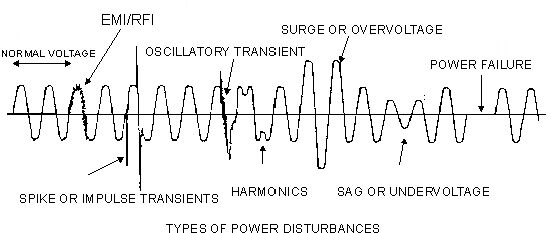
* If have any 5 point problem come out it may be broken the equipment or loss out date. but you use UPS that problem can not come out, because the UPS can get the Voltage when the Main power supply before have problem in the 4~8ms.
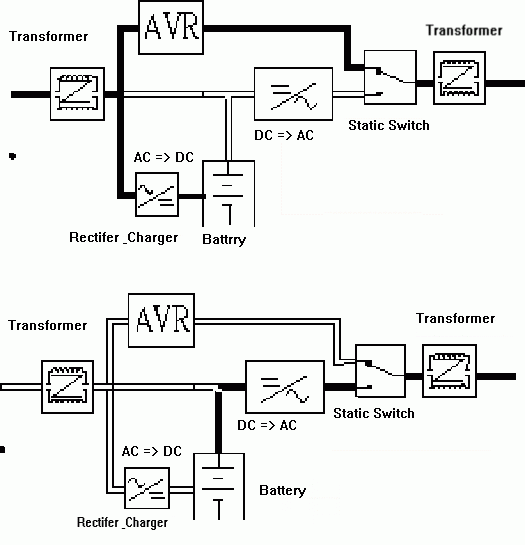
The UPS have two main kind system
1) Off Line UPS
2) On Line UPS
The
UPS off line system have 7 setting, (to see the fig.3)
1)Rectifier
(Is AC =>DC function to charger the battery)
2)Charger
(make the constant current to charger or discharge battery)
3)Battery
(Lead-acid or nickel-cadmium)
4)Inverter
(Is DC=> AC function some UPS is (sine-wave or square-wave)
5)Static
switch (when the main power have problem ,the switch will be
6)AVR
(Auto-transformer Voltage regulator)
(If the Line Voltage up and down is very stable no need use)
7)Transfer
(some UPS is no this parts,if UPS no use 110V=>220V
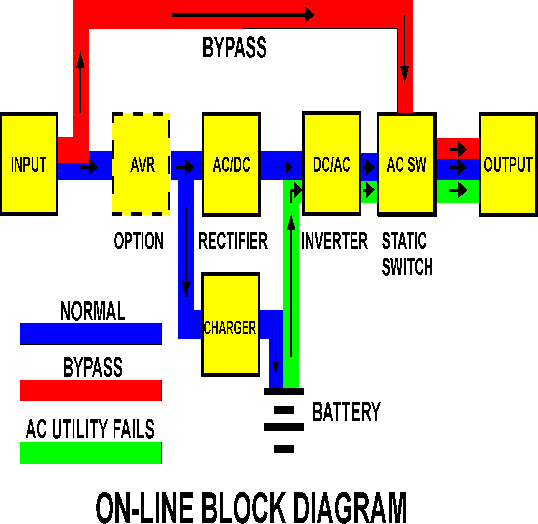
The On Line UPS system is parallel with the input voltage to load. Because it parallel the input so must is sine-wave and frequency it the input voltage.
|
|
Off Line UPS |
On Lines UPS |
|
Advantages |
Cost cheap |
Cost high |
|
Disadvantages |
Frequency unstable |
Frequency stable |
|
Disadvantages |
Not protect unstable voltage |
Can protect unstable voltage |
|
Switch times |
2~8ms |
No switch times |
|
Out waveform |
sine-wave or square-Wave |
sine-wave (50 or 60Hz) |
|
Output KVA |
40~1000KVA |
600~ 3000KVA |
|
Different UPS design |
Isolated the line voltage |
Parallel line voltage |
|
What kin comply use |
Small business and home |
Big comply |
|
|
(computer system) |
(Bank, emergent equipment) |
How
much UPS size for you application?
Multiply the voltage rating of the equipment by the current rating of the equipment to obtain a VA rating. The UPS must be rated to deliver at least this VA rating and the
UPS rating is KVA=V x I (V is Line voltage, I is load current , if your load is nonlinear You must use [(V x I) / θ] θ is the load power factor in the UPS system it is designed your load have poor factor (0.5=>0.6) for the table you can see how much size is you can buy UPS.
Table
1 (Line voltage 220V~)
|
|
Load power (MIX) KVA or KW |
UPS (MIN) rating KVA |
|
Linear Load |
50KVA |
50KVA |
|
Nonlinear Load |
50KW |
90KVA |
|
Load current (linear load) |
50A |
11KVA |
|
Load current nonlinear load) |
50A |
20KVA |
The UPS is use battery so it only can made the power output about 10~30min if over this time UPS may be not working (that time is see your load and UPS rating if UPS size is more bigger than the load that times can long than 30 min)
How to maintain UPS system
1)The battery must discharge in three month once
2)Check all function is normally or not in three month
3).Check the battery is fully change in standby mode and battery is good in one
Month.
4)Keep the UPS room temperature is 25~30℃
5)Keep the UPS clean