ATHLETICS
THE 100 METERS: ANTECEDENT BIOMECANICOS
Prof. Sergio Guarda Etcheverry (*)
Summary
The highest displacement speed that today is able to reach the big specialists of 100 plane meters, thanks to the development of a bigger capacity of acceleration, of a prompt motive answer to the exit stimulus and the capacity of being able to maintain during more time a high index of the reached maximum speed, they constitute, together with the technical and tactical advances of this specialty, the main factors in that the surprising evolution of the yield is sustained in the athletic careers of speed. Each one of these components of the career of 100 meters is analyzed article presently, having like base the studies biomecánicos sponsored by the IAAF during the World Championship of Athens of the year 1.997
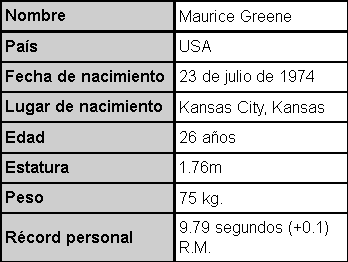
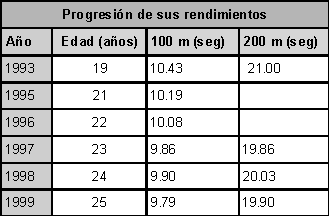
From the I Olympic Games of the Modern Era taken place in the city of Athens in 1896 to the present year, that is to say, in the 104 year-old course, the test of the 100 plane meters has had a spectacular progress in its yield that goes from the 12.0 seconds reached by Tomás Burke of the United States, measured with manual timing, until the effective world record of 9,79 electronic seconds achieved by its countryman Maurice Greene June of the year 16 1999 in the city of Athens.
Many are the factors that allow to base this notable progress in this classic test of speed of the athletics. First, those that have been product of the technological advances are and that they allowed big improvements of the athletic infrastructure (you advanced from the earth hints rammed to the current of synthetic resin), the incorporation of specific athletic equipment for this specialty (from the support of the feet directly in the floor, going by holes in the floor carried out for (you same corridors, until the modern departure blocks with regulation in distance and inclination) and for the footwear production and wardrobe specially designed for this athletic specialist (from the common plane slippers until the sophisticated and special slippers with nails for the careers of speed, as well as, the slight meshes of synthetic fabric to diminish the close contact and that they grant great freedom in their movements to the corridor).
Then, it is necessary to consider the advances carried out as for methods and means of training for the development of the quality speed, giving to the training a more integral focus from the physical qualitative point of view and granting to the increment of the force a special attention in the development of the speed; the technical advances introduced in the athletic tests of speed (exit lowers with use of departure blocks, what doesn't only favor a better answer to the exit stimulus, but also, it allows to achieve a more efficient phase of acceleration in the career). Finally, it is necessary to keep in mind the best procedures with which today it is counted for the selection of talents in this specialty; biotipos ectomesomórficos, of high frequency of movements, of big levers and with great physical strength, those that present a better aptitude to respond to the modern technical requirements of the athletic tests of speed.
Evolution of the 100 plane meters in the Games OlímpicosAño Headquarters Athlete Country Rend. (seg.)
|
Año Sede Atleta País Rend. (seg.) |
|
|
1896 Atenas Thomas Burke USA 12.0 1900 Paris Frank Jarvis USA 11.0 1904 Saint Louis Archie Hahn USA 11.0 1908 Londres Reginald Walker RSA 10.8 1912 Estocoimo Ralph Craig USA 10.8 1920 Amberes Chanes Paddock USA 10.8 1924 Paris Harold Abrahams GBR 10.6 1928 Arnsterdam Percy Williams CAN 10.8 1932 Los Angeles Eddie Tolan USA 10.3 1936 Berlin Jesse Owens USA 10.3 1948 Londres Harrison Dillard USA 10.3 |
1952 Helsinki Lindy Rimigino USA 10.4 1956 Melbourne Bobby Morrow USA 10.5 1960 Roma Armin Hay GER 10.2 1964 Tokio Bob Hayes USA 10.0 1968 México Jim Hines USA 9.9 1972 Munchen Valery Borzow URS 10.14 1976 Montreal Hasely Crawford TRI 10.06 1980 Moscú Allan Wells GRB 10.25 1984 Los Angeles Carl Lewis USA 9.99 1988 Seúl Carl Lewis USA 9.92 1992 Barcelona Linford Christie GSR 9.96 1996 Atlanta Donovan Bailey CAN 9.84 |
During the 60 celebrated World Championship the year 1997 in the city of Athens, it was carried out a project of investigation biomechanics directed by the Prof. Dr. Gert-Peter Bruggamann of the Institute of Athletics of the University of Sports of Colony, Germany, the one that was published recently by the International Foundation of Athletics, dependent organism of the International Federation of Fond Athletics (IAAF).
This publication understands a finish study of the athletic tests carried out in that world competition, what allows to pick up a great quantity of technical new antecedents - the most outstanding specialists' biomecánicos and to analyze its acting in the technical phases of each test.
In the mentioned competition, the final of the 100 meters of males was won by Maurice Greene of the United States of North America that ran for the andarivel number 3 and who, with a registration of 9.86 seconds, it established a new record of the world championships of athletics. This test one ran the day August 03 at the 21.50 hours, with an ambient temperature of 25 grades Celsius, with a humidity of 40% and with a wind in favor of 0.2 meters per second.
The values registered by 6 of the 8 finalists, analyzed in the investigation to the one that before reference has been made, those that continuation is analyzed were.
1.
Time of reaction
It corresponds at the time lapsed between the impact of the departure gun and the moment of application of the maximum pressure in the exit blocks.

In the 6 finalists that are part of this study they registered the following values, expressed in seconds:
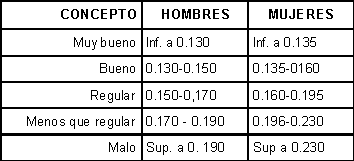
The time of reaction average registered by the 6 finalists was of 0. 133 seconds with a standard deviation of 0.007 seconds. According to studies carried out by Maravec and collaborators in the year 1988, the value average registered in this end would be qualified as good, being specialist males in 100 meters.
The athletes highlight I Tie Boldon of Trinidad and Frank Fredericks of Namibia who achieved a time of inferior reaction at the 0. 130 seconds that it locates them in the level of very good according to the chart of values presented by Maravec. Maurice Greene a thousandth of second reacted for about the time average of this sample; the slowest in reacting in the exit was the athlete Donavan Bailey of Canada (0, 145 seconds) who shone olympic champion's title, distinction achieved in the Games of Atlanta'96 to the date of this competition, and that he/she was also the possessor of the world record for the 100 meters. In the Olympic Games of Atlanta, Bailey won the career of (hectómetro with a time of 9,84 seconds (27.07.96), registering in that opportunity a time of reaction of 0. 174 seconds in the reaction
salida.
Tiempo of reaction (Maravec and cabbage., 1988, expressed in seconds)
Another antecedent that can point out in this respect you is that of the final one of the 100 meters of the Games Olimpícos of Seúl (24.09.88), where the athlete Ben Johnson registered a time 9.79 seconds and his time of reaction fué of 0.132 seconds; Carl Lewis that in first term fué declared silver medalist in that same opportunity, he/she ran in 9.92 seconds and it registered a time of reaction of 0.136 seconds. Later on, Johnson was disqualified by positive doping and Lewis declared winner of the test.
One of the best times of reaction in the exit Ben registers it Johnson in the 20 World Championship taken place in Roma'87. In that occasion (30.08.87), this Canadian athlete of Jamaican origin established a new world record for the 100 meters with 9.83 seconds and her time of reaction was of 0.109 seconds. Carl Lewis that arrived in second place to the goal with 9.93 seconds registered 0.194 seconds as time of reacción.
2. Evolution of the speed in the 100 meters
The registration of the partial times each 10 career meters, it allows to establish the extension of the phase of each athlete's acceleration (I scheme of distance until which each corridor was able to increase its career speed), its speed peak or «peak of speed» (moment in that it reaches the maximum displacement speed), the duration of this phase and the moment in that the phase of deceleration begins in the distance (loss of the maximum speed that registers toward the term of the career distance and that it depends from the resistance capacity to the speed of each corridor).
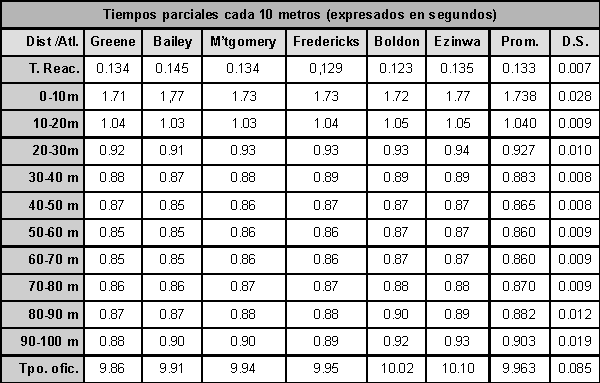
The registration of the times partial singular, used by the athletes that conform the sample of this study, to cover each one of the tracts of 10 m of the total distance of career allow to observe that, although 3 of them use their menortiempo in the tract from the 40 to 50 m and the 3 remaining newly they achieve it starting from I scheme that goes from the 50 to the 60 m, all they are able to only maintain this same level of efficiency until the 70 m of career. Starting from this distance, all they begin to lose the maximum level of efficiency reached as consequence of the slight symptoms of fatigue that you begins to manifest in the athlete subjected in this type of effort anaerábico aláctico of maximum demand neuromuscular.
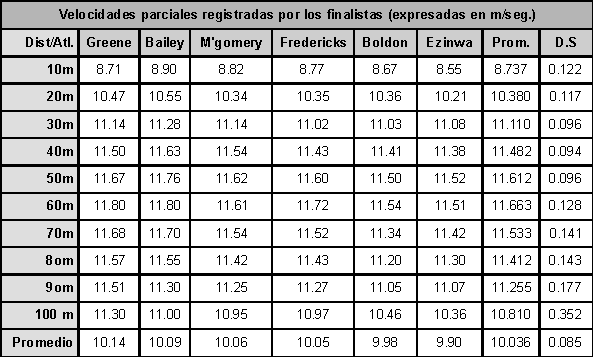
Four of the six corridors that conform the sample of this study reach the highest displacement speed to the 60 career meters; the other ones two remaining they achieve it to the 50 meters. The highest registered speed corresponds the winner of the test Maurice Greene; it reaches it to the 60 m of initiate the career, it is of 11.80 meters per second (42.48 km/hora) and it overcomes in 0. 137 m/seg the value average registered by the 6 finalists. The highest average of speed for the total distance also corresponds the winner of the test; it is of 10.14 m/seg. (36.504 km/hora), superior to the average of this sample that is of 10.036 m/seg. (36.129 km/hora).
3. maximum instantaneous speed
The use of videotape cameras installed in perpendicular form to the line of the athletes' career, allowed to Bruggemann and its team of collaborators to determine the distance of the career in which each one of these participants achieved its maximum displacement speed and the value of this. The registered values are presented in the following square:
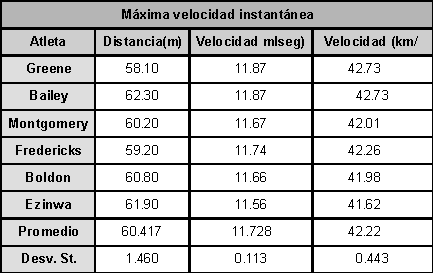
The contributed antecedents allow to observe that Maurice Greene and Donovan Bailey was who achieved the maximum displacement speed, but that contrary to the Canadian, the American it reached it when taking smaller traveled distance.
4. frequency of steps
The longitude and frequency of the steps of the career was another of the factors registered in this investigation. For their study, the total distance of the test was divided in three tracts: the first one from the exit until the 30 m, the second of the 30 at the 60 m and the third of the 60 m to goal, registering the following ones values averages for each athlete in the suitable tracts:
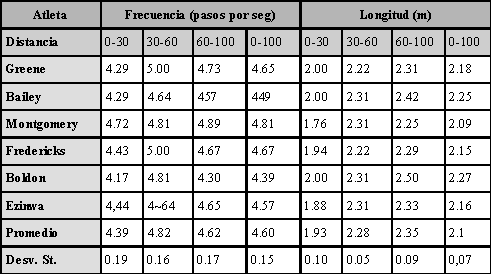
The analysis of the registered averages allows to observe that the frequency of the steps increases from the exit until the 60 m and that starting from that distance it diminishes toward the goal. The biggest f recuencia registered for 5 of the 6 corridors in the tract from the 30 to the 60 m, being the highest value the one reached by Greene and Fredericks of 5 steps porsegundo.
As for the longitude of the steps, this he/she goes in progressive increase from the exit to the goal, registering in all them an increment of the longitude in the tract of the 30 to 60 m when relating it with the first tract (0 at 30m). 1 of the 6 corridors Only registered smaller longitude in the tract from the 60 to the 100 m with regard to the immediately previous tract. The biggest longitude in the stride f ue registered for I Tie Boldon in the tract from the 60 to the 100 m and their average was of 2,50 meters.
ConclusionesEl analysis of the registered values, so much of the time used in covering each tract of the career like of the speed reached in cadafracción of the 100 meters, they allow to conclude that at the moment the phase of acceleration in these elíte athletes is prolonged until the 50-60 career meters; that the highest displacement speed is achieved newly around the 60 career meters, and that in all the specialists, starting from this distance, a slight and gradual deceleration takes place until arriving to the goal, product of the decrease of the f recuencía of the steps in spite of the increase of the longitude of these. Still when, for the simple spectator it seemed that some velocistas hurried in the last meters to reach the arrival line, what really happens is that these they lose less speed than their occasional opponents.
Finally, it fits to point out that the antecedents contributed by the investigators corroborate that the main decisive factors of the speed, starting from a briefer time of answer to the departure stimulus, are the appropriate relationship that is reached between the frequency and the longitude of the career steps. Although the frequency of movements is certain fundamentally for the individual's genetic aptitude, the modern specific means of training of the speed allow to stimulate its development lightly. With regard to the longitude of the stride, this is broadly improvable by means of an integral training of the physical qualities, with emphasis in the development of the special force, the resistant speed, the movielasticidad and the coordination. The above-mentioned, supplemented by a good specific technical training and an appropriate career tactics to achieve an efficient distribution of the energy, constitutes the fundamental pillars on which he/she should be formed a velocista that seeks to reach levels of so high yield as the registered ones for world and olympic finalists.
References
• Brugemann and cabbage. Biomechanical Research Project, Athens 1997, Final Report. Meyer and Meyer Sport. Germany 1999.• Maravec P., and cabbage. Science and Movement. Volume 04, N ~ 2, April 1990.
CURRICULAR ANTECEDENTS:
Prof. Sergio
Guarda Etcheverry
(*) Academic DEFDER; Editor Responsible Physical Education - Chile (Official Organ DEFDER) Address: Dr. Luis Bisquert 2765 Ñuñoa - Santiago, Chile - Telephones: 56-2-752.0645/7/8/9 and 752.0651/2/3 Fax: 56-2-238.8811
The work has been published in the Magazine Health, the Sport and the Boy Edic. 11 year V, 2001