 |
|
|
|
|
|
|
|
|
|
|
|
|
|
|
|
|
|
|
|
|
|
|
|
|
|
Port Gibson After Action Report April 30-May 1st, 1863 |
|
|
| Our regiment landed at Port Gibson, some distance south of Vicksburg on April 30th, 1863.� We landed with no opposition from the Johnnies. We spent the evening on the Bruinsburg Road next to a large cornfield alongside the road.� Corporal Kimball and myself shared a few songs and dropped off to sleep with Company B of the 21st Iowa around us.� |
|
|
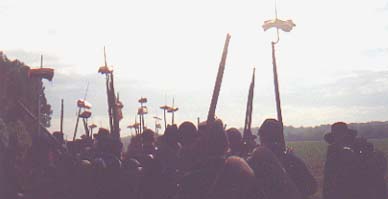
| I awoke on May 1st at first light and took roll call, finished the morning report and we awaited our marching orders. At about 10 am we were ordered to move up the Bruinsburg road towards Port Gibson. We were marched ahead of the main army. The quartermaster department had dropped our boxes of rations alongside the road with no wagons in site to transport our food. |
|
|
|
 |
|
|
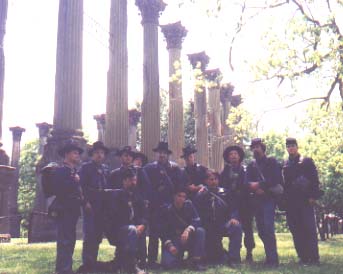
| We broke open the boxes of slab bacon and cut them into large pieces and carried them on our bayonets.� We were also ordered to carry the large boxes of hardtack.� Each company slung a box with two rifles and we began carrying them from the bottomlands up the road rising up onto a bluff.� Luckily, the battery attached to us helped us transport the rations to our first stop at Windsor Plantation. The plantation had already been abandon.� We were ordered to cook rations. Again, the Johnnies still gave us no opposition. The weather was beginning to heat up and the men were beginning to feel it. |
|
|
|
 |
|
|
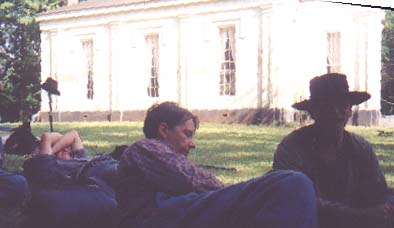
| The next leg we marched on more level ground to the old Bethel Church.� We passed many curious local civilians en route.� By this time the men were quite tired and we rested and watered for the final leg. |
|
|
|
 |
|
|
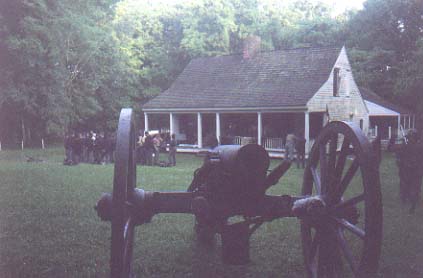
| It was now getting close to dusk as we moved on our final leg to Port Gibson.� In most places the road ran along deep ravines some 15 to 30 feet high.� We worried that the Rebs could ambush our column very easily on the road and shoot us like so many turkeys. In some places deep ravines dropped off the sides of the road. But again, no sign of the Johnnies.� Darkness fell and visibility was very limited.� We were the last company in the column and after a few miles we heard a commotion at the head of the column.� Then we began to hear musketry and could see muzzle flashes and the roar of cannon to our front.� The Johnnies had barricaded the road and then began to fire on our front companies as they tried to clear the road.� Our artillery section also suppressed the Johnnies and they finally dispersed with our superior numbers. That night we camped in the front yard of the Schaefer House. As we were quite tired, everyone dropped off to sleep quickly. |
|
|
|
 |
|
|
| But, at about 3 am, the skies bellowed thunder and lightning.� As the Schaefer family had abandoned their home, we quickly took refuge in the home.� We crammed into the house and stayed dry and slept out the night in the Schaefer house. In the morning we resumed our trek into Port Gibson. |
|
|
| Jim Butler |
|
|
 |
|
|
|
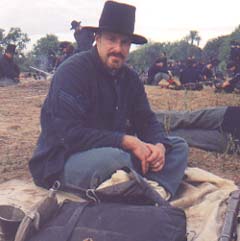
| Honoring 1st Sgt. William Lyons |
|
|
|
|
| Co B 21st Iowa |
|
|
|
|
| �������������������������������� |
|
|
|
|
|
|
Port Gibson March AAR and Analysis May 1st-May 2nd, 2003 |
|
|
| I arrived on site with some Salt River Rifle pards who had caravanned with me about 5 pm.� Registration was quick and easy and we chatted with other pards and staff while we changed and awaited our transport to the site.� Our weapons were inspected and we were shuttled to the start point.� I really enjoyed the fact that we were at the original sites and many of them were unchanged since the Civil War.� We camped on a dirt road thru a farmers cornfields.� The Mississippi River had changed course over the past 140 years and was some distance from our starting point. Folks were shuttled in all evening and into the early morning.� We had 104 men and a section of artillery.� I really enjoyed having a full artillery piece with horses and caisson with us.� The sounds of the horses and caisson on the roads were unforgettable and really added to the experience! We began to start our march at about 10 am.� I appreciate the historical accuracy of this, but I think we would have faired better on the march if we had enjoyed the cool of the morning.� In any case, we began our march and were ordered to carry our bulk rations as the original soldiers had done.� We carried the slab pork on our bayonets and carried the hardtack boxes with rifles and rope.� This didn?t last long as it was just too grueling and hot for us to carry them.� The artillery kindly carried our boxes to the Windsor Plantation. The road climbed out of the bottomlands and this was the toughest part of the march, especially with the added weight of a slab of bacon on your rifle. But the scene made for a surreal experience. |
|
|
| We were issued rations, cooked, ate and rested at the ruins of the Windsor Plantation. The columns were very inspiring and the original home must have been massive (even by Antebellum standards).� Again, this was a wonderful period moment resting along the route at this site.� We then began our next leg of the march towards Bethel Church. |
|
|
| The next leg was the most difficult as the heat of the day was wearing on the men.� Fatigue was not an issue as no one had complaints of hurting feet or back.� It was clearly just the heat.� Part of this leg was on modern roadways and this also made it hotter and more difficult.�� Just short of the Bethel Church we had men begin to fall out (probably about 15-20 men).� These men were transported ahead to the Bethel Church.� We arrived at Bethel Church and the men got a long and much need rest.� Gatorade and water were needed to rehydrate the men.� The staff and officers made the difficult decision at this point to by-pass 4 miles of the march route.� We were shuttled past the 4 miles of modern roadway to a dirt road about 3 to 4 miles from the end point at the Schaefer House.� Again, it was a great experience to see the original Bethel Church. |
|
|
| Once shuttled to the dirt road it was getting very late in the afternoon and the men were much refreshed and the cooler weather and shaded roadway was welcome.� The men faired much better on this leg.� This leg was very enjoyable as there were few, if any, modern intrusions and the roadway lied in the bottom of a 15 to 30 foot ravine most of the way.� In places, ravines off the side of the road dropped off sharply.� Darkness fell and we could not see even a couple of feet in front of us.� We had to place a hand on the knapsack of the man to our front to try to keep our alignment and not get lost. Finally we heard musketry and could see muzzle flashes to our front as the front of the column ran into the Rebel barricades.� We were the rear company and were not engaged in the brief fight.� After the fight, we were ordered to make camp in front of the Schaefer House. |
|
|
| This was also a great experience camping in front of this historical building.� The men fell asleep very quickly and we enjoyed a restful sleep till 3 pm.� A thunderstorm was rolling in and we awoke to lightning and thunder.� The men made a quick exodus to the Schafer house.� We all found a piece of floor to throw down on and we stayed dry while the skies outside opened up.� We all were openly thankful for the house being there as we were carrying very little means to erect a shelter. Morning came with some sunshine.� |
|
|
| Some of the men cooked up what food they had that morning and chatted up about the events of the past day.� The last leg of the march into Port Gibson was skipped as it was felt that many of the men wouldn?t make it on the modern roads after the prior days exertion. The ancestor (and owner of the Schaefer home) of the original Schaefer family read us some interesting post war histories of Mr. Schaefer. The men were then shuttled back to town for the afternoons living history.� Some stayed and some departed and visited the nearby Vicksburg Battlefield Park. |
|
|
| For me Port Gibson was very enjoyable even with some of the challenges we all faced. Clearly, the heat was the biggest challenge for all of us. I don?t believe anyone should be ashamed that we marched 10 of the 15 miles.� It gave me an even deeper appreciation for the toughness and grit of our ancestors who actually fought and sacrificed 140 years ago along those roads.� I for one had some period moments at the Windsor Plantation, Bethel Church, along the final dirt road and at the Schaefer House.� Most of all we raised over $6000 for battlefield preservation.� Thus, this should be a great source of pride for us all.� Many thanks to Company B comprised of The Salt River Rifles and The 1st GA Regulars.� You fellas are great comrades and you worked together as a team! When assigned to a detail, you all did your duty and pulled together even when you were already quite tired. Finally, many thanks to John Cleveland and his staff for their excellent preparation and execution of this event!� You have a lot to proud of and you had to face several challenges en route and I believe you conducted yourselves well. |
|
|
| Jim Butler |
|
|
| 1st Sgt Co B 21st Iowa |
|
|
| P.S. For those at the Schaefer House Kenny Wayne is the man! |
|
|
|
back to AAR index page |
|