 |
|
|
|
|
|
|
|
|
|
|
|
|
|
|
Furled Stingers for Tandem Flies |
|
|
|
Tandem-tied flies, those being flies with two hooks connected to each other, can be very productive yet also time consuming to tie as a result of the labor involved in manufacturing the tandem chassis. The unique furling technique described herein saves time, is easy to perform and in some instances is stronger than the traditional way in which the tandem chassis is manufactured. The use of this technique will greatly enhance the process of tying flies such as the Rangeley classics, steelhead leeches or about any other articulated pattern by reducing the number of steps and time necessary to construct the stinger assembly of the tandem chassis. It should be noted that, although the furling can be accomplished by hand or without the use of a Nor-Vise as depicted below, this unique vise facilitates the procedure with much more ease. If using a Nor-Vise or similar aparatus, extreme caution should be exercized during the spinning stage of the process as the hooks are sharp and with this process they are also rotating at a high rpm. It is recommended that a protective sheath be fashioned out of Velcro to cover the hook bend and point to prevent injury or, as an alternative, to use a short piece of flourescent Larva Lace tubing over the hook point. Either will protect both the point and the fly tyer. The latter recommendation was provided by Don Ordes of Fantasy Fly Company at www.fantasyflies.com.
Completed J-Rig assemblies (as pictured in the bottom, left picture) are available for purchase in differing configurations of hook size and connection material. Please contact via e-mail for specifications and pricing.
Nor-Vise pricing and specifications are also addressed by direct e-mail or you may visit the factory site at www.nor-vise.com for a full description of available products.
Don Johnson, [email protected]
Photography by Lou Hurlbut. |
|
|
|
 |
|
 |
|
|
|
|
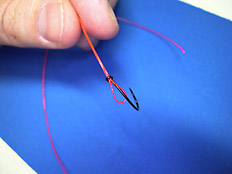
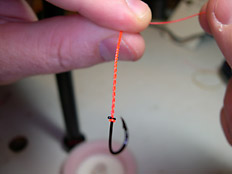
Form a loop-to-loop connection between the connection material (about 12 inches of 20# Amnesia in this case) and the hook-eye (pictured is a Daiichi 2551 Octopus hook). |
|
|
|
|
|
|
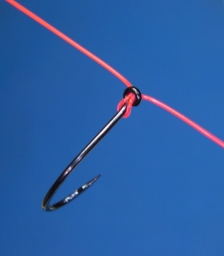
This is a close-up view of the loop-to-loop connection with the hook and Amnesia monofilament material. |
|
|
 |
|
|
|
|
|
|
 |
|
|
|
|
|
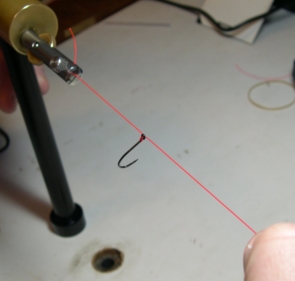
Hold the loose tag end in the axis of rotation and spin the vise head to initiate twisting which will later enable the furling of the Amnesia. Exercise extreme caution and follow the advice for covering the hook point. |
|
|
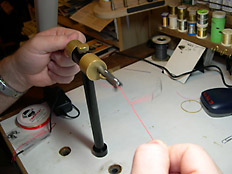
With one tag end locked into the Nor-
Vise jaws and the other grasped firmly between the fingers, the vise head can be spun to start twisting the material. |
|
|
|
|
|
|
 |
|
|
|
 |
|
|
|
|
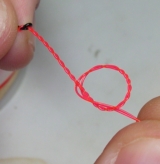
After sufficiently twisting the material, which will vary depending on the material being used, stop the vise head and as the tag end in your hand is brought towards the tag end locked in the jaws, furling will ensue. This is a completed "J-Rig" Ready for attachment to a lead hook of a tandem fly chassis. |
|
|
|
|
|
|
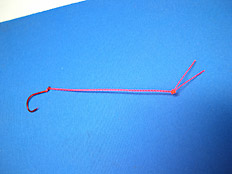
To prevent the furled connection material from unravelling, tie and overhand knot into the furled section. This allows for preconstruction of the "J-Rigs" which makes tying the tandem chassis at a later time much faster and easier. |
|
|
|
|
|
 |
|
|
 |
|
|
|
|
|
|
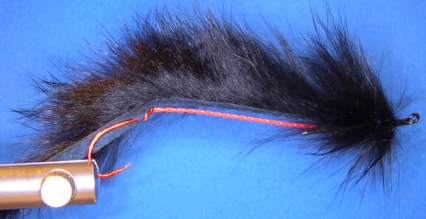
This is an example of an Articulated Steelhead Bunny Leech tied with a size 2 Daiichi 2553 stinger, furled 20# Amnesia connection, a size 1 Mustad 36890 lead hook (bend clipped off) and Hareline rabbit strips for the wing and body. |
|
|
|
|
This particular "J-Rig" has had an overhand knot tied into the furled material which prevents unraveling. This allows the preconstruction of numerous "J-Rigs" for use at a later time. This particular setup is a Daiichi 2553, size 2 married to 20# Amnesia via the furling process. |
|
|
|
|