 ATTACHMENT
Salisbury Power Pipes
P-21 P-42
P-45 P-90
P-92 Power Pipe Instructions
Revision
F
Pipes Of High Power, Light Weight and Excellent
Durability.
The Salisbury Power Pipe range has been very
successful over the years, winning many racing events.... in some Australian
racing events the Salisbury C/F pipe has become the most popular and successful
of all pipes to be used.
ATTACHMENT
The pipes are available in difference fixed lengths,
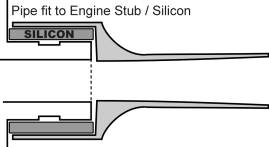
and attached via a silicon coupler and a rigid stinger mounting. The header
flange/silicon sizes are designed to fix all existing engines. The silicon is
sleeved over the engine exhaust stack, the pipe then fits over the silicon to
achieve a snug fit. Use a petroleum jelly (or similar) to help the pipe slide
over the silicon.
 In some cases the silicon will need to be reduced in
size. To do this, slide the silicon over a suitable mandrel such as a wooden
dowel and carefully reduce its diameter using a course sandpaper or sanding
disk.
In some cases the silicon will need to be reduced in
size. To do this, slide the silicon over a suitable mandrel such as a wooden
dowel and carefully reduce its diameter using a course sandpaper or sanding
disk.
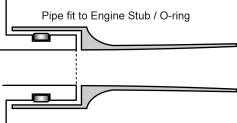
Several versions may attach directly over the exhaust
stub O-ring.
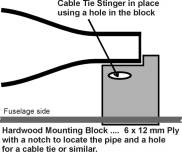 Generally Salisbury Power Pipes are attached at the
stinger end only, usually cable tied to a suitable hardwood mounting block. A
notch in the block is a good way of preventing the pipe slipping rearward.
Generally Salisbury Power Pipes are attached at the
stinger end only, usually cable tied to a suitable hardwood mounting block. A
notch in the block is a good way of preventing the pipe slipping rearward.
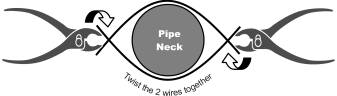 For some applications attachment is via a spring
stretched around the engine cylinder. The spring must connect to an attachment
point around the neck of the pipe. A simple spring attachment can be made by
twisting 2 pieces of wire around
the pipe neck to form 2 eyelets or hooks.
For some applications attachment is via a spring
stretched around the engine cylinder. The spring must connect to an attachment
point around the neck of the pipe. A simple spring attachment can be made by
twisting 2 pieces of wire around
the pipe neck to form 2 eyelets or hooks.
To achieve optimum performance, the engine, pipe and
prop combination need to be trialed and tested. As we have a fixed pipe length, the optimisation is done via
changes to the engine and propeller. The greater the combustion chamber
pressures, the greater the power. The
biggest factor in the 'setup' is heat. Controlling
the heat generated is the optimum factor, ie more combustion = more heat, bigger
prop load = more heat, inadequate cooling = more heat.
Observe the plug and head closely.
Blown plugs and a sandblasted head is a sign of
'over compression'; raise the head / volume or decrease prop load,
however he biggest engine killer is being under-compressed and too lean.
If the engine is difficult to 'come on pipe'; decrease prop load.
Pipe pressure is recommended as it is easier to use
on high exhaust timed engines. Crankcase pressure can be used on engines with
less than 175o exhaust timing. We recommend the use of the MACS
brand, thin wall pressure nipples. Conventional pressure fitting can be used,
but can sometimes come loose.
Some recommended pipe setups are:
We
have Short, Standard and Long versions available for most of the below pipes.
P 92
Latest, high volume, high power pipe for .80 through to .108 engines.
About 18,000 on ground.
P 90
Suitable for .65 to .77 ducted fan / marine use. Prop at about 19,000 on
the ground.
P 45
.45 Ducted fan or marine use. Prop at about 20,000 on the ground.
P42 STD
A Carbon version of the worlds most popular FAI pipe. Prop at 25000 - 26000 on the ground.
P21
Short The most
successful Australian QM pipe (.21) ever. Use
at 28,000 rpm or more on the ground.
Instructions for
P-15 & P-40: These
pipes have been discontinued but are available to special order. These
instructions are largely applicable to these pipes.