SALISBURY POWER PIPES
Carbon Tuned
Exhaust Systems + more.
5 ARCOONA ROAD, SALISBURY
PLAINS, SOUTH AUSTRALIA.
5109
PHONE
No. 0403296194
FAX No.
(61) 08 - 82509092
E-mail:
[email protected]
...............................................................................................................................................................
Carbon
Composite Pipes & Mufflers
: GENERAL
INSTRUCTIONS Revision
G
The Salisbury Carbon Fibre Pipes & Mufflers are
the result of many years of constant development, featuring ;
ü
Low
weight - between 10% and 50% lighter than metal.
ü
Exceptional
strength for weight. Far stronger than alloy.
ü
Dent
resistant, and less prone to fatigue.
ü
Very
quick heat dissipation, giving excellent cooling and lower operating
temperatures.
ü
Depending
on the pipe’s use, generally much quieter and / or more powerful than
equivalent metal pipes.
*
*
*
*
*
*
*
*
*
*
*
*
*
*
Features to Note
Due
to the different materials used in Salisbury pipes and mufflers, several unusual
features need to be noted.
1.
salisbury
Pipes and mufflers will change colour with the heat. This makes a very good temperature gauge.
The hotter the pipe the darker the colour, and visa versa.
2.
The pipes may make some 'crackle and pop' noises during the first few
runs.
3.
This is caused by the dissipation of any moisture trapped in the
laminate. Factory oven curing removes an estimated 95% of the moisture, the
final 5% will slowly dissipate during use.
4.
The pipes
have an unusual smell, which will eventually ease with the pipes use (moisture
evaporation).
5.
Our
Special Resin & Carbon Fibre will withstand exhaust temperatures ... PROVIDING the pipe is well cooled.
6.
DO
NOT insulate
the pipe. These pipes rely on their ability to dissipate heat through cooling to
atmosphere.
7.
In some
circumstances, the pipe may 'weep' exhaust gases. Weeping is more likely to
occur if the pipe has been 'run hot' (engine too lean or poor cooling),
especially in it's first few flights. It is best to make sure the first few
flights are ‘rich’. The weeping is caused by the expansion of the Carbon
Fibre weave or pinhole caused by the ‘popping’ of moisture trapped in the
laminate (see note 2). There is no
detectable power loss from the weeping.
*
*
*
*
*
*
*
*
*
*
*
*
*
Using Salisbury Pipes & Mufflers
1.
The pipes
are given a basic cleaning before packing. To clean, wash out with
thinners or methanol & blow dry.
2.
Make sure
the silicon joiner, is a good fit and in good condition. Nylon cable ties
can be used for attachment.
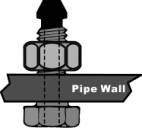 3
If you wish to use a pipe pressure fuel system, we stock the MACS brand
thin wall pressure fittings. These are a captive system, with a flange inside
the pipe and a threaded nut on the outside. Alternatively, a large bore pressure
nipple in the alloy header (for Quiet pipes) is also OK. Most users prefer to
place the pressure fitting at or about the maximum diameter of the pipe, however
extensive testing has proved it makes little difference where the pressure
fitting is situated. For ducted fan use we prefer fan pressure, and for pylon
racing we prefer pipe pressure taken from the max pipe diameter unless
exhaust timing is below 170o, were we use crankcase pressure.
3
If you wish to use a pipe pressure fuel system, we stock the MACS brand
thin wall pressure fittings. These are a captive system, with a flange inside
the pipe and a threaded nut on the outside. Alternatively, a large bore pressure
nipple in the alloy header (for Quiet pipes) is also OK. Most users prefer to
place the pressure fitting at or about the maximum diameter of the pipe, however
extensive testing has proved it makes little difference where the pressure
fitting is situated. For ducted fan use we prefer fan pressure, and for pylon
racing we prefer pipe pressure taken from the max pipe diameter unless
exhaust timing is below 170o, were we use crankcase pressure.
4.
The first
ground run and test flight should be done with the models cowl / belly
pan removed for extra cooling.
5.
When cowled,
as in a pylon racer, cooling air MUST be provided, especially for the first 1/3
of the pipe length.
6.
For
cowled racing models it is ESSENTIAL that cooling air be directly directed into
this area.
7.
The air
exit to any cowl needs to be least double (or treble) the inlet area.
8.
Occasionally
the pipe should be removed from the model and be allowed to drain ...
front end down. If it is to be unused for any time, wash out with thinners or
methanol..... shake and blow through to dry before storage.
9.
A Well
Cooled Pipe is worth it for gains in power and reliability.
*
*
*
*
*
*
*
*
*
*
*
*
*