SALISBURY
POWER PIPES
5
ARCOONA RD SALISBURY PLAINS, S.A 5109
Ph 0403296194 Fax
08–82509092 [email protected]
EQ 60
EQ 62 EQ 62N
EQ 63S EQ
80N
Instructions
Revision F
EQ 60
our very popular, standard / sports
.60 pipe, for above 9,750 – 11,000 rpm.
EQ 62
a larger volume, higher powered version of the
EQ60. Our most popular pipe.
EQ 62N
‘Narrow’, a rectangular version of the
EQ62... designed to fit shallow cowlings.
EQ 63S
‘Square’, the latest shape .... very high power .... but needs a
large cowling area.
EQ 80N
As per EQ62N, but for .80 / .90 engines.
All of the SALISBURY EQ (Extra Quiet) Pipes are
renowned for their broad power
range and very effective noise suppression. Their strength for weight is
exceptional. The EQ62 – 63’s are optimised for 9,250 to 10,500 rpm.
INSTALLATION
 All Salisbury EQ Series Pipes have an optimum 'operating length'. This length is
quoted as a distance in mm from the exhaust (piston face) via any curves in the
alloy header pipe to the first baffle inside the pipe. The system's length is
varied by shortening the header (preferred as it is heavier than the C/F), or
lengthened by adding a spacer to the system... usually by inserting a length of
header cut-off, inside a longer piece of silicon
All Salisbury EQ Series Pipes have an optimum 'operating length'. This length is
quoted as a distance in mm from the exhaust (piston face) via any curves in the
alloy header pipe to the first baffle inside the pipe. The system's length is
varied by shortening the header (preferred as it is heavier than the C/F), or
lengthened by adding a spacer to the system... usually by inserting a length of
header cut-off, inside a longer piece of silicon
To find the pipe's first baffle,
insert a rod inside the pipe until it contacts the baffle. Mark it's position on
the outside of the pipe. .... Caution.... the first baffle has a hole in the
centre, double check that you haven't found the second baffle.
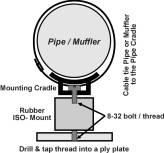
This pipe / muffler should be
rubber mounted at or near it’s C of G. Excessive heat and vibration are
the biggest destroyers of exhaust systems (metal or composite).We use the Bolly
'Tuned Pipe Mount' combined with a Bolly Iso-Mount and a cable tie for the
rearward attachment.
USING
These pipes will work at any
reasonable length, however only trial and error will find the best combination
of pipe length, prop size, head clearance and fuel etc. Below are the
recommended lengths from our development testing. Use only as a guide as there
are literally thousands of possible combinations.
All
of the Salisbury EQ 60 - 63 pipes
use a similar operating length. Generally they are best used as long as
possible... giving the smoothest, quietest operation...... 530mm @ 9,500 rpm.
510 mm @ 10,000 rpm
490mm @ 10,500 rpm
Please note: the above is only a
guide and is subject to a large variation depending on the overall setup.
Low rpm = longer pipe ; Higher rpm
= shorter pipe. When in doubt, use the pipe long. It is a safer option than being too short.
Pipe too short:
= frequent blowing of plugs
Pipe too long:
= prone to burbling rich running
= overheating
engine
= low power, low noise
levels
= sags under
load - ie in climbs
= harsh and /
or lean running despite taking off with a good needle setting.
Please note: The symptoms of being too short may also occur if the
engine is over compressed (often the case when using a pipe on an engine not
specifically designed for pipe use) ..... Using a pipe will increase the
effective compression ratio of an engine. (as will adding more nitro to the
fuel). Add a .1 to .2mm shim under the head
to decrease the compression.
Beware: We have found
that some modern 2 stoke engines have very low exhaust timing (below 145
degrees), and do not respond as they should on a pipe. If the engine is too low
on exhaust timing, the pipe may cause poor throttle response or even inhibit the
engine performance. Such engines will usually go rich with throttle transition
from idle to full power. In these cases, use a very long pipe (it will now act
like a muffler) and a hot plug.
Caution: Rubber mounted pattern engines often suffer severe vibration,
hence careful pipe and engine mounting is paramount. The alloy header is at
most risk, so it is best to keep the header length as short as practical and
mount the pipe at it’s C of G.