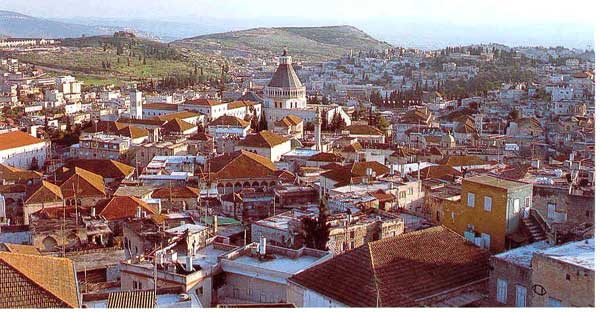
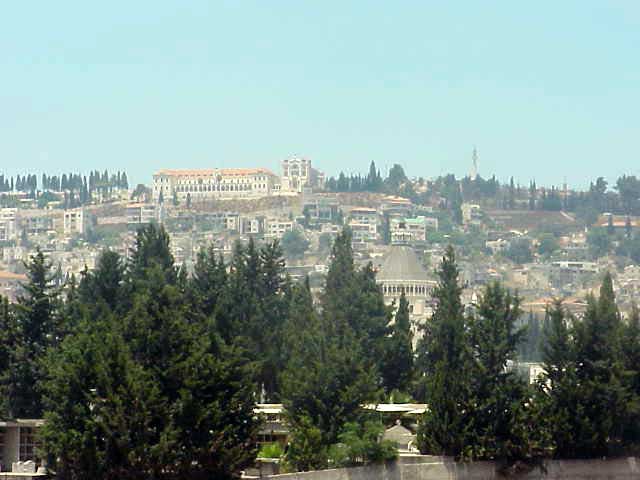
The site where Nazareth exists today was founded and settled between 600-900 BCE. Nazareth is located between the open space of the Jezreel valley and the mountainous regions of Galilee. Nazareth is also 60 miles north of Jerusalem and midway between the Mediterranean and Galilean seas. Before Jesus� time great battles had taken place in the valley that is seen from Nazareth. The Jezreel as it is seen from the town, is a natural battlefield. The villages and farms in the at the time of Jesus consisted of walled terraces, watch towers, and rock quarries. The village was surrounded be vineyards, olive grooves, and terraced crops, that might have inspired some of Jesus� parables. Nazareth was isolated however because no trade routes ran through the city.
Nazareth was a small agricultural village settled by a few dozen families. Pottery remains testify a continuous settlement during that period (600-900 BCE). After those years there was a break in settlement until about the year 200 BCE. It is believed that first-century Nazareth was a village comprised of approximately twenty-five families.
Since then, the site of Nazareth has been consistently inhabited. The majority of the Archaeological finds consist of underground rooms (which were common because the soft chalk of Nazareth made it easy to hew caves), cisterns, and grain storage bins. The agricultural aspect of the city was discovered from the discoveries of oil mills and mill stones.
The geographical area next to Nazareth included the lower Galilee and the Beti Netofa valleys. These regions were occupied by many small Jewish villages and towns settled by Hellenized Syrians. The largest of these towns was Tzippori, which was the capital of the Galilee until 18 BCE. This town is not mentioned in the New Testament despite being only a forty five minute walk from Nazareth.
Nazareth is in the central area of Galilee and is surrounded by numerous sites of international historical and archeological importance, such as Cana of Galilee, Sephoris, Mount Tabor, the Mount of the Precipice, Tiberias, Capernaum amongst others. The heart of Nazareth today is the Old City, which is comprised of two parts: the nucleus - the historical and religious core - and the ``casing" - the markets, mansions, and houses on the slope of the Nebi Sa'in Ridge. Nazareth is now the largest Arab city in Israel with a population of, half Christians, half Moslems. These groups live together in a peaceful harmony coexisting with each other. |