Web and silk
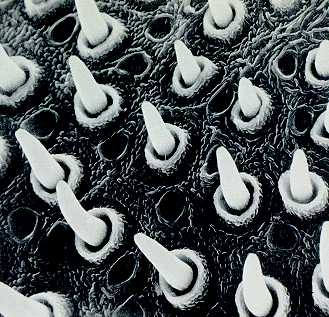
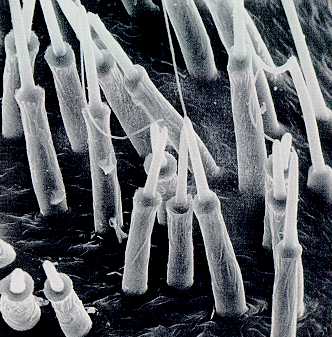
There are several glands located at the spider's abdomen, which produce the silken thread. Every gland produces a thread for a special purpose. There are seven different glands known. But each spider possesses only some of these glands and not all seven together.
The glands known as Glandula Ampulleceae major and minor is used for the silk of the walking thread. Glandula Pyriformes is used for the production of the attaching threads. Glandula Aciniformes produces threads for the encapsulation of prey. Glandula Tubiliformes produces thread for cocoons. Glandula Coronatae is used for the production of the adhesive threads.
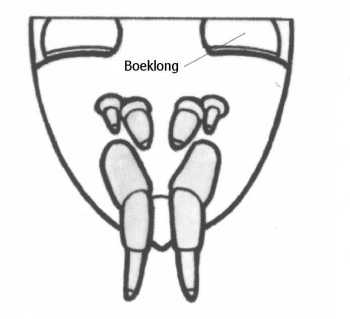
Normally a spider has three pairs of spinners. But there are spiders
with just one pair or as many as with four pairs of spinners. Every spinner
has it own function. There are small tubes in the spinners, which are connected
to the glands. The number of tubes varies between 2 and 50.000.
| |
|
|
The human eye is capable of detecting objects at a distance of 10 cm
with a diameter of 25 mm. The average diameter of a thread in a orb web
is around 0.15 mm. The smallest measured thread was only 0.02 mm thick.
We are able to see the web only because of the reflection of sunlight on
the thread. These thin wires are capable of stopping a bee flying at full
speed. This thread is not only strong but also very elastic. These properties
make the material tougher than any material or metal we know. The strength
of a material is given in a unit called dernier. (1 dernier = 1 g per 9000
m) A thread of a spider has a value between 5 - 8. This means that the
thread will break under its own weight at a length of 45 - 72 km. Materials
that are comparable are nylon and glass. Steel has a value of approximately
three.
 |
 |
|
|
|
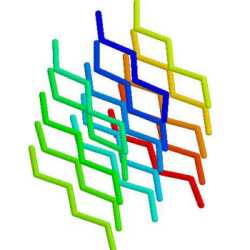
What is the thread made of? It is a protein of a molecular mass of 30.000 Dalton in the gland. Outside the gland it polymerizes to a molecule named fibroin with a molecular mass of around 300.000 Dalton. It is still not clear what activates polymerization process.
Why does the silk made of protein not decompose by fungi and bacteria like all other proteins? We conserve protein by cooking, salting, drying or adding acid. In spider silk there are three substances that are important for its durability: pyrolidin, potassium hydrogen phosphate and potassium nitrate. Pyrolidins can be found in dyes and plant poisons and are very hygroscopic (binds water). This substance prevents the thread from drying out. Pyrolidin is also found in high concentration in the glue of catching threads. Potassium hydrogen phosphate makes the thread acidic and prevents fungal and bacterial growth. A low pH causes denaturation (become insoluble) of proteins. A phenomenon we can observe in sour milk. Potassium nitrate prevents this and the proteins are salted which prevents bacterial and fungal growth.
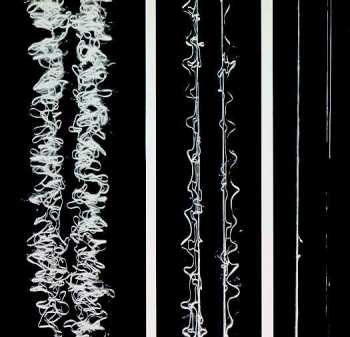
The thread of the orb web spider Araneus diadematus is very elastic and can be stretched 30 - 40% before it breaks. Steel can be stretched only 8% and nylon around 20%. In the picture one can see the thread of the spider Stegodyphus sarasinorum that, because of its weaving technique, can be stretched up to 20 times it original length.
A lot of orb weaving spiders recycles their web. The weaving of a web
takes up a lot of the spider's resources. Since they need to renew their
web regularly, they eat the silk. Only the main thread of the web is left
intact. They usually weave a new web in the morning.
 |
 |
|
|
|
By studying their threads two groups of spiders can be recognized, the Cribellate and the E-cribellate spiders.
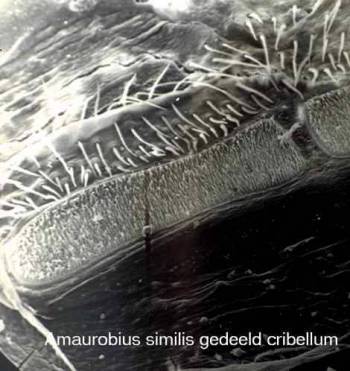
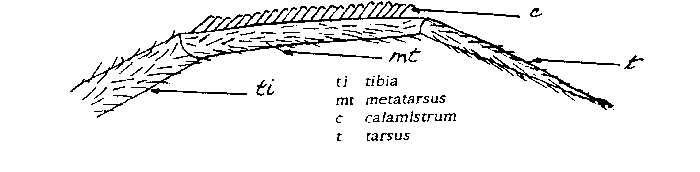
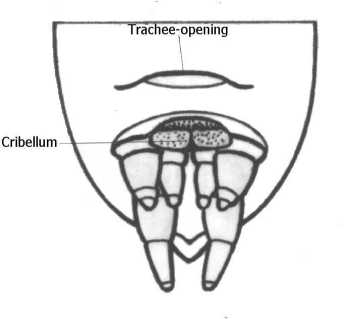
Cribellate spiders comb their silk to a wooly structure. To do this
they have a comb (calamistrum) on the metatarsus or the tarsus of the fourth
legs and an extra silk producing organ (cribellum) just in front of the
spinners, which appears as a transparent plate. The comb pulls the silk
out of the cribellum and the silk is combed to a wooly structure. The combed
silk is made up of thousands small threads enforced by some thicker ones.
There is no glue on the threads but the insect gets stuck with the hairs
on their body in the silk. The thicker threads in the silk prevent the
insect from tearing the silk.
 |
 |
|
|
|
Applications of spider silk
Spider silk was and is used for several applications. Polynesian fishermen use the thread of the golden orb web weaver Nephila as fishing line. In the New-Hebrides spider web was used to make nets for the transportation of arrow points, tobacco and dried poison for the arrow points. Some tribes in New-Guinea used webs as hat to protect their head for the rain
In World war one the threads of Araneus diadematus, Zilla atrica, Argiope aurantia and other orb weavers were used as cross hair in instruments.
In 1709 a Frenchman, Bon de Saint-Hilaire, demonstrated the possibility to make fabric from silk. Many cocoons were boiled, washed and dried and the thread was collected with fine combs. Some socks and gloves were produced. A study to the economic yield of this method revealed that this would never be profitable. It was calculated that 1.3 million spider cocoons were needed to produce one kilogram of silk.
In Madagascar there were some attempts to milk Nephila's for the production
of silk. By hand a thread was pulled out of the spinner of the spider.
If the spider was exhausted she was put back in the forest and the next
spider was milked. The gathered silk had a beautiful golden color. This
project was also banned because of many problems. Nowadays one tries to
produces silk in factories.
 |
|
|
The web
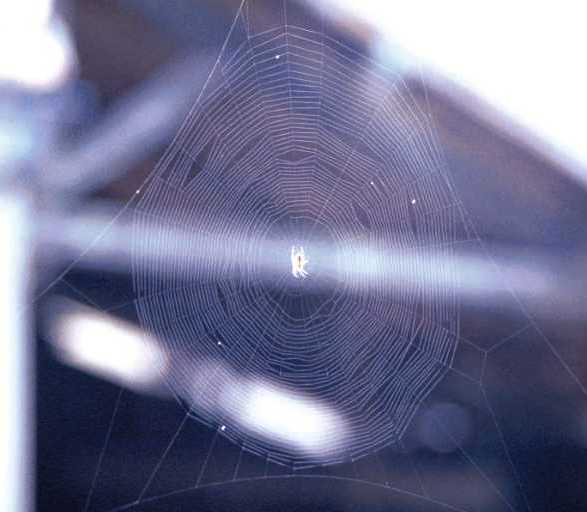
Three simple forms of web can be recognized. The sheet web, the orb
web and the spatial web. The most well known form is the orb web. How is
this web constructed?
 |
|
|
The most difficult part is the construction of the first thread. This is a sturdy horizontal thread on with the rest of the web is hanging. How does the spider connect this thread between the two connecting points? She can not fly. Does she connect a thread at one place, walks downs with an enrolling thread behind her to the other side where pulls the thread horizontal and connects it?
No, the answer is simpler. She makes use of the wind and some luck.
 |
 |
 |
 |
 |
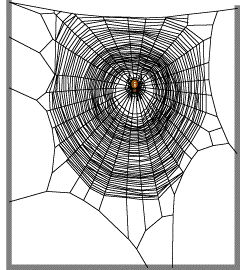 |
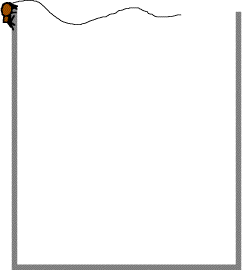
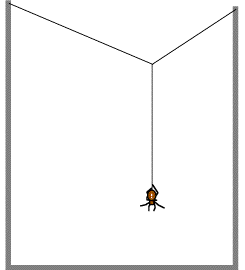
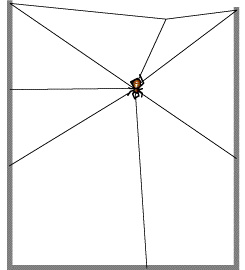
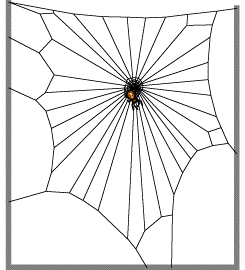
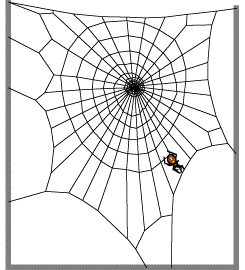
The wind caries a thin adhesive thread released from her spinners while making the thread longer and longer. If she is lucky the thread sticks to a proper spot. Then she walks carefully over the thread strengthening it with a second thread. This is repeated until the primary thread is strong enough. After this she hangs a thread in the form of an Y below the primary thread. These are the first three radial of the web. More radials are constructed taking care that the distance between the radial is small enough to cross. Then the adhesive spiral thread is placed and the web is ready to be used. Not every web is constructed in this way, a lot of variation are possible. The web on the pictures above has a inverted Y that was connected to an electrical wire 10 meters higher. Besides the orb webs other catching web designs are used. A particular one is that of the net-casting spider Deinopsis. This spider constructs a web between her forelegs and hangs head down waiting for a insect to pass. The web is thrown over the victim and entangles it. The Bolas spider also has a special catching technique. As the name may suspects she throws the thread with an adhesive bubble at the end to her prey. The prey is decoyed by chemical substances (pheromones).
The trapdoor spider hides in a tunnel that can be closed with a door. If the prey walks over a signal thread the door is opened and the spider grabs it.
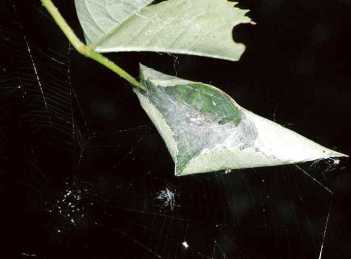
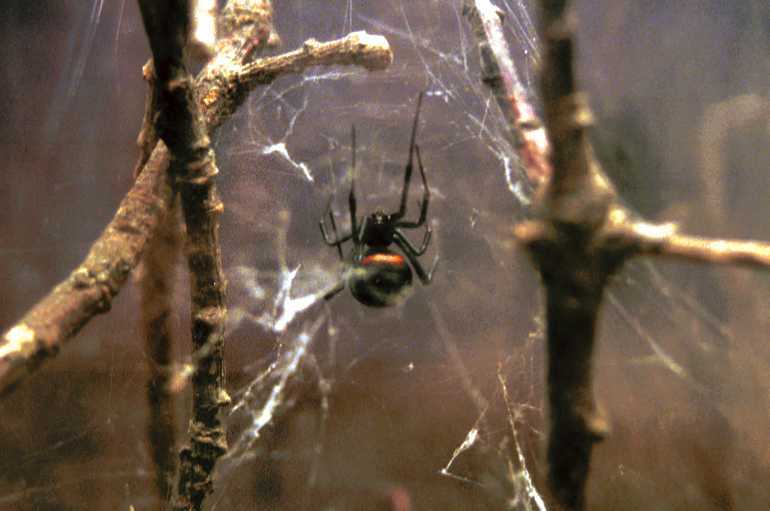
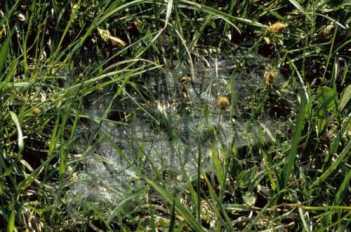
Besides the flat, two-dimensional orb web the Linyphiidae and Theridiidae
to which the black widow belongs use three-dimensional space webs. Linyphiidae
makes a horizontal dense sheet web with a lot of non-adhesive threads above
it. If an insect flies against a thread it tumbles down on the mat and
is grabbed. The Theridiidae construct a messy space web in which the prey
gets entangled.
 |
|
|
 |
 |
|
|
|
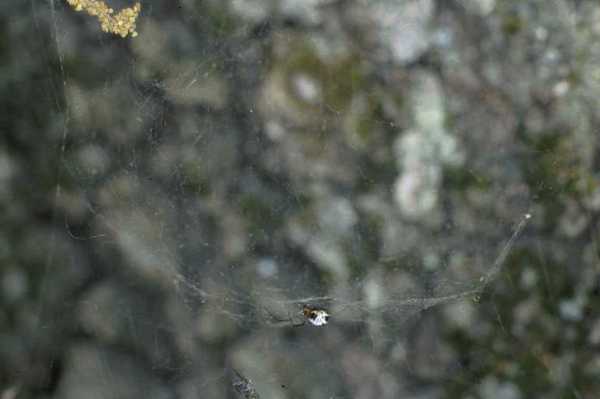
Funnel weavers construct horizontal mats and wait in a funnel at the end of the web for an insect to land on the sheet.
Hunting spiders like the jumping spider, the lynx spider and the wolf
spider do not use webs to catch prey. They use their eyes and speed to
catch insects. They often use a thread as lifeline. While moving they release
a thread. If they fall down after a jump the lifeline makes it possible
to return to their original position. The wolf spider only uses silk for
furnishing her hiding and breeding place.
 |
|
|