The Spider Jaws and Poison

The Spider Jaws and Poison
Only two spiders are dangerous to man: the black widow and the brown recluse. The bites of these spiders rarely cause death. However, they may cause serious health problems for children, the elderly, and those in poor health.
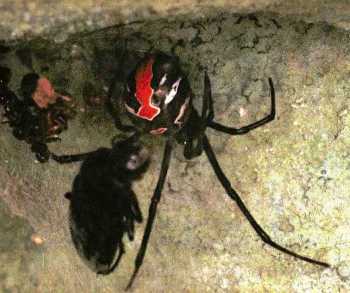
The female black widow is a black, shiny spider with a red or orange hour glass shape on her belly (underside). The smaller, brown male spider is not poisonous. The black widow spins her web in dark, quiet places - under rocks, debris and woodpiles. Black widows also like attics, cellars, and other damp storage areas. The bite of the black widow may be painful. Within one hour after being bit, you may experience stomach pain, dizziness, stiffness, and trouble breathing.
The brown recluse is a yellowish-tan to dark brown spider. It is about the size of a quarter. The brown recluse has a dark violin-shaped marking on its head. This spider also spins its web in dark, quiet places. The bite of a brown recluse may be very painful. Within 36 hours after being bit, you may experience restlessness, fever, chills, nausea, weakness, and joint pain. A bulls-eye shaped blister or wound may develop at the bite site. If the wound is not treated by a doctor, it may get larger.
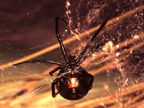 Black Widow
First Aid: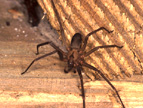
1. Wash the bite site with soapy water.
2. Call or go to the Hospital right away for more treatment advice.
Brown Recluse
Safety Tips:
Before dressing, shake out clothing, shoes, and hats that have not
been worn for a while. Wear shoes and gloves when getting fire wood, lumber,
and other items that have been stored for a long time. Get rid of clutter
in basements, closets, attics, and garages. Dust and vacuum around windows,
corners of rooms, under furniture, and in storage areas regularly.
 |
 |
|
|
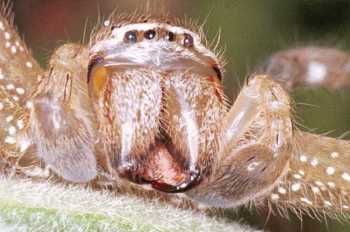
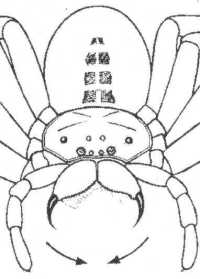
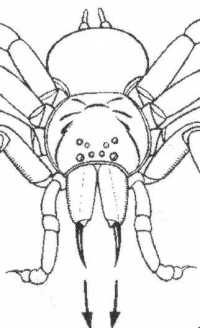
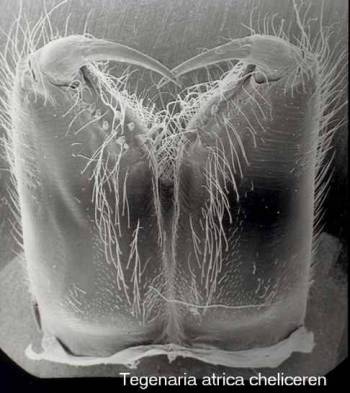
The jaws of a modern spider, Aranaeomorphae, are
used to grab and crunch a prey. Most spiders use poison to kill their victims.
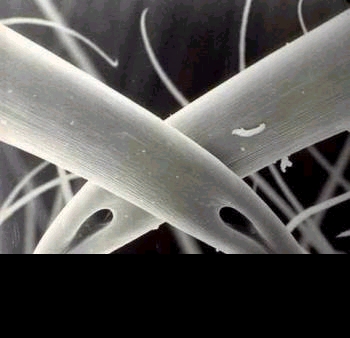
At the end of the jaws are two syringe-like structures that are hollow
and very sharp. These are used to puncture the body of a victim and to
inject the poison. The poison is produced in special glands. These cells
grow into small sacs with poison (vesicles) which, migrate to a special
bladder where they burst. Around this poison bladder there is a spiral
muscle that contracts to eject the poison through the syringes in to the
prey.
 |
 |
|
|
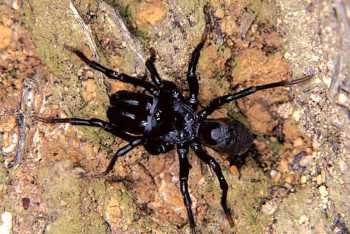
Primitive spiders, Mygalomorphae, have forwardly
pointing jaws that move forwards and backward in contrast to the modern
spider. Therefore they can not crunch a prey. They wait until the prey
contents are dissolved before they can suck it empty.
 |
|
|
The poison of a spider contains protein, amines and polypeptides. Some of these molecules are capable of disrupting thecommunication between the nervous system and the muscles, which causes paralysis. Other molecules cause death of cells,which leads to necrosis. After the prey is killed the spider spits enzymes from its mouth into the victim. Enzymes dissolve the contents of the prey. Mammals dissolve their meal in a stomach using the enzyme pepsin. The spider digests the proteins in the prey itself and sucks it empty.
How lethal is the poison of a spider? This is difficult
question to answer. A poison is given a number LD50 to express its toxicity.
LD50 stands for quantity of a lethal dose needed to kill 50% of a tested
population. The poison of a black widow spider has a LD50 of 0.9 mg per
kg mouse. Therefore 0.013 mg poison is enough to kill one mouse. The spider
needs 2 mg to kill a frog. So the lethality differs among animals. Such
a test has never been performed on humans. Therefore it is difficult to
calculate how poisonous a spider is for humans. We know that the black
widow can kill people.
 |
 |
|
|
The lethality of spider's poison to humans is very
exaggerated. However there are spiders that are dangerous to humans. The
Latrodectus species (Black widow), the Australian Sydney funnel web spider,
Atrax robustus, and some wandering spiders from South -America are dangerous.
These spiders use a substance that disturbs the nerve system, which can
cause heart rhythm disturbances, cramps, shaking, pain and dizziness. A
spider sting can be fatal to children and persons with weak constitution.
 |
 |
|
|
|
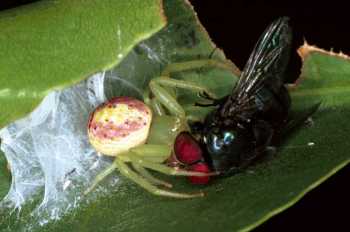
There are also many spiders that give a nasty bite comparable to the stinging of a wasp. Most of the venom injected with these bites causes cell death and gives rise to a wound that does not heal properly and becomes easily infected. In Europe there is the water spider, Argyroneta aquatica, which has a very nasty bite. Immediate cooling of the wound is the best medicine.
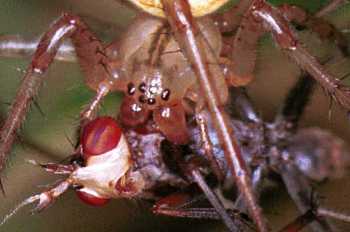
Most modern spiders crunch their catch with their
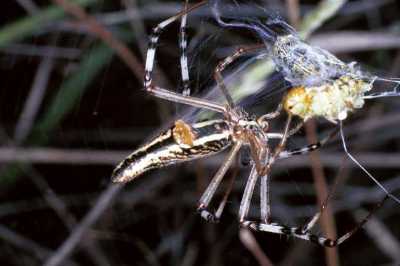
jaws. Other spiders wrap their prey in silk, taking care that the victim
does not bite them. Orb weaving spiders make a parcel of the prey and wait
until the prey is dissolved before sucking it empty. Crab spiders do not
use silk but use a rapid working poison. Spiders of the family Uloboridae
do not have any poison and put their trust completely on their silken thread.
 |
|
|
The injected enzymes dissolve the prey. Then it is sucked empty. The mouth of a spider is located between the palps which, is connected to the stomach muscles that perform the sucking. Between mouth and stomach is a filtering device that is made up of thousands of fine hairs. Only particles smaller than 1 mm can pass through this filter. This is so small that even the particles in India ink will be filtered out so that only water can pass through. With these filters the spider prevents bacteria, viruses and other harmful life forms from entering its own body. The filter is regularly cleaned with its upper and lower lip.
Because the food that is taken up can be large in comparison to its own body volume, the abdomen of the spider can swell enormously. The digested proteins are stored in a special place. This makes it possible for the spider to live for several weeks on a single prey. The waste substances are chemically converted to harmless crystals and are stored in special cells. These white colored guanocytes are located in-groups and can be seen through the skin. This shows up as a very special pattern on the back of the orb weaving spiders.
Special excretor