 |
| THE FUTURE FATE OF THE MILKY WAY GALAXY |
| COLLISION SCENARIO FOR THE MILKY WAY AND ANDROMEDA GALAXIES |
|
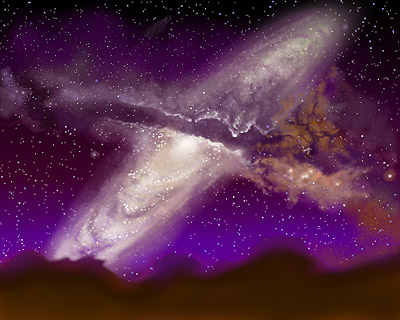
| The Milky Way and the Andromeda Galaxy are approaching each other with a speed of 300,000 miles per hour. It's not certain yet wether we're in store for a head-on collision or a simple sideswiping by the massive galaxy, wich is a near twin to the Milky Way. Astronomers will first need to use powerful new telescopes to ptrcisely measure Andromeda's tangential motion across the sky. (Just as a baseball outfielder estimates wether a ball is heading directly toward him or is going to miss him by determining wether the ball is moving sideways.) |
| A directly collision would lead to a grand merger between the two behemoths, and the Milky Way would no longer be the pinwheel spiral we are familiar with. but would evolve into a huge elliptical galaxy. It would happen no sooner than five billion years in the future, By the sun may have burned out, and the Earth reduced to a frigid, lifeless cinder. It's impossible to predict if there would be any vestige of humanity colonized among the stars, not to mention extraterrestrial civilization around to witness this great collision. |
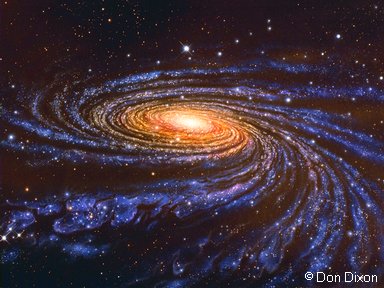 |
| The collision will take several billion years to fully run its course, so it will be hard for any one civilization, like ours, to fully understand the vast scale - both in time and space - of the collision. However, by studying pairs of other colliding galaxies and using computer simulation, astronomers can assemble a series of snapshots of the collision process and get a preview of what might eventually happen to our galaxy Here is a scenario of how the Milky Way might change if it were to have a head-on collision with Andromeda. |
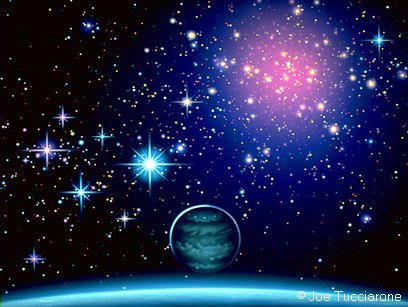 |
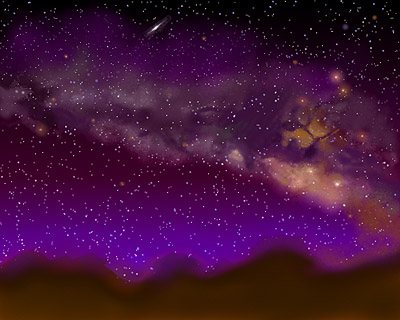
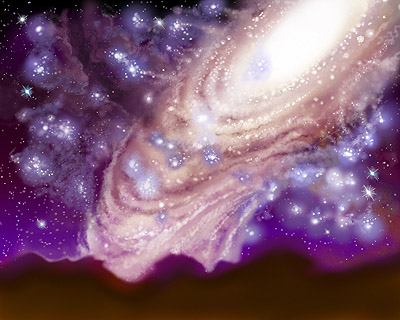
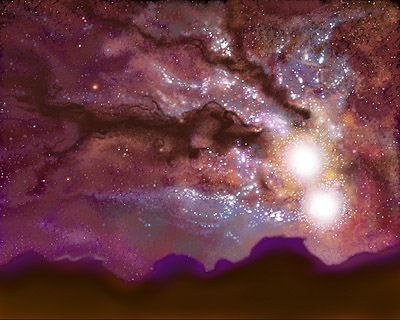
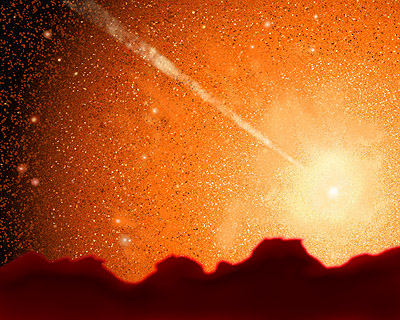
| The disk of dust and stars that for billions of years marked the lanes of our galaxy and the Andromeda galaxy, will also begin to come apart under the gravitational pull of the two galaxies. As Andromeda swing past our galaxy, the sky will grow increasingly jumbled with tattered lanes of dust, gas and brilliant young stars and star clusters. So many new stars will be born that the fraction of massive stars that are presents will increase dramatically. These stars will begin popping off like a string of firecrackers as they self-destruct as supernovae. After swinging by our galaxy, Andromeda will take perhaps 100 million years to make a slow and graceful U-turn, before plunging nearly directly into the Milky Way's core. Another, even more spectacular burst of star will the occur with the winds from the supernovae driving most of the remaining gas and dust out of the galaxy. Soon both the old and new stars of the two galaxies will intermingle to form a single elliptical-shaped galaxy. As the stars gravitationally settle into their new home, through a dynamic process called "violent relaxation", any hint of the Milky Way and Andromeda as majestic spiral galaxies will be gone. The band known as the Milky Way will be gone, but far into the core of the new elliptical galaxies. They would have no clue that there were once two majestic spiral galaxies, called the Milky Way and Andromeda by a long forgotten civilization, |
| The Andromeda galaxy appears simply as a spindle-shaped smudge of light in the northern autumn sky. Because it is 2.2 million light years away -- or roughly 20 time the diameter of our Milky way galaxy - it only appears four times the width of the full moon. As the two galaxies approach each other, Andromeda will grow larger in the sky, resembling an eerie glowing sword of light. When the Andromeda galaxy and our Milky way galaxy are close enough, huge clumps of cold, giant molecular clouds, each measuring tens to hundred of light-years across, will be compressed. Like plugging in a string of Christmas light bulbs, these dark knots will be in brilliant blue clusters, many o them 100 times brighter than the original globular star clusters already present in the two galaxies. |
 |
 |
 |
 |
 |

|
 |