 |
|
|
|
|
|
|
|
|
|
|
|
|
|
|
|
|
|
|
|
|
|
|
|
|
|
|
|
|
SCHOOL CAPACITY�������������������������������������December 16, 2003 |
|
|
|
Return to Home Page |
|
|
|
|
|
How do we measure school capacity?� Specifically, how do we measure capacity at Avon High School? |
|
|
|
An analysis prepared by the Avon Public Schools seems to indicate that capacity should be measured by applying a standard space allocation for each pupil.� For purposes of the analysis, a space allocation of 180.5 per pupil was applied to total building size of 163,500 to arrive at a "design capacity" of 900 pupils. |
|
|
|
The analysis goes further to suggest that "recommended square feet per student" of 180.5 should be used as a "standard" design parameter.� A reader of the report would then be led to believe that if the projected enrollment of 1,200 students at the high school is reached, we should have a 216,600-square foot building.� And this would necessitate adding 53,000 square feet to the existing facility. |
|
|
|
I find the analysis misleading. The use of 180.5 sf per pupil as a capacity constraint is inconsistent with its intended use. (Read the BOE report and analysis: Avon High School Facility Report, Dec 2003, - pdf file) |
|
|
|
State Department of Education (SDE) documents define the above "standard" as the maximum square footage per pupil allowance that the department would consider in the calculation of school construction grants.� To wit: |
|
|
|
"These standards shall be used as maximums for grant computation purposes.� The square footage per pupil allowances for all grades housed shall be summed and divided by the number of grades housed to determine a maximum square foot per pupil for the facility."� (Regulations of the State Board of Education Concerning School Construction Grants) |
|
|
|
"The enclosed worksheet will assist you in computing the maximum facility total square footage eligible for reimbursement for this project."� (Instructions for Space Standard Worksheet) |
|
|
|
"In actual construction, districts are not limited to the maximum allowable square footage per pupil.� However, grant reimbursement is reduced to reflect the degree by which a school exceeds the maximum allowable square footage."� (Space Standards, Educational Specifications, State Department of Education website) |
|
|
|
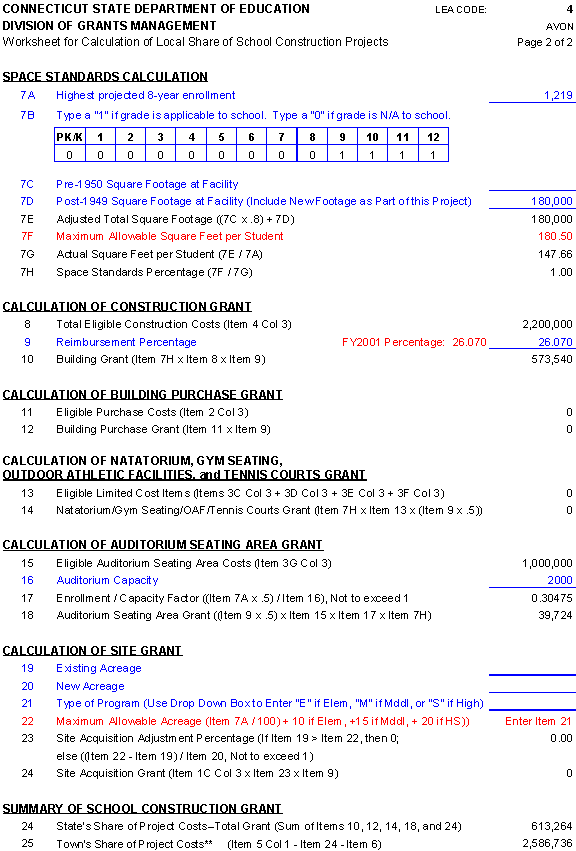
In other words, the "standard' is not intended to be used as design parameter. It is a cap used to limit the amount of school construction grants.� A district that builds a school with a square footage per pupil of less than 180.5 sf would not suffer a reduction in grant money.� This statement can be validated by inputting data into the Grant Calculation Worksheet that is posted at the SDE website.� Please refer to Grant Calculation Worksheet below.� There is no penalty for building less than 180.50 per pupil. |
|
|
|
 |
|
|
|
In the strictest sense, the minimum size of a school building will be dictated by the State's Basic Building Code, Connecticut Fire Safety Code and, to a certain extent, Federal accessibilities law under the American Disabilities Act (ADA).� With adjustments for specific program requirements at the school and guided by an established set of space standards, the proper size of the building can be determined. |
|
|
|
How then can we measure existing school capacity? |
|
|
|
One approach is to conduct a "classroom inventory" similar to the worksheet at the end of this article.� The second to the last column is a calculation of "practical capacity" for each classroom. "Practical capacity" is the number of classes offered in a given classroom multiplied by an average class size of 23 pupils.� The sum of "practical capacities" for all classes offered in the same core subject will yield the school's capacity for that subject.� The calculation is replicated for all core subjects.� Based on this calculation method, the existing capacity at the high school is estimated to be around 1,050 to 1,100 students (vs the declared capacity of 900 students). |
|
|
|
Click here to view the classroom inventory at Avon High School |
|
|
|
The above calculation took into consideration "current class offerings" and made no adjustments for 6th period teaching assignments, or the planned reassignment of classrooms to other programs.� There was also no adjustment made for additional classes that could be offered, if practicable, to increase utilization of existing classroom space.� Finally, there was no adjustment made for possible changes in average class size - currently, 23 pupils per class. |
|
|
|
If the existing building can indeed accommodate up to 1,100 students, the average square footage per pupil would be 150 sf.� This space allocation is not unrealistic.� For comparison purposes, average square footage for high schools in other states or districts is:� Illinois = 140; Texas = 150 to 170; Anchorage, Alaska = 150. |
|
|
|
The above analysis indicates that the Town should wait until a more detailed analysis of existing capacity at Avon High can be completed. |
|
|
|
Click here to view the BOE's Powerpoint presentation: High School Facility Report (requires Powerpoint Viewer) |
|
|
|
Return to Home Page |
|