 |
|
|
|
|
|
|
|
|
|
|
|
|
|
|
|
|
|
|
|
|
|
|
|
|
|
|
|
|
|
|
|
|
|
|
|
|
|
|
|
|
|
|
|
|
|
|
|
|
Avon Public Schools - Enrollment Projections |
|
|
|
"The recent past will be a good indication of the near future." Peter M Prowda, Ph D, Education Consultant, State Department of Education, Oct 30, 2001 letter to Avon Public School Superintendent |
|
|
|
"... the enrollment projection assumes that what has happened in the past will continue to happen in the future." Appendix A: Population Characteristics and Projections, Avon Public Schools, circa November 2003 |
|
|
|
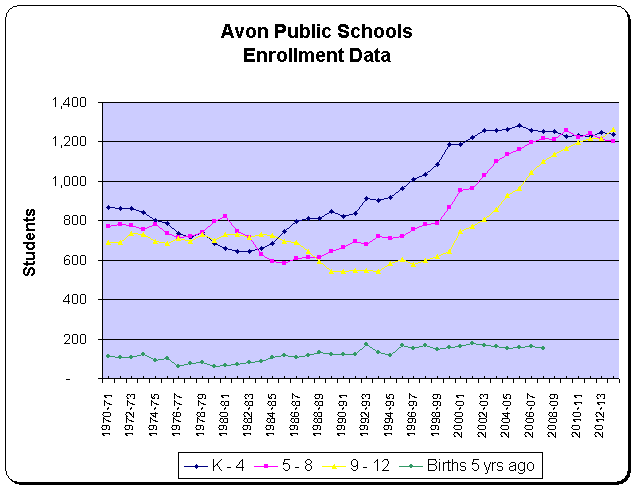
Chart 1 - Enrollment Data from 1970-71 to 2003-04 (Actual) and thru 2013-14 (Projected) |
|
|
|
 |
|
|
|
Please refer to Appendix A for detailed enrollment data for Grades K to 12. The above projections indicate enrollment of 1,263 students in high school Grades 9 thru 12 in school year 2013-14. The discussions that follow question the reliability of the above projections. |
|
|
|
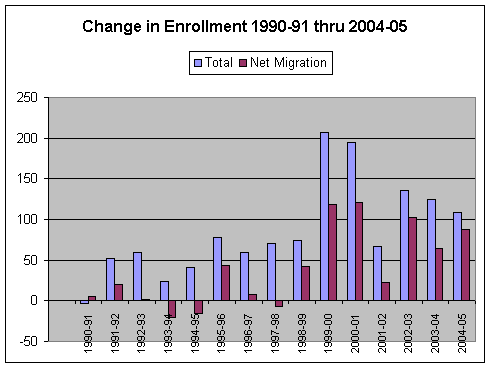
First, let us examine the impact of net migration on the student population. Data for the last fourteen years is presented in Chart 2. |
|
|
|
Chart 2 - Change in Total Enrollment including Net Migration from 1990-91 |
|
|
|
 |
|
|
|
From the above data, it is clear that net migration into Avon had a material impact on the size of the student population. The data also validates the explosive growth in student population that started in the late 90's. Further analysis of the data however reveals an interesting phenomenon. Over the same period, the impact of net migration on different grade levels is not equal. |
|
|
|
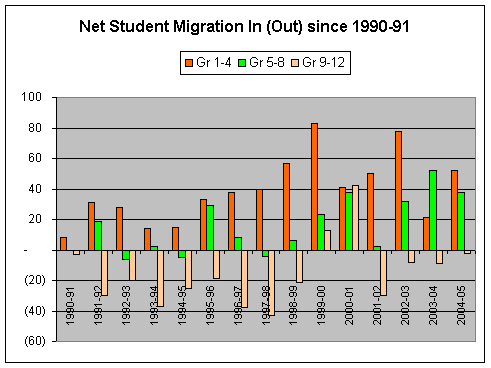
Chart 3 - Net Migration Classified by Student Group |
|
|
|
 |
|
|
|
As the above chart clearly shows: (a) Consistently, there was net migration into Grades 1 thru 4; (b) There was less consistency in net migration into Grades 5 thru 8; and, (c) In 12 of the last 14 years, there was net migration out of the high school. Please refer to Appendix B for details by grade. |
|
|
|
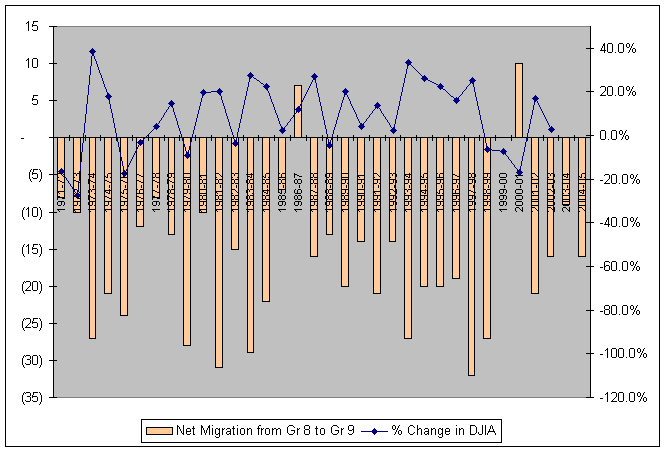
Chart 4 - 30-year History of Net Migration between Grade 8 and Grade 9 vs Change in DJIA Index |
|
|
|
 |
|
|
|
Historical data also shows that most movements out of the high school occur when students transition from Grade 8 to Grade 9; most likely to continue their high school education in private schools. Chart 4 above shows the phenomenon clearly. This phenomenon is quite important as it would affect the projections for high school enrollment over the next ten years.
The effect of the business cycle is quite evident from the above chart. It is perhaps not a coincidence that outward migration between Grade 8 and Grade 9 occurred during market boom years; the latest one having started in 1992 and ended in 2000 - a typical 8-year business cycle. When times are good, more parents send their children to private schools. Conversely, when times are not so good, children stay in public schools.
Net migration reversed in the years 1986-87, 1999-00 and 2000-01 when the bear market set in. But this trend was short-lived. We are now again in the beginnings of a new bull market; and, slowly but surely, net migration out of 9th Grade had began to show up in the charts - witness the last four years in the above chart. |
|
|
|
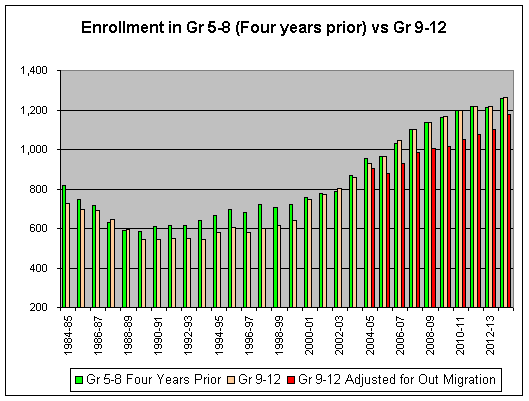
It is now time to look at the recent past. Chart 5 compares enrollment at the high school with enrollment in Grades 5 thru 8 four years prior. The migration trend that occurred during the 90's is unmistakable - enrollment in Grades 9-12 were consistently lower than those in Grades 5-8. |
|
|
|
Chart 5 - Enrollment between Grades 5-8 and Grades 9-12 (Four Year Lag) |
|
|
|
 |
|
|
|
The above chart supports the hypothesis that during the prosperous 90's, parents took their children out of the public school system. As we enter into a new cycle of economic expansion, historical data should guide projections of enrollment at the high school. One could definitely argue that increased out migration would occur again in the next eight to ten years. Witness the beginnings of this phenomenon in enrollment data for 2003-04 and the projection for 2004-05. In both of these years, enrollment in Grades 9-12 is lower than enrollment in Grades 5-8 four years prior. |
|
|
|
The red column in the above chart is a projection of high school enrollment after adjusting for out migration. The adjustment factor was determined by taking the five-year moving average of the loss in enrollment (between Gr 5-8 and Gr 9-12) during the period from 1992-93 thru 2001-02 - a full ten years of the most recent boom/bust cycle. The loss percentage was then reduced by 2% to allow for a margin of error in the averages. |
|
|
|
"The recent past will be a good indication of the near future." |
|
|
|
" ... the enrollment projection assumes that what has happened in the past will continue to happen in the future." |
|
|
|
Recommendation: Enrollment projections must be reevaluated. The Board of Education must reassess high school enrollment projections for the next ten years by taking into account what happens to high school enrollment during economic boom years. These projections are a critical element of the high school expansion project, as they will dictate the magnitude as well as the timing of this very large capital expenditure. |
|
|
|
Appendix A - Enrollment Data |
|
Return to Home Page |
|
|
|
Appendix B - Migration Data |
|
|
|
|
|
|
|
|
|
Net Migration was calculated based on prior years' enrollment for each grade. For example, if the enrollment in 1st Grade last year was 200 students and the enrollment in 2nd Grade this year was 250 students, the additional 50 students are deemed to have come from net migration. This calculation was applied to Grades 1 thru 12.
Net migration at the Kindergarten leven was determined by comparing Kindergarten enrollment with the number of births five years prior. |
|