Life of St. Stanislaus Kostka S.J. 1550 – 1568
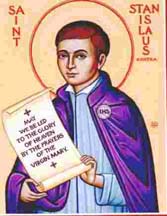
Stanislaus Kostka was born on October 28th,1550 in Rostkovo, Poland. His father, John Kostka, was a Senator of the Kingdom of Poland, and his mother, Margaret, was the aunt of a Chancellor of Poland. Stanislaus was the second of seven children. He and the rest of his siblings were first taught at home under the care of a tutor.
In July, 1564, when Stanislaus was fourteen, he and his older brother Paul were sent to Vienna to attend the Jesuit college there. They were accompanied by their tutor, Bilinski, and three servants. Among the students at the college, Stanislaus was conspicuous not only for his amiability and cheerfulness, but for his religious piety. It was at the college that he first formed the idea that he wanted to be a Jesuit. He remained at the college for three years, until it was shut down. The Emperor had died, and his successor was Lutheran, so the college was forced to close. Stanislaus and his brother, along with their tutor went to live in a fashionable house in Vienna, continuing their studies privately.
Stanislaus and his brother were of different personalities. Paul was a man of the world, with plenty of money, and wanted to enjoy all the amusements Vienna had to offer, while Stanislaus was very religious, with a strong sense of right and wrong. This led to a battle of wills between them. Paul constantly bullied his brother and ridiculed his piety. Stanislaus put up with the ridicule and violence, but stood by his principles. He considered Paul’s way of life wrong and refused to join him. Eventually, Stanislaus fell ill, so ill that his tutor thought he was going to die. Stanislaus asked for a priest to administer the last sacraments, but the landlord, who was Lutheran, would not allow a priest into the house. One night, Stanislaus had a vision of the Virgin Mary, who spoke to him and told to become a Jesuit. In the morning, Stanislaus was found to be well.
For many months Stanislaus had wanted to be a Jesuit, but he hesitated. If he mentioned it to his brother, it would bring on more jeering and bullying. In addition, because his father was a nobleman, he regarded it as a disgrace for his son to become a priest and a Jesuit. After his recovery he hesitated no longer, and applied to the Provincial of the Jesuits asking to be admitted to the Society of Jesus. The Provincial, knowing that trouble from Stanislaus’s father would follow, refused to admit him unless he obtained permission from his father. However, Stanislaus was advised by a priest that the only way he could realise his ambition was to apply to Fr. Peter Canisius, the Provincial of Upper Germany, who was at Augsburg, and therefore not so close to Prince John.
On the morning of the day he left, he told his servant to notify his brother and tutor that he would not be back for dinner. He then began his journey, taking the first opportunity to exchange his gentleman’s clothes for those of a beggar. When evening came and Stanislaus had not returned, his brother and tutor formed a search party started to follow him, but were not able to catch up with him.
Stanislaus walked the 300 miles from Vienna to Augsburg, were he pleaded with the provincial, Peter Canisius to allow him to enter the Society. After hearing his story, Peter Canisius agreed to accept Stanislaus into the Society. However, Stanislaus felt that he was still too close to Poland, and that his father would demand that he return home. He therefore asked to be sent to Rome, and, after a journey of a thousand miles, he arrived in Rome in October, 1567. He was then admitted by the general of the order, Francis Borgia to the Jesuit novitiate (a period of training in religious life and prayer).
According to the testimony of the master of novices, Stanislaus was a model of religious perfection. In spite of his delicate constitution, he did spare himself the slightest penance. After ten months in the novitiate, Stanislaus became ill on August 10th1568. At three o’clock in the morning of August 15th, he said that the Blessed Virgin Mary and the saints were around him, and he quietly and happily died, a few months short of his eighteenth birthday.
Stanislaus was beatified in 1605, and canonized on December 31st, 1726. St. Stanislaus is a patron saint of youth, and many religious institutions have chosen him as their patron saint. His feast day is celebrated on November 13.