| Le Triomphe de l'Amour
"The basest soul, the most vulgar lovers, the most folly-ridden youth, have not known my turbulence: worries, jealousies, soaring ecstasies, all take their turn with me!" -- Hermocrate, Act II, Scene XII. (Want to see more? Read a translation of Act 1, Scene 8, where Hermocrate, the philosopher, meets the Princess, who is disguised as a man; and then, a translation of the dialogue from Act II Scene 12.) (The Triumph of Love), first produced in 1732, is
"the little dictionary" to the plays of Marivaux. Its
language, plot and stratagems serve as a Rosetta-stone to the author's
romantic vision. Little In recognition of this honor for Marivaux, we will present
some material on the play and, if we are lucky, we may be able to provide
some insight and entertainment. Le Triomphe de l'Amour will be staged
at the Almeida in Bath
in August, but it will also tour in Norwich and Malvern, as well as London
of course.
As the perplexed Marivaux himself reported, the play,
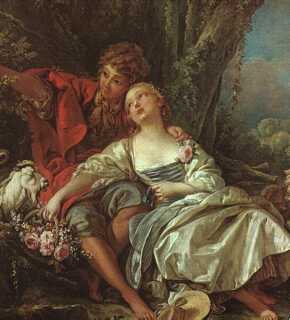
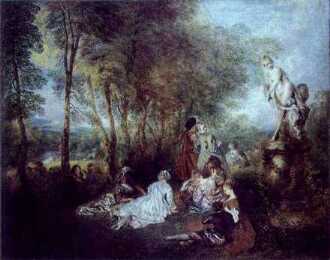
which is in many ways about The paintings on this page are by François Boucher
(top) and Antoine Watteau, respectively.
Reviews and Related -- The Triumph is often shown to take place in a wonderfully elegant country setting, but the plot affords a tremendous latitude in set design. You might visit a web site featuring photos of the set from a past production by another theater company. The same site provides a brief synopsis of the plot. -- Along with that, you might read Steve Capra's mixed review of yet a third recent production, review courtesy of the Xlnt Arts site. – review of a 1998 staging by another company and translator -- Planchon's direction of / comments on the play, with ref to Hermocrate and Le Réunion . . . -- Elizabeth Reitz Mullenix's 1997 article on the revival enjoyed by Le Triomphe de l'Amour. http://www.arts.ilstu.edu/shakespeare/research/ISFtriumph.html -- Read the enthusiastic review of a 1996 musical production, jointly by Center Stage (Baltimore) and the Yale Repertory Theater. -- In French. Short bio of Marivaux, together with a reasonable picture, from the Comédie-Française. |
 wonder
this elegant jewel about the relationship of head and heart, about how
love melts its way through all resistances, is today one of Marivaux's
most popular and often-staged plays. It is currently in rehearsal for performance
in a new translation by Martin Crimp, at the enormously respected and admired
wonder
this elegant jewel about the relationship of head and heart, about how
love melts its way through all resistances, is today one of Marivaux's
most popular and often-staged plays. It is currently in rehearsal for performance
in a new translation by Martin Crimp, at the enormously respected and admired
 the
capacity of head and heart to be deceived but to eventually arrive at the
truth of love, apparently puzzled everyone at its first performance. The
play uses an audacious and imaginative range of stratagems and disguises:
friend, lover, confidante, all deceive and all are true. At first it was
received with indifference, but a mere four days later a performance at
the royal Court received enthusiastic acclaim. Since then the play has
received raves, but it has also languished. In the 20th C., and especially
in the last decade, it has been rediscovered and it has been cast into
many molds -- musical, pure classical comedic theater, romance, and that
of a philosophical reflection on love, passion and asceticism.
the
capacity of head and heart to be deceived but to eventually arrive at the
truth of love, apparently puzzled everyone at its first performance. The
play uses an audacious and imaginative range of stratagems and disguises:
friend, lover, confidante, all deceive and all are true. At first it was
received with indifference, but a mere four days later a performance at
the royal Court received enthusiastic acclaim. Since then the play has
received raves, but it has also languished. In the 20th C., and especially
in the last decade, it has been rediscovered and it has been cast into
many molds -- musical, pure classical comedic theater, romance, and that
of a philosophical reflection on love, passion and asceticism.