Salons.
Looking into the past, it is impossible to describe the atmosphere. Intellectual,
refined, socially  complex,
to be sure; but beyond that we can only surmise and extrapolate. -- Or
maybe we can do more. We can sense the ambience between the lines of the
literary works that are, in some sense, the emissaries of the Salons. And
where better to begin than at Saint-Sulpice? complex,
to be sure; but beyond that we can only surmise and extrapolate. -- Or
maybe we can do more. We can sense the ambience between the lines of the
literary works that are, in some sense, the emissaries of the Salons. And
where better to begin than at Saint-Sulpice?
Ever since the unfortunate "incident
of the tossed bone," there has in fact been a special link between the
Ninon de Lenclos and the name Saint-Sulpice (the priestly order, not to
be confused with our web site). Perhaps Ninon's respect for religion was
thus not of the highest order. In any case the 17th C. author Tallémant
des Réaux recounts, in a famous Historiette touching on Lent
of 1651, that instead of fasting, persons from the Royal Court would feast
sybaritically and conspicuously at Ninon's Paris apartments into the late
hours. It happened that during one of these indiscreet celebrations, a
bone was tossed out of a window and it struck, of all people, a passing
priest (who moreover was of Saint-Sulpice!!). The priest, we are saddened
to report, complained to his curé,
and also embellished on the story, saying not only that bones were being
tossed out of windows during nights of the holy fast, but in addition two persons had been killed at the party! The resulting tohu-bohu required an
application of Ninon's considerable connections to calm.
Be
the
case what it may, what we do know is that the women who were the leading
figures of the Salons were -- even adjusting for the over refinement known
as preciosité and for the baroque romanticism of the atmosphere
-- gifted with intelligence and charm. That they also enjoyed the privileges
of aristocracy and wealth, including powerful social connections, should
not obscure the extraordinary talent and character they displayed.
La
Princesse de Clèves,
a novel published in 1678, written by Mme
de La Fayette, is a book altogether too easily dismissible for the artifice
of courtly elegance which seems to circumscribe it. Its style may seem
stilted from today's vantage, but it is a germinal work in a tradition
we can follow to 19th C. Romanticism and even to 20th C. "cool".
The Marquise de Sévigné and Ninon de Lenclos Mme de Sévigné put
an indelible mark on salons even though she spent much of her life outside
of Paris. She is The marquise de Sévigné's voice (she detested pretense) is lively, feminine, penetrating, now challenging, now sympathetic. There is a curiously melodic quality to her writing. She displayed a remarkable emotional range and an almost modern flexibility of mind; but she also possessed the gift of intimacy. To the intellectual males who attended the Salons, she and others like her brought a moral and spiritual standard. We should add to such qualities,
a masterfully subtle erotic presence. Ninon de Lenclos (already referred
to in Mlle Mauvornin's intro
to salons) was as famous for this combination as for her arresting
physical beauty. She became something of a legend; "daring sensuality"
was Gary Kamiya's characterization in the web-zine Salon. Women
like her (although how many could there have been?) were able to link powerful
sexual energy to aesthetic and intellectual conversation -- a fusion of
idealism, manner and sensuality that would have been quite intoxicating.
Just as the desire to surrender can increase proportionately with the danger
associated with surrendering, the desire for adventure increases in proportion
to the sharpness with which the lines constraining our behavior are drawn.
In the 17th-C. social context, a Ninon de Lenclos would be devastating
exactly because she presented an entirely different set of standards: the
eye of the woman whose mind could grasp the complexities of the intellectual
sphere, but whose instincts were closer to the boudoir. She was able to
weigh those around her from a more sensually-evolved viewpoint; hence she
made notorious observations such as "if men's bodies were as solid as their
spirits, few would have much to brag about". She was a great temptress,
for some the most dangerous kind of woman -- a "knowing" one, to echo the
name of a 20th-C. perfume.
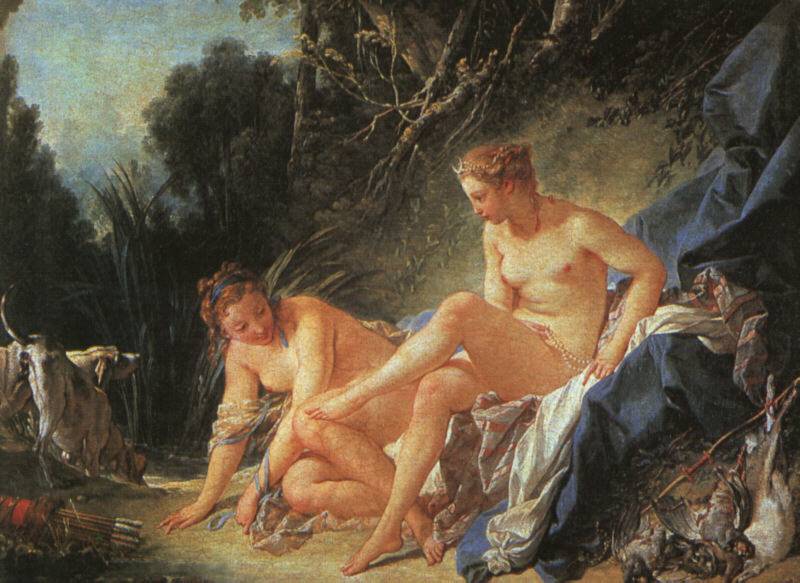
Hypnotic Arousal There is little doubt that Ninon de Lenclos stimulated the sensual awareness of the persons around her. She raised erotic awareness to the status of a cognitive mode, that is to say, a way of perceiving the world that was valid and that revealed the familiar in a new light. She shifted attention to qualities that are only revealed in the bedroom, and she made these seem important. "It takes a hundred times more spirit to make love well, than to command armies," she is reported to have said. Thus she fascinated, and it may be safe to assume that she was even idolized by members of both sexes. One is reminded of François Boucher's outrageously erotic 1740 painting, "Diana Leaving Her Bath", in which the artist presents one of Diana's nymphs gazing, from a near-crawling position, in hypnotized adoration at the gracefully extended foot of the goddess. Such states of being hypnotized
by the amorous idol disclose a particularly French, and particularly Baroque, Ninon and Mme de Sévigné
knew each other well -- perhaps a little too well, as Ninon is known
to have seduced both the marquise's husband and her son. Even Mme de Sévigné's
son-in-law was reputed to have been tempted, although we do not know the
details. Ninon's antagonists were prejudice and moralistic denial of the
sensuous, and she found both of these embodied in religious hypocrisy.
-- Mme de Sévigné, in a letter to her daughter, April 1671 ("But how dangerous she is, this Ninon! If you knew how she dogmatizes about religion, you'd be horrified. Her zeal to pervert the young is on a par with that of a certain Monsieur Saint-Germain")
Maps and Strategies These vignettes provide sketches of the emotional and psychological tapestry against which the salon conversations took place. In no way should we assume today that we are more advanced in understanding the pathways of the heart and mind, than those who managed to weave romantic and philosophical -- or to cite another classic polarity: sexual and theological -- verities into a coherent vision. Thus the profound insight of these women, and of some of the men who frequented them, into human behavior and mores would have gone beyond the "traditional feminine arsenal" for navigating the treacherous waterways of amour. And what could be more French than a mix of clarity and passion, of sexuality and religion? The more ruthless and clear the vision the better. The enormously admired writer and romantic figure Mlle de Scudéry created a map of the territory of love, the Carte de Tendre, as she called it -- a geography of the journey from first meeting to mad passion and union, through a country irrigated by the river of "Inclination", and if one drifts too far from its magical flow, one encounters the "Lake of Indifference" on one side and the "Sea of Enmity" on the other. The delicacies of the language, combined with the expectations of gallantry made for a richly baroque texture within which the amoureux could pursue their interests. But behind the whimsical, parlor-game
surface of the famous Carte are some hard edged truths. The rules
of love were being formulated.
Les Politesses Amoureuses If we look at the literary products by women who participated in these Salons, from Mme de La Fayette to de Sablé and de Scudéry, we might also temper any criticism with the recognition of the literary conventions of the day and the degree of realism, or lack of it, that was expected at the time. Conventionality was but one mask through which a master weaver worked. In matters of the politesses amoureuses, we begin with politesse; it is the packaging, and the surprising erotic force and sensuality we may discover deeper within is maintained at all costs within social norms. If we can read La Princesse de Clèves with a readiness to "breathe within the imagery of the work", we can intuit much deeper waters and a sharper consciousness -- in spite of the somewhat relentlessly vague and idealized descriptions of the characters. But articulation has a price. The
vision of love that emerges from the Salons is often taken to be a cynical
and pessimistic one. It is a temptingly easy assumption. Love is presented
as selfish, because it is driven by the desire to possess; dangerous, because
it overflows all control ; humiliating, because it makes the lover a slave;
and false, because its satisfaction almost certainly assures the rise of
complacency if not of infidelity. In the next century, another great French
philosopher of love, Marivaux, wrote:
 "De
toutes les façons de faire cesser l'amour, la plus sûre est
de le satisfaire. Le coeurs ardents et sensibles cessent bientot d'aimer
parce qu'ils se hâtent trop d'aimer." (The
surest way to end love is to satisfy it. The most ardent and sensitive
hearts soon stop loving because they were in too much of a hurry to taste
it.") "De
toutes les façons de faire cesser l'amour, la plus sûre est
de le satisfaire. Le coeurs ardents et sensibles cessent bientot d'aimer
parce qu'ils se hâtent trop d'aimer." (The
surest way to end love is to satisfy it. The most ardent and sensitive
hearts soon stop loving because they were in too much of a hurry to taste
it.")
Why such views might have gained currency is a question that leads us toward a central secret. In the French Baroque view, love is not about fulfillment. It is about desire and what it does to the self. It is a modern psychology because it is an evolutionary psychology: it describes the effects of love in terms of transformation of the lovers. If one rushes to satisfy passion, one risks killing it; one certainly interrupts the sequence of energies and inner events which, if sustained, are creative and transforming. Ironically, it is for this creative role that the view of love in the Baroque French tradition has been accused of being pessimistic. Yielding to the "sequence" of passion – seen by its disparagers as a kind of elegant parlor version of Hogarth's "Rake's Progress -- or surrendering to forces that may lead to one's peril, are unacceptable to conventional wisdom, which detests adventure involving potential social or financial risk. The French 17th C. view seems strikingly amoral. That is because it sides with the power and force of love itself, not with any individual lover. If the French vision has a virtue, it is that it blames no one. It finds the recipe for tragedy in the very rules of love, in its fateful, inexorable power -- perhaps it is for that reason more closely allied with the Greeks. In any case, while happiness
and fulfillment are possible outcomes, they are neither the goal nor the
ideal of this view of love. Happiness and fulfillment were overlaid as
ideals upon this vision by the bourgeoisie, who needed to justify marriage
economically, and to rationalize their guilt about arranged marriage. It
was ok to throw one's daughter into unpredictability and peril, even if
the husband seemed boorish or abusive, because love leads to happiness,
and love buttressed by money virtually assures it. To the degree that we,
in our contemporary world, have laundered our passion by belief in love
as the passport to happiness – bad outcomes being accidents or quirks of
fate, somewhat like airplane disasters -- it is possible that we
have devolved, gone backwards from a more advanced view of passion.
The vision of the salons is that the purpose of love is to subject the personality to the transformations imposed upon it by desire. It is an adventure and nothing is guaranteed. Or, one might say that in the fullness of energy amplified by desire, the self in some sense is fulfilled, it reaches the apogee of its self-knowledge. This self-restraint, which is not imposed but is discovered in the very heart of love, reveals to us an inner relationship between denial and acceptance, surrender and control, monasticism and decadence. The realization that one has never been alive before love, and that one is fully committed to something beyond oneself and feels alive because one is aware of that condition, are crowning moments; but these are not necessarily connected in any way to fulfillment in the conventional sense, which avoids both the risks and rewards of passion. Ninon's lover might have encountered the highest ecstasies of happiness and the greatest depths of despair in a very short period of time. Whether he felt imprisoned by his own passion, or abandoned when her interested waned, the process involved a spiritual transformation – at least as long as it was survived. Insight and self-liberation are profound prizes, and not commonly obtained in the world of the senses. All of that contrasts with the truly
cynical view in which love becomes an object; it is corrupted; the lover
becomes a capitalist of the heart. The emotions are then calculatingly
used as an element of personal gain. What is then lost is contact with the
most thrilling phase of love, its incipience and concealment, where it
communicates itself through the subtlest of signals; where torment and
longing are inseparable from pleasure, and where the noblest ideals are
merged with shameless duplicity and base strategies for possession.
How to Be Princess So, dear friends, those dry-looking 17th and 18th century novels and plays might look innocuous, but they are in fact texts of a secret school -- the school of lovers. La Princesse de Clèves is a seminal novel of Baroque French vision. In it, romance is coolly analyzed into its stages. There we learn that the deliciousness of love equals its condition of being veiled and unconsummated. Nobility is related to silence. A large part of the French 17th and 18th C. intellectual legacy regarding love is presented in terms of the clandestine: hidden phases and movements of the heart; refined language, perceptive descriptions. A remarkable psychological landscape emerges. It presents a highly sophisticated attitude toward relationships, and a dramatically daring practice for how to use the impulses of the heart to enhance the excitement of life. As a philosophy it is hedonistic and ascetic, generous and selfish, noble and base. In the end, La Princesse de Clèves provides, in its own bizarre way, some of the satisfaction of popular romances ("drug-store paperbacks"). The heroine succeeds in doing something nearly superhuman: overcoming her heart's desire. She stops the relationship whose illicit nature had caused such torments to her conscience. To be sure, this only happens AFTER the unveiling, the meeting in which the lovers reveal to each other their longing, and in which, in however abbreviated a fashion, they get to tell each other the story of their suffering and commitment. (As LaRochefoucauld wryly observed, "Lovers are never bored because they are always talking about themselves.") And that meeting is, in effect, the climactic scene -- more profoundly fulfilling than actual physical possession. The fact that it is so, reveals the degree to which love is about communication, the longing for a spiritual completeness which can come simply through the fusion achieved through disclosure. It seems incorrect to conclude, as does Antoine Adam in a Preface to La Princesse de Clèves, that Mme de La Fayette's view of love is darkly pessimistic. Without question she felt pessimism and even despair; but nothing is that flat and one-dimensional. Her pessimism can also be taken as a posture, as an element of conversation, and a gambit in the game. Mme de la Fayette, through the sophistication of her views, announces the difficulty of reaching her heart; she is a realist; she knows that love deceives; she says that she does not count herself among the fools of passion; but by means of the very articulateness and delicacy of these arguments she presents convincing reasons, for a prospective lover, of why she is a worthy object of mad passion. Her dark view of love is a form of anticipation. In it, she is already possessed by the shadow image of her ideal lover, the magician who can release her from the dungeon of her own pessimism, who can invert her perverse views of right and wrong (the system whose prisoner she has been), who can change the relationship of light and dark, and passion for whom suspends all rules and reason. Thus Salon philosophy is a conversation; it is a social activity, not a body of thought. What we think about love, or how we judge it, in the end says little about it and much about us. Thus our indictments of the dangers of love are a technique of managing it through a certain verbal and conscious dialogue. Our views on love are designed to bring it into some satisfactory relationship with our intellect and ego, to provide us with a sense of order and comprehension that is, in fact, lacking to the one who is driven by the mad wave of passion. Love is an addiction, and it is humiliating to the ego, with its social visage and posturings, to admit that one is addicted to something that is not in one’s control. On the wings of these turbulent visions, we enter into
the Salon ourselves. The French engage in philosophies of love as an enhancement;
intellect is the aphrodisiac, conversation the means by which it is administered;
and the subtle lover can find its stimulating effect in the most indirect
references and unsuspected connections. It is not always the most intimate
conversation that is the most satisfying; it is the one where the complexity,
both of relationships and language, is the most suffused by subliminal
eroticism, and where the meaning carried by a word or a phrase is the most
rich, baroque and inscribed with personal symbolism. That is why the reality
of the lover always parallels that of the mystic. It is why “Saint-Sulpice”
refers to a public square, but without leaving its religious reference
entirely. This parallel, once perceived, invites us to the Sea of Love;
on the surface, elegant conversation glides over a heaving main, while
in the waters, we experience a fullness; this is the setting; it is dangerous,
it is thrilling, it calls to us; at Saint-Sulpice, it is what makes life
worth while.
Link to Gary Kamiya's brief intro to Salons in Salon (the webzine) |
| © Copyright 1997, 1999 Studios Saint-Sulpice. All rights reserved. |
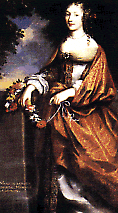 synonymous
with a natural grace and an unaffected, fluid elegance that is quite inimitable.
Born Marie de Rabutin Chantal, she was married at the age of eighteen to
the marquis de Sévigné, a charming womanizer who was killed
seven years later in a duel fought over a mistress. Through this blessing
in disguise, Mme de Sévigné was thrust into veuvage,
widowhood, which was the only condition that could create independence
for women of a certain social and financial station in 17th C. France.
Among other things, this allowed her to develop into quite probably the
greatest epistolarienne in French history. Her letters became famous and
today can be had in three handsome Pléiade volumes from Gallimard.
synonymous
with a natural grace and an unaffected, fluid elegance that is quite inimitable.
Born Marie de Rabutin Chantal, she was married at the age of eighteen to
the marquis de Sévigné, a charming womanizer who was killed
seven years later in a duel fought over a mistress. Through this blessing
in disguise, Mme de Sévigné was thrust into veuvage,
widowhood, which was the only condition that could create independence
for women of a certain social and financial station in 17th C. France.
Among other things, this allowed her to develop into quite probably the
greatest epistolarienne in French history. Her letters became famous and
today can be had in three handsome Pléiade volumes from Gallimard.
 even
Rococo, formula for what is meant by the folie d'amour. The hypnotic state
in which one encounters this type of passion is intimate, private and powerful
-- what Marivaux later termed "transports". The lover becomes the emotional
prisoner, even slave, of the beloved. These realities are little
discussed in the contemporary world because they transcend genders and roles and approacch a state that is purely emotional,
instinctive and, at its finest, spiritual. The world is concentrated in
the relationship, and nothing else exists. The beloved becomes an idol at whose feet the lover is privileged to offer
his ardor. Indeed, it is a sort of schooling. Nothing teaches like ardor; nothing is as memorable as desire when it is experienced with
every atom of one's being. Desire is a fire that ravages, consumes and empties.
A lover of Ninon's might have felt, through this experience verging on
total emotional annihilation, that he was being emptied, feminized - as if he were
female and she, more independent, was the male. Caught by this phenomenon,
such a lover might have appreciated the delicious irony posed by her last
name, which means "enclosure".
even
Rococo, formula for what is meant by the folie d'amour. The hypnotic state
in which one encounters this type of passion is intimate, private and powerful
-- what Marivaux later termed "transports". The lover becomes the emotional
prisoner, even slave, of the beloved. These realities are little
discussed in the contemporary world because they transcend genders and roles and approacch a state that is purely emotional,
instinctive and, at its finest, spiritual. The world is concentrated in
the relationship, and nothing else exists. The beloved becomes an idol at whose feet the lover is privileged to offer
his ardor. Indeed, it is a sort of schooling. Nothing teaches like ardor; nothing is as memorable as desire when it is experienced with
every atom of one's being. Desire is a fire that ravages, consumes and empties.
A lover of Ninon's might have felt, through this experience verging on
total emotional annihilation, that he was being emptied, feminized - as if he were
female and she, more independent, was the male. Caught by this phenomenon,
such a lover might have appreciated the delicious irony posed by her last
name, which means "enclosure".