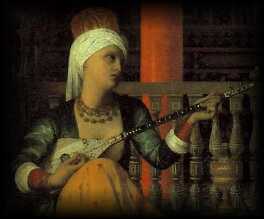
Salons: The duc de La Rochefoucauld
and Feminine Intelligence
Hosted by some of the leading women of French society, Salons were evening get-togethers among the social and intellectual aristocracy: showcases for art, poetry, literature, philosophy and even scientific theory. But most of all, they consisted of conversation.
Still, while Salons were fascinating and instructive, all too often their "product" remained fugitive. Comments witty and profound were made and then faded on the air and fell into oblivion. It was a performance art.
Thus, any introduction to Salons would do well to focus on François duc de La Rochefoucauld (1613-1680), who lived in the 17-th C. Golden Age of Salons (including the period of the Court of Louis XIVth) and who is famous for authoring the Maximes, a collection of some 600 elegant and penetrating observations, many only one short sentence in length, on human nature, society, morals, ambition, love and other related matters. Not only was le prince de Marcillac (as he was also known) a romantic; he was also rigorously self observant and ferociously concise. His maxims embodied the Salons' finest "output": penetrating insight expressed in refined phrasing. These pithy and sagacious "sentences" --as they were known -- provide a record of fascinating glimpses and paradoxes.
One surprising element of La Rochefoucauld is how an acerbic pessimism co-existed with idealism to produce the unique flavor of his thought. He anticipated Descartes and he was a romantic. His integrity carried over to the heart as well, revealing a noble soul. In spite of immense political pressures he was was unwaveringly loyal to the women whom he adored (including the Queen herself).
While today we can get a copy of the Maxims, it is not
as easy to peer into the process: the mill of ideas as it churned and shaped
the mind of an era. To complete the image, we should look at the works
of certain its leading women. The Salons of Mme de Sablé, de Sévigné
(pictured), 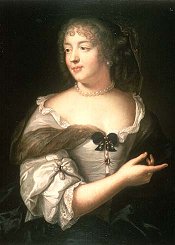 the
Comtesse de La Fayette and the seductive Ninon de Lenclos, served as spiritual
and emotional sources for leading figures of the day in art, literature,
science and other fields. Their works are the missing layer of the Maxims.
the
Comtesse de La Fayette and the seductive Ninon de Lenclos, served as spiritual
and emotional sources for leading figures of the day in art, literature,
science and other fields. Their works are the missing layer of the Maxims.
All of these women bore witness to the emotional turbulence beneath the enameled surface of the French court. Many of them left us writings. Mme de Sévigné's correspondence gave her lasting fame and provides real insight into what is a neglected art today. It is not for nothing that she is considered the greatest epistolarienne of France. What we have of Mme de La Fayette, Mme de Sablé and Mlle de Scudéry is also rich. It is astonishing to see the degree to which our contemporary attitudes toward love, courtship, nobility of character and in general the relationship of heart and mind were shaped in another place and time. Salons have been given credit for creating certain standards of civilized behavior and conversation; yet the degree to which women have shaped these standards and have given them life and energy has not been adequately acknowledged.
Still, what remains hidden is something at the very core:
the interaction between the feminine and masculine, the men and the women
of the salons -- and the extent to which this interaction worked to form
the ideas and viewpoints with which the salons are now synonymous.
In this regard, something should be said of Anne, called Ninon, de Lenclos -- a woman whose intelligence, charm and seductive presence attracted minds as diverse and restless as those of Molière, Fontenelle and La Rochefoucauld. Ninon's presence left an enormous mark, and her reputation as a spiritually gifted seductress lives on -- as attested to, among other things, by an unfinished opera based on her by the 19th C. Brazilian composer A. Carlos Gomez. Even today there is a beauty cream supposedly derived from Ninon's "miracle formula" -- still bearing witness to the radiance of her skin. The Salon she kept (at l'hôtel Sagonne, 36, rue des Tournelles) attracted persons who shaped literary and romantic perception. It is not too much to say that Ninon had the intellectuals of the age at her feet, but she is nevertheless given short shrift by history exactly in those areas where she deserves most mention. A beautiful woman who had crossed the barrier into what was then the male preserve of intellectual formulation, could be formidable indeed; Ninon's attractiveness became the envelope for the ideas she presented. But she was most compelling when the envelope and the contents became mixed. In this envelope was concealed the script of an indivisible fusion of the sexual and the spiritual. Thus Ninon represented a magnet for the creative energies that inspired ideas, impelled their formation and drew them forward.
Though Ninon wrote letters, she was not in a formal sense a writer – which is understandable, for she properly belongs to that other category of the beloved who inspires, fascinates and devastates; of persons who are unforgettable by their very presence, and who teach others on an intimate, wordless level because they inspire imitation.
What we know of her thought comes to us from two sources: from brief apocryphal quotations, some of which are sourced from letters, and the letters themselves that she wrote to a few recipients – chief among the latter being the young Marquis de Sevigne, who was graced with  55 missives instructing him in matters of the heart, and forming a veritable abbreviated Bible of seduction. (We will have more to say on the subject of these letters, in a separate article.)
"If men's bodies were as solid as their minds are whole," she is reported to have said, "few would be great lovers." And on the same subject: "It takes more talent to make love well than to command armies." She stood apart from the social systems that would classify or subjugate her, making her a model for even our contemporary times. A century later, Marivaux's heroine Araminte (from the play False Confessions), an 18th C. precursor of the woman who is both sexual and independent, and who is thus extraordinarily magnetic, was of necessity a widow -- i.e., someone who had broken the chain of the woman's conventional role by having acquired economic autonomy. So with Mme de Sévigné,
so with Ninon: both were wealthy, beautiful, and their moral and religious
attitudes lent them a sense of authority, by means of which they could
exert an influence. It should be noted that while Mme de Sévigné inspired intense interest and even arguments among rivals, Ninon was known to have enjoyed, not only the marquise de Sévigné's husband, but also her son, as a devoted lover!
55 missives instructing him in matters of the heart, and forming a veritable abbreviated Bible of seduction. (We will have more to say on the subject of these letters, in a separate article.)
"If men's bodies were as solid as their minds are whole," she is reported to have said, "few would be great lovers." And on the same subject: "It takes more talent to make love well than to command armies." She stood apart from the social systems that would classify or subjugate her, making her a model for even our contemporary times. A century later, Marivaux's heroine Araminte (from the play False Confessions), an 18th C. precursor of the woman who is both sexual and independent, and who is thus extraordinarily magnetic, was of necessity a widow -- i.e., someone who had broken the chain of the woman's conventional role by having acquired economic autonomy. So with Mme de Sévigné,
so with Ninon: both were wealthy, beautiful, and their moral and religious
attitudes lent them a sense of authority, by means of which they could
exert an influence. It should be noted that while Mme de Sévigné inspired intense interest and even arguments among rivals, Ninon was known to have enjoyed, not only the marquise de Sévigné's husband, but also her son, as a devoted lover!
It is in such atmospheres that one learns, informally, that which is taught in no university on earth. Thus, one could say that of great significance for a late 20th C. Salon (a new fin de siècle), is that La Rochefoucauld's achievement also represented the output of de facto training and mental preparation by some of the subtlest and most intellectually (and erotically) powerful women of his day. Feminine beauty functions not only as the focus of sexual desire but also as aesthetic ideal which embodies something of the classical Greek harmony, as witnessed by the poet Keats, to which intellectual longing still aspires. It is profoundly true that a sort of osmosis takes place through the devotion to an ideal; the imitation of Christ for the Christian mystic is part of an assimilation, a conformation and perhaps even a transformation; but a parallel assimilation occurs in the world of mind that has been infused by the feminine ideal. One who admires Venus passionately, will import some of her qualities into his thought -- that is what "con-formation" really means.
Let us not mince words: talented as he was, La Rochefoucauld had become, through his romantic idealism and devotion, the disciple and product of feminine intelligence: shaped, milled and polished. His correspondence with Mme de Sablé, and the collaboration clearly manifest therein, merits more than a superficial glance in this regard. His aristocratic status gave him access to the highest levels of society and the most refined women of his day; combined with the nobility of his character (which made him receptive) and his native perceptual gifts, he became the vehicle by which a specifically feminine intelligence was able to articulate itself.
Women, traditional experts at the art of ornament, can also be the most practiced and talented as seeing through all artifice to the essence. This talent found perfect resonance in the gifts of the duc de La Rochefoucauld. Certainly, one senses that La Rochefoucauld was the beneficiary of a rare gift -- sharp perception, a sense of intimacy and the ability to fashion out of the vision of the ruses and vanities of the self a refined style which expresses this intimacy and its truths wittily, discreetly and therefore elegantly. The result is a kind of sonorous and rich androgyny in which each gender's voice retains its own unique note, and where there is no deformation of the masculine in order for the feminine to be expressed. It is sad that this richly articulated merging, so sharp in its paradoxes and so revelatory in its insights, has sometimes been mistaken for pessimism. In order for us to perceive it purely, it is necessary to hear the voice of femininity in its empowered form, broken out of the shackles of prejudice and objectification -- and this may in fact be what our time, through trial and error, is in the process of accomplishing.