|
One of the world’s
most beautiful and exotic islands, Sri Lanka,
(formerly Ceylon) lies just below the southern
tip of India. This pear-shaped bit of tropical
paradise, about the size of Sicily, is a
tourist’s delight offering British teahouses,
rubber plantations, and gem mines.
Marco Polo wrote of his
visit in 1292: “I want you to understand that
the island of Ceylon is, for its size, the
finest island in the world, and from its streams
comes rubies, sapphires, topazes, amethyst and
garnet.” Little has changed since Marco Polo’s
time except that Sri Lanka faces overpopulation
and a faltering economy.
Its gemstones, however,
seem to occur in endless supply. Known as the
“Jewel Box of the Indian Ocean,” Sri Lanka, like
possibly no other locality on earth, has yielded
precious stones and fine gems in a great
profusion of gem species and varieties.
The
island was known in the ancient world as
Taprobane (copper colored in Greek). Native
Veddahs, bathing in smooth flowing streams,
noticed colored pebbles scattered in sandy
bottoms. It was not until 500 B.C. that
conquering Buddhists from northern India also
discovered gems in the rivers and began to set
rough stones into crude jewelry. They bartered
stones with traders from abroad and eventually
the treasures found their way to the
marketplaces of Asia and Europe. Ancient Greek
and Chinese historians referred to the beautiful
gems of Ceylon, and King Solomon reportedly
wooed the Queen of Sheba with Ceylonese precious
stones.
Geologically, gemstones originated within a
broad belt known as the Highland Series which
runs through the center of Sri Lanka. The edges
of the belt form a trough bordered by chains of
mountains and peaks. The trough, made up of
highly crystalline Precambrian metamorphosed
rock, featured components of schists, quartzite,
marbles, and sometimes pegmatite deposits. Rock
erosion resulted in the formation of extensive
gem-laden placer deposits along stream beds in
lower valleys.
|
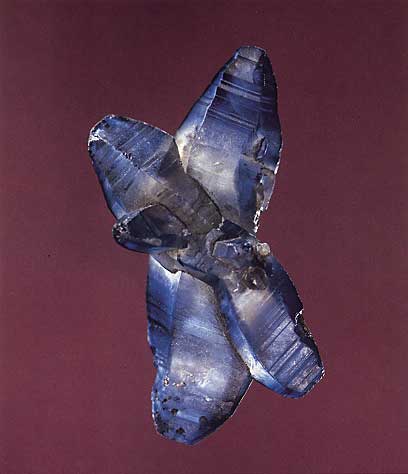
BELOW: Sapphire Size: 3.5 by 2
cm
Locality: Ratnapura
Collection: Harold and Erica Van
Pelt
Photo: Harold and Erica Van Pelt
|
|
|
Miners
soon learned the richest deposits were composed
of blue and yellow clays called illam
which lay just below the surface of lush valley
farmlands. During their tortuous journey
downstream, most gem crystals were worn to
rounded pebbles, but harder than host minerals,
they managed to retain much of their size.
Every available square meter of stream bed
was mined until all known gem areas were
exhausted. The miners discovered that the rivers
they were working were in reality “surface
streams” and that by digging downward from 7 to
30 meters, “ancient streams” could be
encountered. Unfortunately most of the ancient
streams lay beneath cultivated fields.
Prospecting and mining operations caused great
destruction to crops and created considerable
animosity between farmer and miner.
|
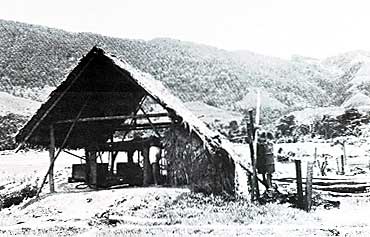 |
Pelmadulla mine near Ratnapura
Photo: Peter Bancroft |
|
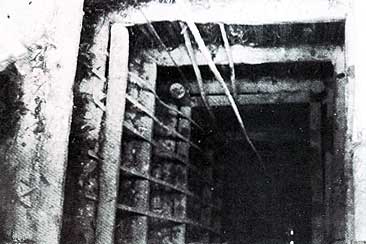
Eventually new mining methods were devised
whereby the gem hunter could operate at a profit
and still leave the farmland virtually intact. A
vertical shaft was dug downward until the illam
was reached. Feeder tunnels extended in a number
of directions like the spokes on a wheel. The
shaft and tunnels were carefully supported by
wood and bamboo timbers. The miners dug along
the tunnels, loaded the gravel into knapsacks,
and then climbed to the surface with their
loads.
Washing, screening, and sorting
occurred on the surface. Usually pumps operated
full time to keep the tunnels free of water.
When a mine played out, the tunnels were closed
off, the shaft filled, the buildings removed,
and new topsoil spread over the area. As another
growing season approached, all vestiges of the
mine vanished.
|
The
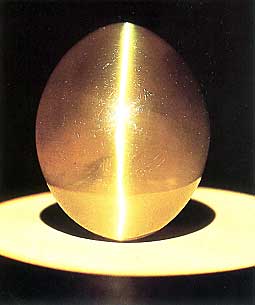
“Maharani” chrysoberyl cat’s-eye
Locality: Sri Lanka
Weight 58.2 carats
Collection: Smithsonian
Institution
Photo: Dane Penland |
 |
|
In
1974 when the author visited Sri Lanka, the
Pelmadulla mine was in operation about 15
kilometers west of Ratnapura. It proved to be a
good producer of white and cornflower-blue
sapphires. Like all gem gravel mines on the
island, when the Pelmadulla was worked out, its
shafts were filled, its sumps removed, and rice
was planted over the old workings. Today it
might be impossible to locate the old mine site.
Ratnapura (Singhalese for ‘gem town’) lies
about 100 kilometers southeast of Colombo. Its
mining region has produced an incredible variety
of gemstones, many of them outstanding in
comparison with stones from other regions.
Sapphire occurs in all hues of blue, as well as
yellow, violet, green, pink, and the remarkable
pinkish-orange “padparadsha.” Other gemstones
include topaz in bright yellow with a reddish
tinge; brownish yellow to cinnamon-colored
grossular; orange-yellow spessartine; blood-red
pyrope; red to brownish red almandine; the
world’s finest zircon in a broad spectrum
including brown, yellow, orange, green, and
colorless (known locally as ‘Matara diamond’– a
misnomer); green, yellow, and brown tourmaline;
yellow, green, and brown chrysoberyl; yellow
chrysoberyl cat’s-eye; the unique white
translucent variety of microcline with a blue
sheen known as moonstone; and great quantities
of spinel in brown, green, blue, purple, violet,
yellow, pink, and red. Unusual and rare stones
from the same area include sillimanite,
andalusite, scapolite, enstatite, kornerupine,
diopside, and sinhalite. Recently a 5000-carat
cat’s-eye chrysoberyl, the size of a man’s fist,
was taken from a mine near Ratnapura.
|
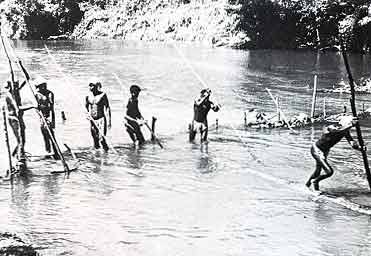 |
“Gemming”
a river. Disturbing the gravels
with poles causes waste to float
away, leaving gems to be
gathered from river bed.
Photo: Edward Gübelin
|
|
The crown jewels of many monarchs gleam with
extraordinary spinels, sapphires, and zircons
mined from Sri Lanka streams. The Imperial
Treasury of the Soviet Union houses a 400-carat
red spinel of great beauty which was once given
to Catherine the Great. The British Imperial
Crown features a giant oval-cut spinel
(previously supposed to be a ruby), known as the
“Black Prince.” Crowns in the Green Vaults of
Dresden are covered with sapphires from Sri
Lanka.
|
Looking
down 25 meters into a gem shaft
Photo: Gerhard Becker
|
 |
|
|
|
Map of Sri Lanka (Ceylon), showing
the location of important cities and
mining areas. Illustration ©
Richard W. Hughes
|
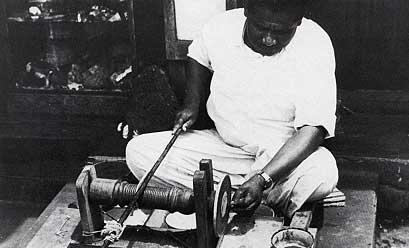
Local
lapidaries cut most of the island’s gem rough.
Striving for maximum weight in each finished
stone, cutters frequently align the faces poorly
with the center of the stone. Therefore, many
stones must be recut, causing a weight loss,
before reaching their full potential.
The forests of Sri Lanka are being felled in
the vanguard of an expanding population. As
natural habitat vanishes, so go the remaining
wild elephants, pythons, crocodiles, bears,
leopards, wild boars, and other wildlife. With
these changes, much of Sri Lanka’s primitive
charm will disappear. But many untouched gem
areas remain and await exploitation. In all
probability the Jewel Box will continue to give
up its precious treasures for centuries to come.
|
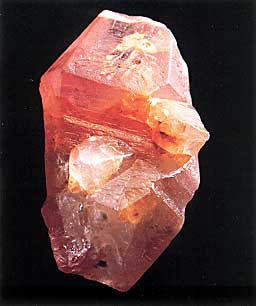 |
Padparadscha sapphire crystal
Size: 8 by 5 cm
Locality: Sri Lanka
Collection: Paul Ruppenthal
Photo: Studio Hartmann
|
|
|
Cutting sapphires on primitive
machine
Photo: Edward Gübelin |
 |
|
|
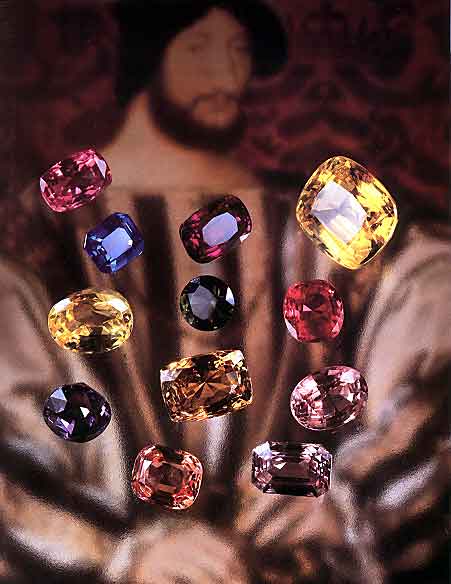 |
Faceted sapphires
Size: Largest is 27 carats
Collection: Los Angeles County
Museum
Photo: Harold and Erica Van Pelt |
|
|
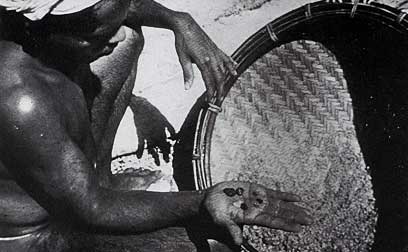
Recovering gems from rattan
basket
Photo: Gerhard Becker |
 |
|
|
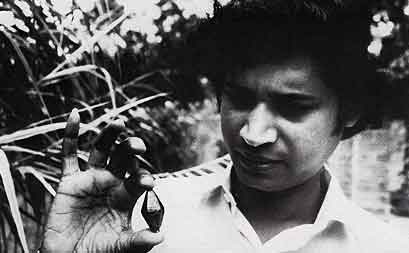 |
Ratnapura museum curator holding
sapphire crystal
Photo: Peter Bancroft |
|
|