
Yu-Gi-Oh! Card Game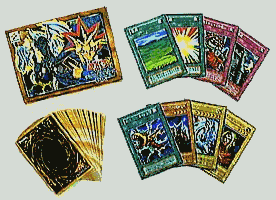
Yu-Gi-Oh! Card Game
The Yu-Gi-Oh! card game consists of the match between two players, head to head in an all out competition of one's skills. It consists of physically and mentally gaining control of the game, playing your cards carefully and strategically. The better strategist or concentrated player will win. Monsters are used to battle, with twenty unique types and many magic and trap cards that can change the direction of the duel, the game is very unpredictable. Welcome to the world of Yu-Gi-Oh! Duel Monsters! Here are the Official Yu-Gi-Oh! League Rules:
Rules:
A deck must contain at least 40 cards. Keep in mind that decks with too many cards means you will hvae a smaller chance of drawing the cards you need, so it's best to limit your cards to around 40 - 45
You can have up to 3 duplicates of the same card in your deck. Cards included in your Side Deck count towards this 3 duplicate limit. Also, be aware of Forbidden and Limited Cards.
Hints:
Keep the Monster Card to Magic/Trap Card ratio at 1 : 1
The building blocks of your deck are the monster cards. No matter how many powerful Magic or Trap Cards you have, no monsters on the field means you've got nothing to defend your Life Points. A general rule of thumb is that roughly half your deck should be made up of monsters. Therefore, if you've got a deck of 40 cards, around 20 should be Monster Cards.
Keep the number of High Level Monsters to a Minimum
In order to perform a Tribute Summon (required for a Level 5 or higher monster), you will have to offer monsters as a Tribute. If your deck is filled with high-level monsters, summoning them to the field will be very costly. Instead, include lots of Level 4 or lower monsters in your deck and keep the number of high-level monsters to a minimum.
Make Good Use of your Effect Monsters
Effect monsters with Magic or Trap effects play an important strategic role in your Duels. You can create a powerful Deck if you take full advantage of these effects.
Include Cards that Increase Opportunities to Draw
In a duel, the basic rule is that you can only draw 1 card during the draw phase. Therefore, it is strategically to your advantage to be able to draw more cards than your opponent.
Creating a Side Deck
In between Duels, you are allowed to use a Side Deck of 15 cards to adjust the contents of your deck. Prepare your side deck with cards that help address the weaknesses in your deck or have the power to neutralize specific cards.
Powerful Cards : Cards that will help strengthen anyone's Deck
�-Raigeki
- Pot of Greed
- Monster Reborn
- Dark Hole
- Change of Heart
Forbidden and Limited Cards:
According to the Official Rules, certain cards have specific quantity restrictions that limit the number that can be included in a deck. These limited cards are announced at Official Tournaments and should be take into account when customizing your deck.
In the game of Yu-Gi-Oh!, there are 3 different types of cards; Monster Cards, Magic Cards, and Trap Cards. Each card is further divided into several sub-catagories. Below are the descriptions of these types of cards.
�Gaming Terms
Play - ���� Whenever you use or activate the effects of a card, change the Attack/Defense Position of a card, or place a card on the field you are executing a "Play". When you play a card, its effect is immediate.
Set - ���� The act of placing a card face-down on the field is referred to as "Set". A Set card's effect is not activated immediately. Also, a Set Monster Card is not considered to be summoned until it is turned face-up. A Set monster must be placed HORIZONTALLY, in face-down Defense Position (monsters summoned normally are placed VERTICALLY, in face-up Attack Position). Set Magic and Trap Cards are placed vertically on the field.
The Field- ���� Throughout the rulings, and on the card text itself, the Monster Card Zone, Magic and Trap Zone and Field Card Zone together will be referred to as the field.
Destroyed- ���� A card that is sent to the Graveyard is destroyed.
Removed From Play- ���� A card that is removed from play is NOT sent to the Graveyard. Instead, it is set aside and is not allowed to re-enter the current Duel.
1) NORMAL Monster Cards: A Monster Card is a basic card used to attack your opponent and bring his/her life total down. Each Monster is categorized by Attribute and Type, which makes up about 20 different types and 6 different categories. The overall strength of a monster is indicated by it's level (the number of stars at the upper right side of the monster card). A Monster Card color is always yellow.
MONSTER TYPES
Dragon - Spellcaster - Zombie - Warrior - BeastWarrior - Beast - Winged Beast - Fiend - Fairy - Insect - Dinosaur - Reptile - Fish - Sea Serpent - Machine - Thunder - Aqua - Pyro - Rock - Plant
ATTRIBUTE
Earth - Water - Fire - Wind - Light - Dark


Chains - A "Chain" is a rule used to easily determine the outcome of a complex battle resulting from a series of Magic or Trap cards played by both players. For example, let's say that a player uses a Magic Card. That magic card is placed in a hypothetical link called Chain Link 1. If the player's opponent responds by playing one of their own Magic or Trap Cards, a Chain has been started, with this card placed in Chain Link 2. Using this method to deal with subsequent plays, the links are stacked from bottom to top until both players have finished playing cards. The effects are then resolved, starting at the top link and working down to the Chain Link 1 at the bottom.
���� The player whose Trap or Magic Card has been countered always has a chance to respond with another play - an opportunity that could result in adding yet another link to the Chain. When making a play on a Chain, you must always ask your opponent "Do you wish to continue?" If you continue play without asking your opponent, they may raise an objection that will lead to a Replay.
Spell Speed - Magic, Trap, and Effect Monster Cards all have different speeds. You can only respond to a card and start a Chain by playing a card of equal or greater speed. The exception to this rule are Spell Speed 1 cards, which CANNOT be used against eachother.
SPELL SPEED 1
This is the slowest of all the Spell Speeds
[Normal Magic - Equip Magic - Field Magic - Ritual Magic - Effect Monster]
SPELL SPEED 2
There cards can be used against a card with a Spell Speed of 1 or 2
[Quick-Play Magic - Normal Trap - Continuous Trap - Effect Monster (multi)]
SPELL SPEED 3
This card can be used against any Spell Speed
[Counter Trap]
Phases of Gameplay -
Turn -
�Gameplay progresses in a series of alternating turns. Each player's turn consists of 6 phases in which a number of actions can be undertaken.
Phase -
�Phases define the order in which actions can be undertake by a player during their turn. Each phase is limited to a specific set of actions.
Step -
�A sub-category of a phase. This is only used in the Battle Phase
Draw Phase - During this phase, you are required to draw 1 card from the top of your deck. A player who is out of cards and unable to draw during this phase is declared the loser.
Standby Phase - If there are any cards in play on the field that specifically state that certain actions must be taken during this phase, these must be dealt with prior to entering the Main Phase. Refer to the cards for specific details regarding the actions to be taken. If there are no such cards in play, proceed to Main Phase 1.
Main Phase 1 - During this phase, you may Set or Play Monster, magic, and/or Trap Cards. Keep in mind that you may NOT exceed the 5-card limit for the Monster Card Zone or the Magic and Trap Card Zone.
���� During this phase, you may also change the Attack or Defense Position of cards already placed on the field. The position of each card can be changed only once in a single turn, during either Main Phase 1 or 2. The damage Step details how this position effects the outcome of a duel.
���� At the end of the Main Phase 1, you can choose to enter the Battle Phase, or proceed to the End Phase (the starting player cannot conduct a Battle Phase in their first turn).
�1) Setting or Summoning Monster Cards - To set a monster card from your hand, place it face-down horizontally (defense position) on an open space in the Monster Card Zone. Same goes for Summoning a Monster Card.
�a) Normal Summon - This is done without the aid of Magic Cards. You can only do this once per/turn, and only during your main phases. When you play a Monster Card from your hand, you can choose whether to put it in Defense (horizontal) or Attack (vertical) Position. When playing it at a Defense position, it is automatically Set.
�b) Tribute Summon - When summoning a Monster level 5 or Higher, you must destroy 1 or more (specified) monster cards already on the field to Set the Tribute Monster.� When you are summoning a monster level 5 or 6, you must destroy 1 monster. If you are summoning a monster level 7 or higher, you must destroy 2. A Tribute Summon is considered a Normal Summon.
�c) Flip Summon - The act of turning the card over from it's face-down position to Attack or Defense position. A Monster Card is only considered Summoned when it's face-up on the table in a position, NOT when it's face-down but on the Monster Card Zone. A Flip Summon is not considered a Normal Summon, so you can perform it more than once.
�d) Special Summon - The result of a Fusion, Ritual, Magic, Trap, or Monster Effect. It can be used multiple times in the Main Phases, just be sure to follow the instructions printed on the used cards.
2) Setting or Playing Magic And Trap Cards - You may play Magic and/or Trap Cards here. Keep in mind the limit you have with 5-cards at a time in the respectful zones.
BATTLE PHASE -� Once attack preparations have been made, you can enter the Battle Phase. If you do not wish to conduct a battle, your turn proceeds to the End Phase.
Start Step - Declare that you are entering the Battle Phase. Quick Spells can be played here.
Battle Step - Select the Monster you want to use in the battle, and declare a target. Quick Spells can also be played here.
Damage Step - Calculate the damage points of designated monsters. If a monster has a Flip Effect, apply it immediately after damage calculation. Flip effects do not effect monsters that have been destroyed as a result of this damage calculation.
End Step - Resolve all battle decisions and repeat any previous steps as necessary. Then, declare end of battle. Quick Spells can once again be played here.
1) Start Step - Announce that the battle phase is starting.
2) Battling - You must select a target that you wish to attack, flip target card face-up if face-down, calculate damage and apply it to your target, and if successful send target to it's respected graveyard. You are only allowed one attack per turn.
3) Damage Step - This is where you calculate damage dealt to your targets. A monster destroyed as a result of battle is sent to the owning player's Graveyard.
[Determining Damage]
a) When an opponent's Monster is in Attack Position.
���� When attacking a monster that is in attack position, compare the ATK (Attack) of both Monsters.
i) Attacker's ATK Points > Opponent's ATK Points
���� When the attacking monster's ATK points are higher than the ATK points of the opponent's monster, the opponent's monster is destroyed. (DAMAGE: Subtract the ATK points of the opponent's monsters from the ATK points of the Attacking monster. This result is subtracted from the opponent's Life Points (being 8000).)
ii) Attacker's ATK Points = Opponent's ATK Points
���� When the attacking monster's ATK points are equal to the ATK points pf the opponent's monster, the result is considered a draw, and both monsters are destroyed. (NO DAMAGE)
iii) Attacker's ATK Points < Opponent's ATK Points
���� When the attacking monster's ATK points are lower than the ATK points of the opponent's monster, the attackign monster is destroyed (DAMAGE: Subtract the ATK points of the attacking monster from the ATK points of the opponent's monster. This result is subtracted from the attacker's Life Points.)
b) When the Opponent's Monster is in Defense Position
���� When attacking a monster that is in Defense Position (face-down and horizontal.), Compare ATK (attack) of the attacking monster with the DEF (defense) of the opponent's monster.
i) Attacker's ATK Points > Opponent's DEF Points
���� When the attacking monster's ATK points are higher than then DEF points of the opponent's monster, the opponent's monster is destroyed. (DAMAGE: Neither player takes any damage. Their Life Points remain the same)
ii) Attacker's ATK Points = Opponent's DEF Points
���� When the attacking monster's ATK are equal to the DEF points of the opponent's monster, neither monster is destroyed. (DAMAGE: Neither player takes any damage. Their Life Points remain the same)
iii) Attacker's ATK Points < Opponent's DEF Points
���� When the attacking monster's ATK points are lower than DEF points of the opponent's monster, neither monster is destroyed. (DAMAGE: Subtract the ATK points of the attacking monsters from the DEF points of the opponent's monster. The result is subtracted from the attacker's Life Points.
c) Direct Damage - When opponent has NO monsters
���� If your opponent does not have any monsters on the field, they take direct damage. The full amount of the attacking monster's ATK points is subtracted from the opponent's Life Points.
END STEP: Once all battles have been resolved, the player enters the End Step and announces the end of their battle phases.
MAIN PHASE 2: When the battle phase is over, the turn proceeds to Main Phase 2. As in Main Phase 1, you may Set or play Monster, Magic, and/or Trap Cards. Remember that you are only allowed to change the Attack or Defense Position of each monster or perform a Normal Summon or a Set only ONCE PER TURN. Also keep in mind that you may not exceed the 5-card limit for the Monster Card Zone or the Magic and Trap Card Zone.
END PHASE: Announce the end of your turn. If your hand contains more than 6 cards, discard to your Graveyard until only 6 cards remain in your hand. The opposing player then begins his/her turn with the Draw Phase.
END of DUEL: Repeat Phases 1-6 in alternating turns until a winner is decided.
Normally, a Duel takes place between two players and lasts until one player's life goes down to zero from 8000, you can 'deck' your opponent, OR, you have all 5 pieces of the "Forbidden One" in your hand.
�
WIN CONDITION #1:
Each player starts the game with a maximum of 8000 Life Points. These life points can be decreased from damage taken from creatures in the Duel or from special attacks from other cards. The player who hits zero life first loses. It IS possible to have both players hit zero life at the same time, in which case the game would be a draw and you have to play again.
WIN CONDITION #2:
Because each player starts with only 40 cards in his/her deck, it's possible to be 'decked' in the game. When you are decked, you are unable to draw another card. When that happens, your opponent automatically wins. It's easy to be decked, so to prevent such a thing during your games, make sure you know how to play your deck and use your cards at the right time. It can make all the difference.
WIN CONDITION #3:
Normally, a Duel takes place between two players and lasts until one player's life goes down to zero from 8000, you can 'deck' your opponent, OR, you have all 5 pieces of the "Forbidden One" in your hand. 