Focus
The
Changing Nature of
Things
Prospective
The
Shift to a New Economy
Outward
to Inward...The Resource Shift is On
Business
Transformation
Conclusion
References
Focus Back to Top
As value has shifted from outward-physical resources to inward-mental resources, service has taken a dominant position in the Information Economy. This shift has brought with it the need for revolutionary change in the organizational model used to manage businesses in the service and all other sectors of the economy.
The new information infrastructure, built on the scientific breakthroughs of quantum physics, is the highway on which revolutionary changes in organizational models are made. All businesses and the individuals within them will be affected in some way by the construction of the Information Superhighway and subsequent business transformation. Businesses must embrace the business of change or risk obsolescence. As Peter Drucker once said, "obsolete yourself before someone else does."
This paper examines the evolution of the Information
Economy and explores the effects that that evolution will have on the businesses
and individuals within them.
The Changing Nature of Things Back to Top
Every day, millions of us get into cars, buses and trains to get into work. Once there, we interact with people at the office and off-site and use the physical resources that are available to us to perform our jobs. When the day is done, we go home only to wake up the next morning to start over again. What is so special about the office?
The office is where we get our mail. It's where we use the phone to make business calls. Computers are there along with the information that we access through our computer networks. Our filing cabinets full of invoices or customer information or product information or technical information or whatever information that helps us do our work are there. Our books and reference materials are there.
Also, people that we interact with to perform our jobs are there, including presidents, vice-presidents, staff and line workers. Co-workers are there to interact with to get information related to our work that comes from their department that they hand off to us. Co-workers in our own departments are there that we share information and work load with. Customers, suppliers and others that we have relationships with know how to reach us there. But times, they are a changin'.
We are rapidly approaching a time when we will not have to go into the office to be at the office. How can this be? Technology is making it possible for us to dematerialize what are now the material resources of the workplace. For example, imagine if we were able to scan our paper invoices, customer information, product information and other materials in our filing cabinets, drawers and shelves into computer form. The information that was filed and retrieved from our filing cabinets, drawers and shelves, would be dematerialized from physical space to electronic space.
How does this dematerialization affect the way we work? Information preserved in physical form, takes up space. When we shrink content (something contained), the context (the reference point from which we view something) in which we use that content changes. For instance, electronically stored information is available to many people at once. Also, it's available from any space at any time-not just from office space at work time.
Lets take this example one step further. A time will come in the very near future when the intermediate step of printing paper-based information will be eliminated completely. Information will be generated on-line with forms-based software that feeds directly into electronic databases. Instead of printing purchase orders and mailing them, customers will transmit them electronically via EDI (Electronic Data Interchange). When it comes time to bill the customer, instead of printing an invoice and faxing or mailing it, it will be sent electronically. When the customer is ready to pay the invoice, it will be paid via EFT (Electronic Funds Transfer). Information will be generated, stored, processed and transmitted in digital form from beginning to end.
Books, resource materials and other information now stored in paper form will soon be available in digital form. Enhanced with voice, video and graphics, information will be more informative. We will interact with electronic information simply by initiating keyword searches. We will place electronic bookmarks and add annotation anywhere in the text.
How do we access this information any time and from any space? Today's portable, laptop, notebook and hand-held computers give us the same functionality as our desktop computers at work. Wireless and wired communications will make it possible for us to get to the information at the office from a virtual connection.
The Information Superhighway is now under construction. The combination of long distance fiber optics and short distance wireless communications will provide the bandwidth to move data, text, voice and video anywhere in the world in real-time. Video conferencing, video whiteboarding and long distance learning are just a few technologies that are coming on stream that will put us in touch any time from any space.
What do audio, video, computers and appliances have in common? IAs (Information Appliances) will extend beyond the data communications reach of today's PDAs (Personal Digital Assistants), notebooks and desktop computers to create a contextual shift in the way we view our work space. We are about to witness the convergence of whole industries-television, telephone and computers-into parts of a greater whole industry-one giant communications medium.
What does the dematerialization of our material world mean to us? Think about it-we are all limited to a finite amount of physical space. Anytime we can shrink the amount of space required by the physical resources around us, we make room for more resources. When we dematerialize material, it not only takes up less space in its new space but more importantly we can access it from any space.
When human beings can exist in virtual space, we
can be in any space at any time. For example, with video conferencing and
video whiteboarding, we can have a digital video-audio-computer meeting
with people in different geographic locations in real-time. We can communicate
virtually and access on-line information simultaneously-eliminating time
and space barriers.
Prospective Back to Top
Like the weather, it is difficult to predict our economic future. For instance, weather forecasters can predict the weather accurately within a 5 day period. From a long term view though, the best they can do is to predict that similar seasons will occur from year to year. In economics, while it is difficult to predict short term activity, we can take a ten thousand foot view of past economic activity to see certain patterns that can help us understand the shape of the future and thus lay the groundwork for further discussion.
"Like people and all other living things-economies
and the industries, businesses and the products within them-all have a
life cycle," according to futurist Stan Davis, co-author of 2020 Vision.
While each stage of any life cycle is different, the events that occur
within common stages of a life cycle are similar. Life
cycles for economies like people, tend to resemble S-curves.
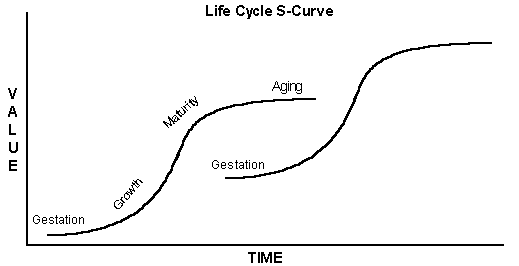
The first stage of an economy's life cycle is the embryonic period. Like people, this stage requires a great deal of investment and development. Davis notes that no contribution to the economy is expected during this differentiating stage of development. The second stage of an economic life cycle is the growth stage. It is during this stage that the investment and development made during the initial stage begins to pay off. Marketing takes over as the dominant activity during this stage while entrepreneurs lead the charge to higher returns.
After a vigorous growth stage, economies like people develop into maturity. The new economy takes its name from the dominant creator of value in the economy. Firmly in place, it is in this stage that the economy begins to dominate all other economic activity. Davis points out that each economy "izes" the previous economy. The Industrial Economy industrialized the Agricultural Economy during its maturity stage just as the Agricultural Economy agriculturalized the Hunter Gatherer Economy before it. The informationalization of the Industrial Economy is taking place as we enter into the maturity stage of the Information Economy.
In the fourth phase of a life cycle, aging sets in.
This stage is marked by heavy capital investment and diminishing returns
. Sectors of the economy that are aging still make a contribution but become
less dominant in the overall economy. According to Davis,
management consultants are prevalent in the aging
sector of the economy as more time is spent running organizations than
businesses.
The Boston Consulting Group developed what is known as the Growth Share matrix to describe life cycle stages. In this matrix, a question mark represents the first life cycle stage symbolizing its uncertainty. The second stage is represented by a star because of its bright and rising future. The third stage is portrayed by a cow, better known as the milking stage, while the fourth stage is symbolized by a dog (the government loves dogs). (George Stalk & Tom Hout)
From this framework, lets examine previous economic life cycle S-curves for similarities in the past and possible differences in the future. It is a fairly widely held view that we are over forty years into the Information Economy. Davis puts the range of the Information Economy between 1945 and 2020 or 75 years. It is a widely held view that the predecessor to the Information Economy was the Industrial Economy which lasted roughly 200 years from 1745 until 1945 (1800 to 1950 in the United States). The two previous economies were the Agricultural Economy lasting 10,000 years and the Hunter Gatherer Economy lasting from the dawn of man until the beginning of the Agricultural Economy.
The graph of the respective economy's S-curves, give
us dramatic information about the past and the future. Notice the difference
in the ranges of the economic ages. Also notice how the steepness of the
respective economy's S-curves, increase over time.
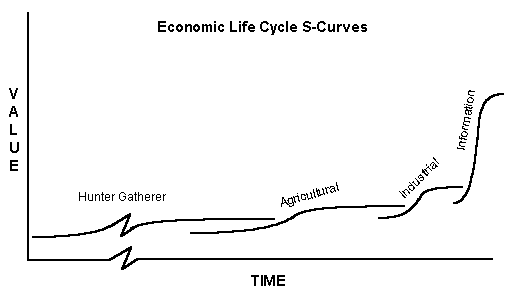
In the past, periods of time were named after the activity that dominated them such as the stone age, bronze age, iron age or golden age. They were called ages because they lasted over many generations. Similarly, economic periods have been called ages. It is easy to see in the previous graph that economic periods no longer last over many generations. In fact, the Information Economy is the first economy predicted to last less than a single generation. Coincidentally, the stages of the Information Economy coincide with the life cycle S-curve of the Baby Boom generation.
What is responsible for the compression of time and the steep rise in value of economic S-curves over time? Technology. Earlier economic S-curves remained virtually flat because technology was relatively constant over time. Not long ago, people were named after their trades. Millers, Bakers and Smiths practiced their trades from generation to generation. Until recently, people were told to go to school, learn a trade and work at that trade the rest of their lives. Today, the average person will change jobs more than six times during his/her lifetime. What used to change in sixty years, now changes in six.
What determines the advance of technology? The rate at which we communicate determines the advance of technology. For example, the invention of the printing press in the 1400s helped make possible the Industrial Revolution. Before the printing press, information was passed on by word of mouth. People spent their entire lives (remember that life spans were much shorter thousands and even hundreds of years ago) teaching the next generation how to work their trade. Consequently, there was little improvement in the way work was done over time. (Paul Zane Pilzer)
The printing press was the first major communications invention that gave people the means to mass produce the information that surrounded their lives. Information was preserved and added upon from generation to generation. As knowledge of a subject became available to large numbers of people over a wider area, techniques improved. As knowledge spread, people learned more quickly-rising up on the shoulders of the previous generation.
Although physical resources continued to be the center
of economic value, the value of information continued to rise. Until recently,
the formula for expressing wealth was: W=P (Wealth=Physical Resources).
Today, the acceleration of the spread of information via more sophisticated
communication devices has not only increased the rate of advance of technology
but has redefined what a resource is. Paul Zane Pilzer, in his book Unlimited
Wealth says, "wealth should be expressed as: W=PTn
(Wealth=Physical Resources x Technology to the nth power--technology to
the nth power is the multiplier effect of technology)."
The Shift to a New Economy Back to Top
How is the Information Economy different from previous economies? Why is its S-curve dramatically steeper than previous economies? An outward to inward resource shift driven by technology is responsible for the steepness of the Information Economy's life cycle S-curve. During its life cycle, the dominant activity of each economy undergoes an outward to inward resource shift as it is "ized" by the dominant activity of the next economy. But what makes this resource shift different? Lets compare past resource shifts to the current shift.
Until the 1930s, wealth from farming was acquired outwardly by farming more land, and more land and more land. Then from the 1930s to the 1990s, an outward to inward shift occurred in which the production per acre of farm land increased 100 times. Correspondingly, the number of people employed in farming fell from some 30 million to 3 million. (Paul Zane Pilzer)
As Davis points out, each economy "izes" the previous economy. In this case, the outward to inward shift that led to the dramatic shrinkage in the amount of physical space required to meet food demand, was the result of the industrialization and informationalization of the methods of agricultural production over a sixty year period. Agriculture, while still vital to our survival, has taken a less dominant role in our economy employing 2% of the work force.
During the Industrial Economy, companies expanded outwardly to gain more wealth. Manufacturers continued to increase their physical space and employ those people that were left in the wake of the shrinkage of the Industrial Economy's agricultural sector. Today, we see an outward to inward resource shift taking place as the Information Economy informationalizes today's industrial sector.
This informationalization began with a manufacturing concept developed at Toyota by Taiichi Ohno in the 1940s known as JIT (Just In Time). JIT, with its exact amount of inventory at the right time design was later enhanced by TQC (Total Quality Control) with its focus on zero defect manufacturing. FMS (Flexible Manufacturing System) was the next logical step in the process of providing just in time inventory, zero defect, high volume, customized production. CIM (Computer Integrated Manufacturing), an information automation technology family consisting of CAD/CAM (Computer Aided Design/Computer Aided Manufacturing), CAE (Computer Aided Engineering), and CAA (Computer Aided Assembly), is the latest automation technology to combine with JIT, TQC, and FMS. Finally, IMIS (Integrated Manufacturing Information System) integrates all links in the supply chain. Information enabled, on-demand manufacturing converts inventory to information, shrinking the need for physical space and physical labor. (William Davidow & Michael Malone)
The scope of plant closings and layoffs of hundreds of thousands of workers by prominent manufacturers beginning in the early 1990s and continuing through today, confirms that the outward to inward shift in the industrial sector of today's economy is well underway. According to Davis, in his book Future Perfect, industry will employ 5% of the work force in the year 2001, down from 21% in 1985. Davis further asserts that during this same period, the industrial sector's contribution to GNP will drop only slightly from 28% to 24%.
Make no mistake, manufacturing will continue to be a vital component of our future survival, even as its economic dominance continues to decline. With 2% of the working population employed in the agricultural sector and 5% of the work force employed in the industrial sector, where will the balance of the working population work in the year 2001? The balance of the work force, 93%, will be employed by the service sector according to Davis. This new outward to inward resource shift goes beyond the outward to inward resource shifts in physical space and physical labor. This shift is from outward-physical resources to inward-mental resources. The focus of this shift is on individual freedom and knowledge.
Tom Peters, in an August, 1992 Business Week interview said:
Stan Davis, in his book Future Perfect, sheds
considerable light on the contextual shift to an anytime, anyplace, no
matter, mass customized, service dominated economy. While this economy
contains an agricultural sector, industrial sector and a service sector,
service has a place in all sectors not just the service sector. Davis describes
service in the following manner:
One simple rule of thumb is, the fewer people
there are between the provider and the user, the greater the likelihood
of user satisfaction. This is because the buyer not only gets and consumes
the service but also participates in its production and delivery.
 Stan
Davis
Stan
Davis
Newtonian physics, from which Adam Smith's industrial model was developed, focuses outward-on solid matter. Newtonian physics claims that the whole is equal to the sum of the parts describing the world in terms of a machine or great clock-work with God as the watchmaker. If the parts can be understood and controlled, it is believed that outcomes can be predicted.
Newtonian physics made possible steam engine technology which powered the first manufacturing machines and led to the production of the first products created in the Industrial Economy. Later, new technologies enhanced manufacturing efficiencies and fostered the creation of new products. The last stage of the Industrial Economy to develop, was the organizational model.
The industrial management model is dominated by manufacturing. This model focuses on the mass production of products. In Adam Smith's model, efficiencies and economies of scale are gained by organizing around tasks (division of labor and specialization), controlling by tasks and rewarding/punishing by tasks. In this command and control style model, steep hierarchy and short span of control are implemented to control the flow of information and decision making.
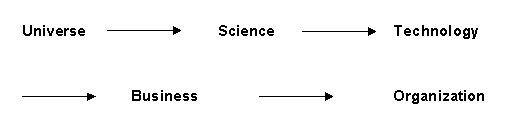
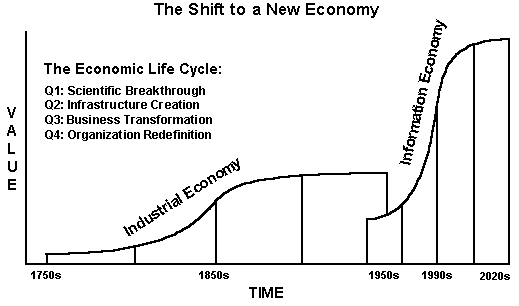
A new iteration of Davis' progression is taking place as the Information Economy unfolds. The new scientific understanding upon which the Information Economy is based is Quantum physics. New technology is built on computer technology. Products are mass customized, product cycles are shorter, markets are fragmented, channels are expanding and competition is global. In this economy as in previous economies, the organizational model will be the last to develop. Until then, an economy continues to be managed by the previous economy's management model. Consequently, most companies in the present stage of the Information Economy are managed by the command and control structure of the industrial management model. What is the progression that is taking place today?
Quantum physics, developed in the early 1900s, refutes the Newtonian idea that matter is solid and impenetrable. It focuses at the sub-atomic, inner level of matter. Invisible fields rather than the visible matter of Newtonian physics are the fundamental properties of the universe in Quantum physics. The holistic nature of Quantum physics views the relationships between the parts rather than the parts themselves as the key elements in understanding the whole system. The Quantum world is a fuzzy world of uncertainty where qualitative rather than quantitative information is the focus.
According to Davis, the first phase of economic progression is based on the "fundamental properties of the universe transformed into scientific understanding." The fundamental properties of the universe in this case is Quantum physics while the transformation into scientific understanding encompasses three significant breakthroughs. The first was the invention of the transistor on a chip at Bell Labs in the late 1940s. The second was the invention of the integrated circuit (the integration of transistors, capacitors and resistors on one chip) at Texas Instruments in the late 1950s, and lastly, the invention of the CPU (Computer Processing Unit-integrated circuit with an instruction set built-in) at Intel in the late 1960s. These inventions were a result of science's ability to move information through matter.
Davis calls this first quarter in the progression that governs the evolution of management models, the scientific breakthrough stage. The second quarter of progression, according to Davis, is defined by infrastructure creation. Infrastructure or in the case of the Information Economy, infostructure creation began in the early 1970s when the integrated circuit and CPU began to show up in calculators, watches and primitive computers. The next major infostructure product was the Apple I personal computer in 1977 followed by the IBM PC in 1981. PCs and peripheral hardware products followed by speadsheet, word processing and database software products became the foundation of the infostructure creation phase known as the personal productivity phase. This phase was followed by the departmental computing phase.
PC networking was developed in the early 1980s to connect PCs together to allow users to share information and computing resources. It wasn't until around 1988 (The Year of the LAN) that PC networking became a workable solution for connecting PCs. Even then, networks were limited to departmental connections because among other things, there were a lack of routing products to connect similar and dissimilar computer systems. Routing products from companies such as Cisco and Wellfleet, along with open computing standards and advances in telecommunications equipment ushered in the next phase of infostructure creation called network computing.
Since around 1990, the infostructure products of network computing have given us the ability to connect disparate mainframe, minicomputer, workstation and PC systems throughout the company into one network system. Also known as enterprise-wide computing, this level of connectivity increases communications in all parts of the organization. On the software side, client/server software from such companies as Sybase and Oracle are providing the tools to program the business content that is beginning to flow through the information infrastructure.
ISDN (Integrated Services Digital Network), SONET (Synchronous Optical NETwork) and ATM (Asynchronous Transfer Mode) telecommunications technology hope to play a major part in the next phase of infostructure creation called inter-enterprise computing. In this phase of communications, organizations will become boundryless as they connect to the computer systems of their suppliers, customers, partners, affinity groups and competitive-cooperative relationships.
The infostructure creation phase of this economy is the enabler on which the other phases in the progression to a new organizational model will be built. As we near the fulfillment of this phase around the end of 1996 or 1997, the wide area communications infostructure coupled with the capability of computers to create text, data, graphics voice and video will prepare the way for the next quarter in the progression that governs the definition of organizational models-the business transformation phase.
One by one, industry by industry, businesses will transform themselves into Information Economy businesses or they will not survive. As the information infrastructure develops, companies will begin to transform themselves by offering new products and services with high information content. Eventually, companies will grow out of their traditional businesses to become new information enterprises. (More on Business Transformation in the next section)
According to Davis, the last quarter of the progression
that governs the evolution of management models is the organization
redefinition phase. It is too early to tell exactly what the Information
Economy organizational model will look like because we don't know exactly
what the outcome of businesses transformation will be. It would
not be appropriate to formulate a new management model before we know what
we have to manage. A graph of the four quarters of the progression into
new management models follows:
 Stan
Davis
Stan
Davis
While we have to wait to see what shape the ultimate Information Economy organization redefinition will take, we do know that some companies are beginning to move away from the industrial management model in order to manage the first phases of business transformation. These companies are using the newly created information infostructure, to rearchitect their organizations based on the increasing service content of their businesses.
David Nadler, co-author of Organizational Architecture, compares the design of physical architecture to organizational architecture. The four components of his analysis are purpose, structural materials, style and collateral technologies.
The purpose of business has changed dramatically today. We no longer have the luxury to focus on production in a local, slow-moving, tangible environment. Today, businesses must have a customer focus in a global, fast-paced, intangible environment. New structural materials of a fast organization are advanced computer and telecommunication networks as was discussed earlier. This new organizational steel makes possible profound changes in the way an organization can behave to satisfy customer needs.
Management style is changing as information moves downward in the organization to the people that participate in the creation of service with the customer. Just as architectural style brings together the purpose and structural materials in the architecting of a functional building, the management style integrates the purpose and the structural materials into a functional organization. The industrial model's centralized management style, with its steep hierarchy and short span of control, is giving way to a management style that is both centralized and decentralized at once. As the organizational structure becomes less vertical and more horizontal, companies are organizing around process instead of around tasks.
Small groups of self-managed teams are taking responsibility for key end-to-end processes such as proposal-order-to-collection that cut across functional boundaries and extend outside the traditional boundaries of the organization to encompass customer, supplier and partner relationships. With appropriate information support, these small, entrepreneurial teams develop their own plans, goals and schedules. When empowered to do so, they manage daily problems and coordinate with other groups. They review themselves and find innovative ways to enhance their productivity.
The central organization provides the economies of scale of a large organization. It creates the overall vision for the company and puts forth and implements the strategic plan and assists in financial matters. The central organization promotes communication and coordination between groups. This adds up to a company that is both small and big at the same time-connecting the tiny with the huge.
If the style of the organization deals with the corporation's hard issues, then the collateral technologies deal with the soft and people issues. The elusive soft issues involved in embracing and changing the culture of an organization can be the most difficult issues. The soft issues beg the question-what are the values and beliefs for the new company and how are they different from the old values and beliefs?
The new organizational architecture will require creative roles and management systems for its people. The focus should be on the group rather than on the individual. What new skills are required of people that work on self-managed teams? What roles do these people play? How are they recruited, trained, promoted and compensated?
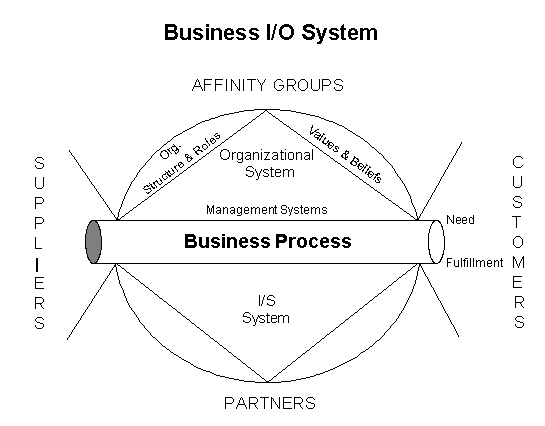
While some companies are integrating information technology for technology sake, the winners will look at their businesses holistically, coordinating the integration of business and technology. Revolutionary change must take place in the entire Business I/O System to achieve a quantum leap in business results. The organizational system, consisting of organizational structure and roles, management systems and values and beliefs must align with key business processes. In addition, a sufficient number of a company's Information Systems personnel must be moved out into the business community and become full partners in supporting key business processes. (Michael Hammer & James Champy)
As an Input/Output system, a business must take inputs, add value to those inputs and convert the sum total to outputs that satisfy a customer's needs at a competitive price and timeframe. Today's businesses must institutionalize the ability to change inputs in real-time based on the changing needs of the customer. (Edward DeBono)
A graph of the Business I/O System follows:
Business Transformation Back to Top
As companies utilize the new corporate information infrastructure to create flatter, more horizontal, cross-functional organizations, they will begin to transform themselves into new Information Economy businesses. Forward thinking companies will shrink, and in some cases dematerialize their product content. Customers will participate in the customization of the production of products and services in their space, in a 24x7 any time, timeframe. Lets look at some examples of what might be the beginning of business transformation for a few industries.
For many years now, the banking industry has been at the forefront of business transformation. Over the last 25 years, banks have successfully moved the act of banking from the bank to the branch and to the ATM (Automated Teller Machine). But recently, banks have tried to move the act of banking into the consumer's electronic space with little success.
To the benefit of banking and other industries, chances of success of moving products and services into the consumer's electronic space will increase significantly as advances are made in building the consumer information infrastructure. All over the world, standard telephone and coaxial cable are rapidly being replaced with massive amounts of wired, high bandwidth, fiber optic cable extending right to the home. Cellular, PCS (Personal Communications Services), and terrestrial wireless communications are experiencing unprecedented growth. Telephone companies, cable companies and entertainment and news content companies are partnering left and right to define the consumer's electronic space and provide future interactive services for the consumer.
Companies such as General Magic, 3DO, GO, AT&T, Intel, Apple Computer, Hewlett-Packard and Microsoft are creating bridge products to facilitate the convergence of television, telephone and computer technologies into one communications medium. These bridge products will provide the power and ease of use necessary to promote a contextual shift in the way consumers access and consume products and services.
This new information infrastructure is pulling banking into the consumer's electronic space. Today, consumers are beginning to check balances, pay bills, transfer money between accounts and negotiate loans over-the-wire. As banks move full force into investment services, they will customize products and services in real-time, while consumers buy and sell stocks and bonds, 24x7 in electronic space.
Already, grocery stores are accepting EFT (Electronic Funds Transfer) payments via debit and credit cards. Gas purchases are being made with debit cards or MC/VISA/AMEX. As more and more industries jump on the EFT bandwagon, will we continue to bank with a bank or will we bank with GM, AT&T, Amex or Ford?
The new information infrastructure is opening markets and reducing barriers to entry for non-traditional competitors. As a result of increased communications, competition will increase, selection will expand, quality will rise and prices will fall.
The greeting card industry is also in the midst of a transformation. Hallmark and American Greetings have enjoyed the vast majority of market share in the greeting card industry for many years now. Today, they are transforming themselves to keep pace in a changing marketplace. For years, traditional greeting cards were sold only in drug stores and company-owned gift shops. Today, as markets fragment and channels expand, greeting card companies must produce a wider variety of greeting cards for a wider, more demanding grocery and department store retailer. Because competitors are using the new information infrastructure to compress time-to-market, Hallmark and American Greetings are faced with dramatically changing their traditional methods of bringing new products to market.
One way that they are transforming themselves is by offering retailers electronic greeting card systems. Consumers can walk into a store (potentially any kind of store) and create their own greeting cards. Consumers can select from menu options on a touch screen computer encased in a free-standing kiosk to choose the type of card (birthday, congratulations, wedding, etc.) and style of card, and then customize the card by adding their own words.
If successful, think of the changes that this new method of producing greeting cards will bring. On the retail side, greeting cards will always be in stock as long as printing paper is available. Retailers will always have the latest greeting card designs as greeting card companies can download new card designs and programs into their electronic systems overnight. Greeting card sales will increase simply because systems will be available on every corner. As product content is dematerialized, retailers will increase their sales/square foot, reducing the need for floor space.
From the production side, as greeting cards move
into electronic systems, the huge cost of operating printing presses will
be eliminated completely, further shrinking manufacturing's need for physical
space and physical labor. As the manufacturing process is eliminated, Hallmark
and American Greetings' ability to change inputs in real-time based on
the changing needs of the consumer will increase dramatically. Davis points
out that there is a direct relationship between value, information and
mass as is demonstrated in the following equation:

Will the greeting card industry's business transformation stop here? No. Ultimately, the production of greeting cards will move into the consumer's electronic space. If software to create greeting cards can be downloaded into a retail electronic system, it can just as easily be downloaded to Compuserve, America On-Line, Prodigy or some other electronic service and accessed from a personal computer and printed on a personal color printer.
As the transformation continues, like banking you may not get your greeting cards from a familiar face. The reduction of working capital due to the elimination of the manufacturing process, as well as the availability for any creative person to create and upload greeting cards to say, some service on the Internet, further increases the potential of the individual to take control of his/her destiny.
The new information infrastructure is opening markets and reducing barriers to entry for non-traditional competitors, and in the case of the greeting card industry, eliminating an intermediary-the retailer. As a result of increased communications, competition will increase, selection will expand, quality will rise and prices will fall.
Business transformation, built on the shoulders of the scientific breakthroughs and infrastructure creation of the Information Economy, will ultimately bring with it a contextual shift in the way we operate in our everyday lives on a scale the likes of which have not seen before. Today, newspapers, magazines, books, radio and television are all top down, hierarchical, one way broadcast mediums, controlled by a powerful few. These powerful few control the content and distribution of the information and entertainment that we, as individuals receive.
The construction of the Information Superhighway and the necessary on-ramps to gain access to it, along with advances in computers and electronics will turn this communications model upside down. Audio and video technology comparable to equipment used by major broadcasters are available now at reasonable prices to the consumer. Information from AP, Reuters, Bloomberg and other news services are available to anyone who has access to a computer and a modem. In addition, most major publications such as the Wall Street Journal and Business Week are now available in electronic form. It is quite possible that in the future Universal, Paramount, Warner and other content providers will make their extensive film libraries available in digital form to the general public on a fee/use basis.
Video-on-demand and 500 channel cable bandwidth will
usher in a communications shift from a hierarchical, one way broadcast
communications medium to a two way, flat, peer to peer communications medium
where each household and business has a point to point connectivity relationship
to every other household and business. As the technology to create and
the bandwidth to upload information and entertainment publications onto
the Information Superhighway becomes available to any individual, the focus
will shift from information and entertainment distribution to information
and entertainment access.
Conclusion Back to Top
One thing is clear, we are entering a new age. An
age of the convergence of previously distinct, communication mediums, television,
telephone and computers into one huge, two way communications medium. An
age of open, ubiquitous communications. An age in which power will shift
to the individual. An age in which, untethered from things, we will have
the individual power and freedom to exercise control over our lives.
References Back to Top
CSC Index; Indications; Creating an I/S Organization for the 90s; 1992, Vol. 9, No. 1
Davidow, William & Malone, Michael; Virtual Corporation
Davis, Stan; Future Perfect
Davis, Stan & Davidson, Bill; 2020 Vision
DeBono, Edward; Sur/Petition
Drucker, Peter; CSC Insights; Fall 1991; An Interview with Peter Drucker
Gilder, George; Microcosm
Gilder, George; Life After Television
Gleick, James; Chaos Theory
Hammer, Michael & Champy, James; Information Week; 5/5/92; Tech Management
Hammer, Michael & Champy, James; Reengineering the Corporation
Hawking, Stephen; Black Holes and Baby Universes
Nadler, David & Gerstein, Marc & Shaw, Robert; Organizational Architecture
McKinsey Corp; Information Week; 8/17/92; Horizontal Organization
Peters, Tom; Business Week; Management's New Gurus; 8/31/92
Pilzer, Paul Zane; Unlimited Wealth
Rothschild, Michael; Bionomics
Schechter, Bruce; The Path of No Resistance
Schwartz, Peter; The Art of the Long View
Stalk, George & Hout, Thomas; Competing Against Time
Stark, Bob; CSC Insights; Spring 1992; An Interview with Bob Stark, Hallmark President
Tapscott, Don & Caston, Art; Paradigm Shift
Thurow, Lester; Head to Head
Wheatley, Margaret; Leadership and the New Science
Woolfe, Roger; CSC Indications; The Path to Strategic Alignment; 1992, Vol. 9, No. 2