 Next-Next
Wave Copyright 2002 Barry Kalet
Next-Next
Wave Copyright 2002 Barry Kalet
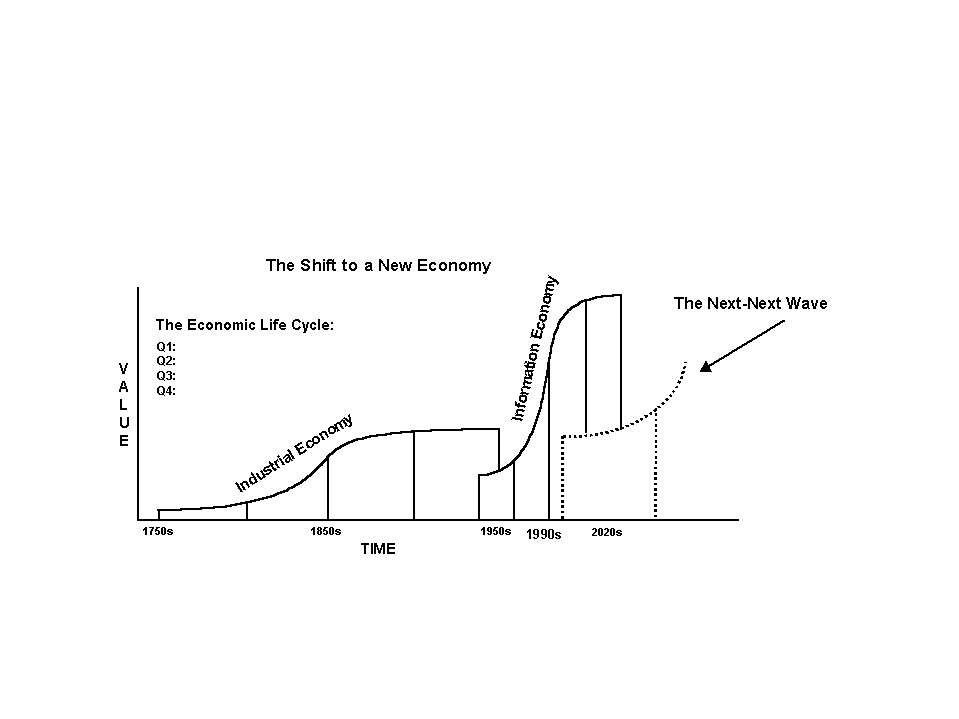
Were the 90's an anomaly? Was the 1995-2000 buildout of the Internet infrastructure the "Big Bang". Our perception of the future has certainly changed since the tech bubble burst back in March of 2000. On Wall Street, the distance between the present and the future continually changes. Pre-march 2000, when Wall Street said the "future looks bright", that meant as far as the eye can see (say 20 years). Today, the future has moved much closer the present.From 1995-2000, the chart of the Nasdaq looked like a hockey stick because the rate of growth was enormous and prospects seemed never ending.
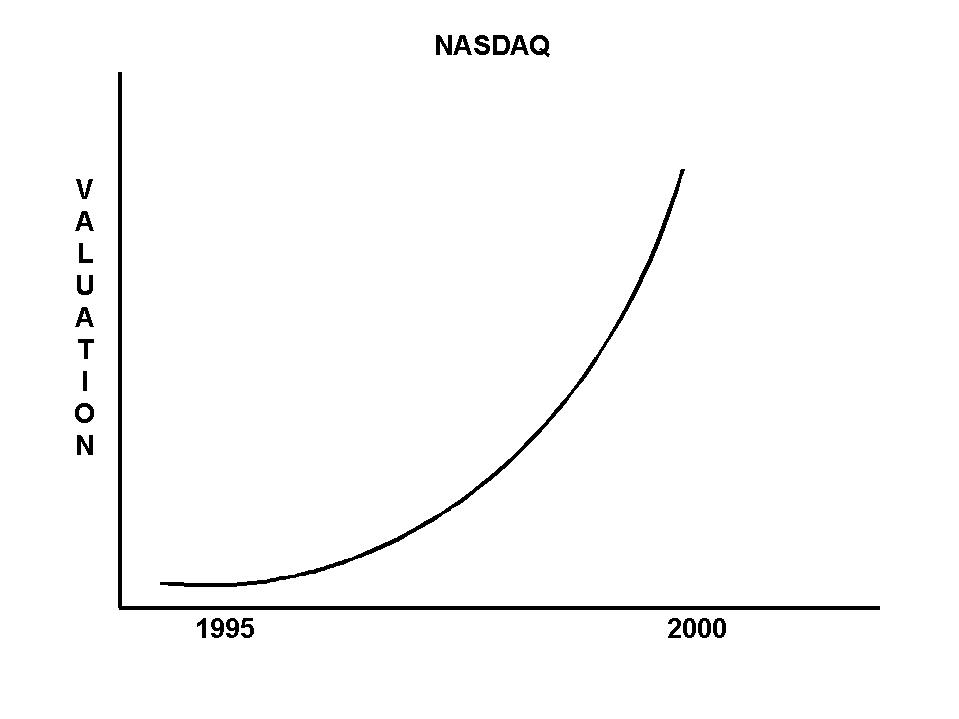
During the boom time, the perception of the future was that demand for bandwidth would continue almost exponentially. We thought that demand was unlimited so money poured into what seemingly was an unlimited number of providers along with a near unlimited number of vendors to supply the equipment to those providers.Analyst made up new metrics to measure the performance of the service providers such as revenue growth, subscriber growth, Central Office growth, footprint. We ignored the only metric that has value, earnings. The service providers ignored the bottom line at the expense of growth, making the vendors that supplied them equipment rich over the short term.
During the boom times, you could literally throw a dart at a list of technology names and pick a winner. Most all technology company charts looked like a hockey stick. There seemed to be so much business to be had, that every company that entered the market would be a winner.
In 2000, as reality set in, everyone realized that the "New Economy" was subject to the same boom-bust business cycles as the "Old Economy". When the "free money, spend faster more better" party was over, demand began to weaken. We quickly realized that the service providers built-out networks in 5 years that should have taken 15. Consequently, the overcapacity in the network was extraordinary.
The more things change, the more they stay the same. In other words, the fundamentals of the way business works don’t change even though the parts and pieces of the business change. From a ten-thousand foot view of past business activity, we can see certain patterns that can help us understand the shape of the future.
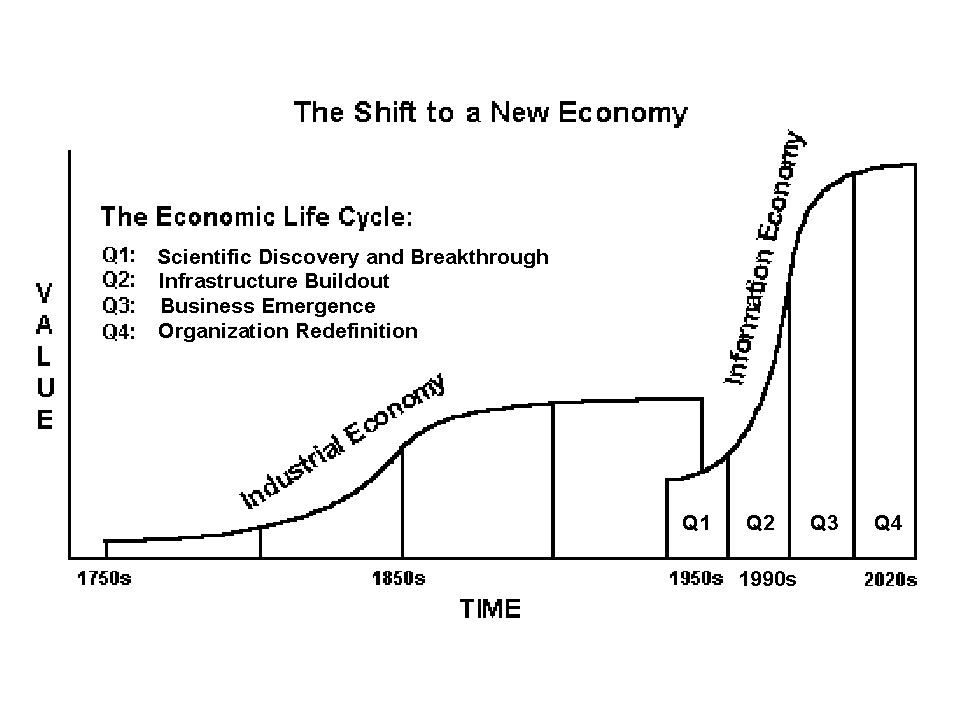
"Like people and all other living things-economies and the industries, businesses and the products within them-all have a life cycle," according to futurist Stan Davis, co-author of 2020 Vision. While each stage of any life cycle is different, the events that occur within common stages of a life cycle are similar. Life cycles for economies like people, tend to resemble S-curves.
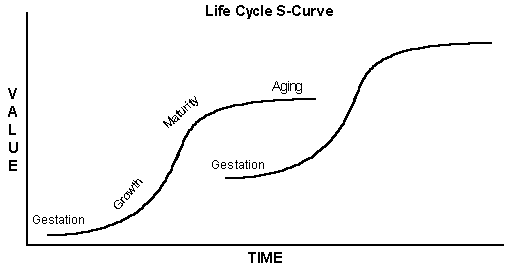
The first stage of an economy's life cycle is the embryonic period. Like people, this stage requires a great deal of investment and development. Davis notes that no contribution to the economy is expected during this differentiating stage of development. The second stage of an economic life cycle is the growth stage. During this stage, the investment and development made during the initial stage begins to pay off. Marketing takes over as the dominant activity during this stage while entrepreneurs lead the charge to higher returns.After a vigorous growth stage, economies like people develop into maturity. The new economy takes its name from the dominant creator of value in the economy. Firmly in place, it is in this stage that the economy begins to dominate all other economic activity. Davis points out that each economy "izes" the previous economy. The Industrial Economy industrialized the Agricultural Economy during its maturity stage just as the Agricultural Economy agriculturalized the Hunter Gatherer Economy before it. The informationalization of the Industrial Economy is taking place as we enter into the maturity stage of the Information Economy.
In the fourth phase of a life cycle, aging sets in. This stage is marked by heavy capital investment and diminishing returns . Sectors of the economy that are aging still make a contribution but become less dominant in the overall economy.
The Boston Consulting Group developed what is known as the Growth Share matrix to describe life cycle stages. In this matrix, a question mark represents the first life cycle stage symbolizing its uncertainty. The second stage is represented by a star because of its bright and rising future. The third stage is portrayed by a cow, better known as the milking stage, while the fourth stage is symbolized by a dog (the government loves dogs). (George Stalk & Tom Hout)
We can label the Information Economy S-curve as follows.
Each phase of a life cycle has it’s own S-curve. It’s now been over two years since the tech bubble burst. Looking back, the pre-March 2000 Nasdaq hockey stick looks more like the peak of a mountain with an immediate steep decline. On the growth side, the growth vs. time hockey stick was an S-curve all along.
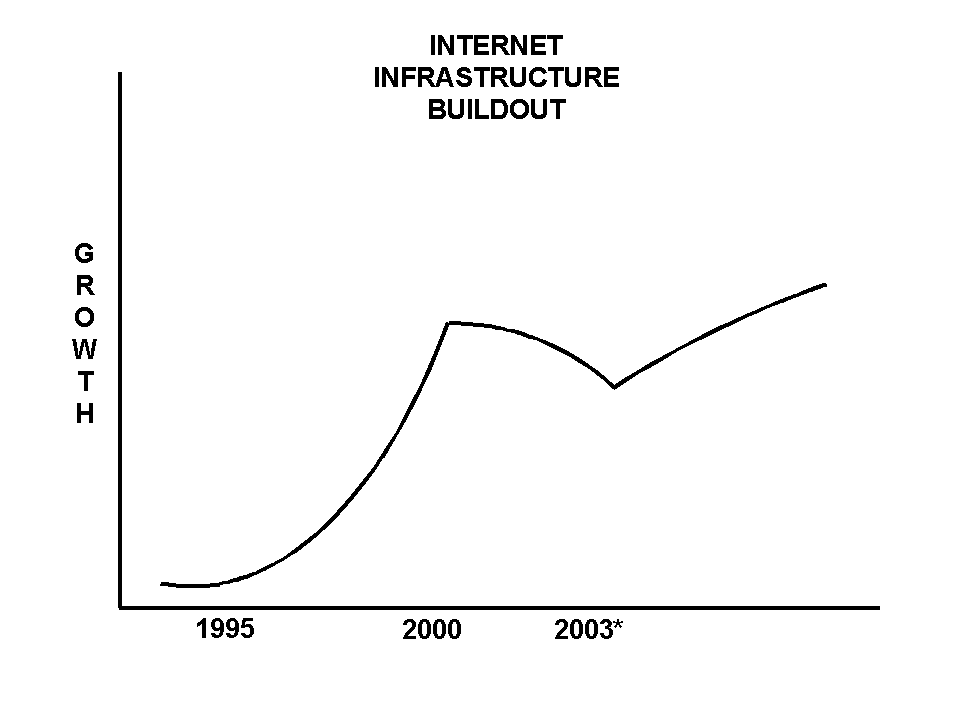
As we enter the maturity phase of the infrastructure buildout, we are also entering the maturity phase of the Information Economy life cycle. Over the last seven years, "Business/Personal Emergence" has been gestating on the Web. For the rest of this decade and beyond, business and personal uses of the Web will emerge in ways that we haven’t yet thought of. In fact, the association of the Web with what we currently call the Internet will change dramatically.
Much like analog is converging into the digital world, we will find a new way of looking at the Web in the future. The Web describes the interconnectivity of the users, but it is what that connectivity enables that is important.
In the age we live in, the only thing that is constant is change. The rate of change, is driven by technology. What drives the rate of technology; the rate at which we share information; communicate. Vinyl records have given way to CD’s. CD’s have given way to DVDs. The Web will give way to a new medium throughout this decade and on to the next.
Over time, the Web will begin to be thought of as a distributed network more than as a distribution network. The Web describes the interconnection of its users but it does not describe what will emerge from this structure. Currently, peer-to-peer is probably the closest description of what the Web will emerge into. But "Business and Personal" emergence goes far beyond peer-to-peer.
Think of a hive of bees, a flock of birds, a colony of ants, a forest of trees. A tree is a fractal (self similarity). Look at a leaf and you see the branch. Look at the branch and you see the tree. However, in studying a single tree, there are no clues as what will emerge from a tree.In "Out of Control", Kevin Kelly uses an example of a whirlpool as an emergent. For example, when you pull the plug in a bathtub filled with water, a whirlpool appears at the drain. The makeup of the individual water molecules don’t change but the water takes on a different form. There is no central source of control, the water acts autonomously, is tightly connected and act in unison. If you disturb the whirlpool, momentarily it disappears. Like a swinging pendulum whose track has momentarily been disturbed; a perfect example of a non-linear, distributed system.
Think of a crowd doing the wave at a baseball game. There is no central control, individuals act autonomously, are tightly connected and act in unison. At this point in time, the stock market is probably the best example of a distributed system that emerges as a crowd or herd of individuals. What can emerge from individual users of the Internet, 24/7 connected to the network, autonomous, and acting together.