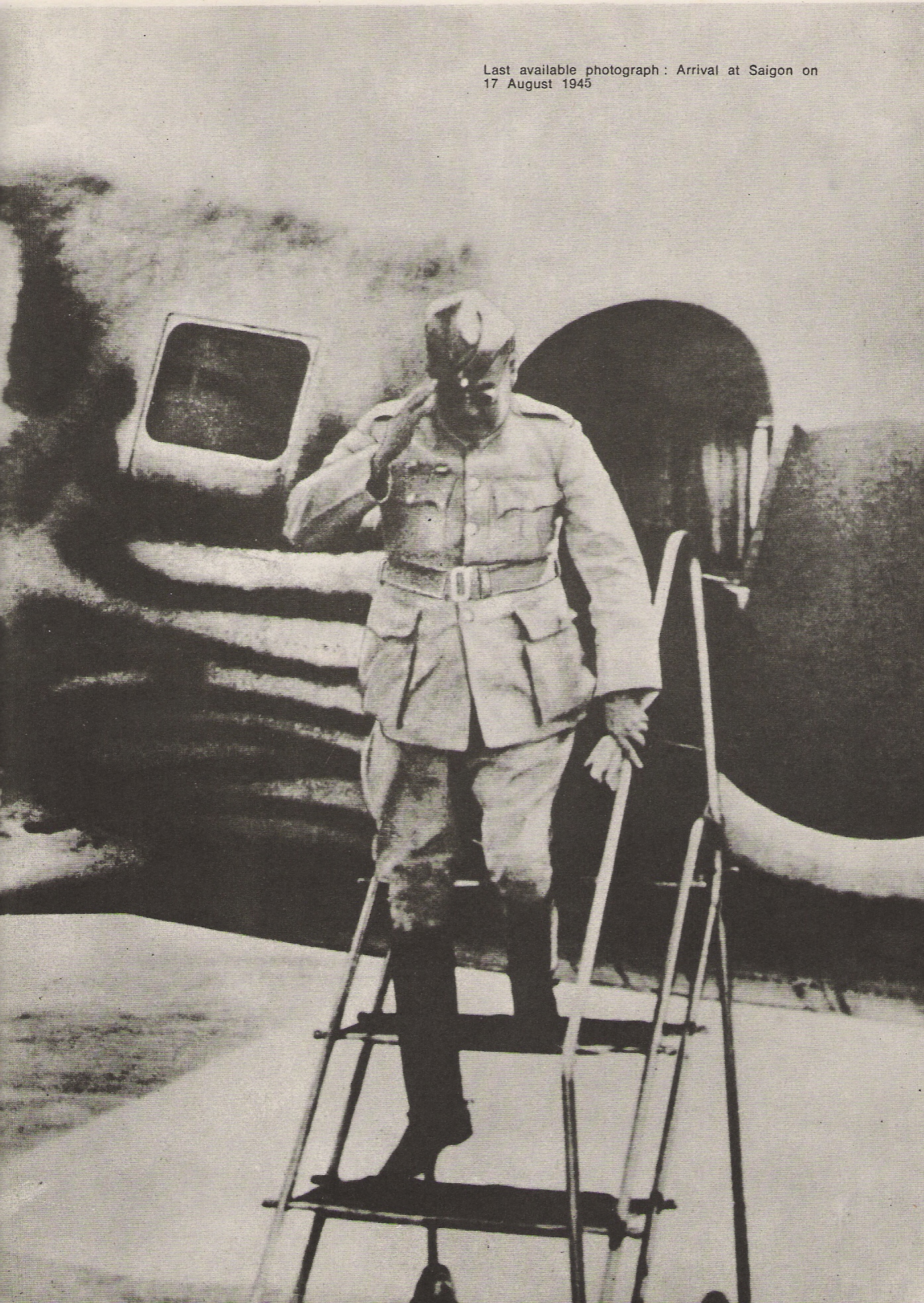
NETAJI'S LAST VISIT TO SAIGON
Material received with thanks from the Netaji Research Bureau, Calcutta
Excerpts of message from Dr. Sugata Bose, Gardiner Professor of History, Harvard University & Director, Netaji Research Bureau:
“I am very glad to know that the Bengali families in Saigon wish to do something to commemorate Netaji's visits to that city.
Netaji visited Saigon three times.
1) He arrived in Saigon on November 24, 1943 at 1.30 p.m. on his way back to Singapore from the Greater East Asia Conference in Tokyo. He stayed at the Nippon Hotel. After a brief afternoon rest there, he met the local commanders of the Japanese Army and Navy. In the evening he attended a banquet in his honour given by the Japanese minister Shigenori Tashiro. He also addressed a mass rally of local residents at which he exhorted his compatriots to join in the crusade to liberate their motherland from British shackles. Netaji left Saigon for Singapore on November 25, 1943.2) Netaji visited Saigon again in the second week of December 1944 on his way back from another visit to Tokyo. He flew from Tokyo via Fukuoka and Taipei to Saigon. We have a letter from Netaji from Saigon dated December 14, 1944, to Mr Rama Murti in Tokyo in which he says he has sent a bundle of "papar" for 'our boys' (meaning the Tokyo cadets) with Major Abe of the Hikari Kikan. He enclosed a cutting from an American journal "Nation" on the Imphal operations, which he wanted sent to General Tojo. He left Saigon for Singapore later that day.
3) Netaji arrived in Saigon on August 17, 1945. There is a description of what happened there in the Shah Nawaz Committee Report. S.A. Ayer has also left a vivid account in his book Unto Him a Witness. On August 17, 1945, Netaji, according to Ayer's book, drove with his colleagues to the house of one Naraindas, Secretary of the Housing Department of the India Independence League in Saigon. Ayer does not give an address but says the house was in 'the outskirts of Saigon'. Chandra Mal, Secretary of the Transport Department of the IIL in Saigon, had met them at the airport. The final conference with General Isoda and others on whether Netaji should travel in the plane that was leaving Saigon took place in this house.
We have his last available photograph, which shows him alighting from the aircraft at Saigon airport.” The photograph is produced below with kind permission of the Netaji Research Bureau, Calcutta, and efforts are on to locate the hotels Netaji stayed in.
From the Shah Nawaz Committee's Report (1956) :
One alleged eye-witness was an Indian darwan Ramneo Gosai. He said that Netaji came to the bungalow, accompanied only by two Japanese officers and left hurriedly after having lunch. The statement of this witness may be ascribed to failing memory after eleven years. One Mr. Narain Das then of the Indian Independence League Saigon and now of Tangier, has said that Ramneo told him the same story. Against his testimony, we have the evidence of the much more reliable persons who accompanied Netaji to Saigon. This witness also said that messrs. Ayer and Chatterjee left that bunglow in Saigon only two days before Netaji`s arrival and that Netaji was inquiring about them. In point of fact, Mr Ayer was actually accompanying Netaji.
3. At Saigon however the arrangements did not work according to expectation. No special plane was available to carry Netaji and his party F.M. Terauchi’s headquarters had been informed before hand by the Hikari Kikan of Netaji’s pending arrival at Saigon Col. Yano who was on the staff of the southern army has stated the F.M. Terauchi had decided that Netaji should reach Tokyo as soon as possible but owing to difficulty in obtaining passages by aeroplane Netaji alone should go. The headquarters of southern army at that time was located at Dalat a short distance from Saigon and there were officers posted at Saigon to carry out the orders of the headquarters. The actual arrangements for transport by air were being made by Lt. Col. Kojima, while Lt. Col. Tada, a staff officers from headquarters southern army who usually dealt with the Hikari Kikan met Netaji’s party which included General Isoda Lt. Col. Tada informed General Isoda that only one seat was available for Netaji in a plane that was leaving Saigon very soon the same day.General Isoda was naturally annoyed, and proceeded at one to Dalat to speak to F.M. Terauchi. On arrival at Dalat airport General Isoda was informed by Col. Yano that it was no use seeing the field Marshal, but he advised him to wait a little at the aerodrome. In point of fact, the headquarters was in a state of confusion following the Japanese surrender three days earlier soon afterwards, General Numjata, Chief of General Staff of the Southern Army, rang up General Isoda and told him that he had brought the matter to the notice of the Field Marshal and 2 or 3 seats besides that of Netaji would be available. When the first proposal of only one seat was broached, Netaji turned it down flat. He insisted that the entire party of his officers and advisers should go with him. There was a lot of discussion on this subject between Netaji and his advisers on the one hand and the Japanese officers on the other. His adviser’s thought that Netaji should not go all by himself. According to Mr. Debnath das, who was an adviser in the Provisional Government of Azad Hind, the Japanese officers had said that Saigon was no longer safe on account of Allied and insurgent activities, and therefore, Netaji should move on as quickly as possible, when the second offer of two seats was made, there were further discussions. During the course of these discussions, according to Col. Pritam Singh of the I.N.A., the Japanese gave out that as the allied forces had restricted the flights of their planes after surrender, the could not be sure whether aeroplanes would be available in the future and advised Netaji to accept the two seats offered. In the end, Netaji reluctantly agreed to accept these two seats, but on condition that those who were left behind were provided with transport on the following day. General Isoda promised to do his best.
4. Netaji selected Col. Habibur Rehman to accompany him. His choice was apparently approved of by the rest of his party as he was a senior staff officer and had been in close touch with Netaji for a long time. This has been mentioned by Col Pritam Singh and Col Gulzara Singh of the I.N.A. Netaji still did not give up hope of getting more seats in the plane. He told all members of his try their luck. On arrival at Saigon airport, however the party was disappointed as only two seats were available. Netaji baggage was unloaded from his car. The chief pilot said that the baggage was too heavy, and could not be put on the plane as it was already overloaded. Consequently Netaji himself discarded a part of his baggage containing books, clothes, etc. The party came to the aerodrome in two cars. Netaji came in the first car, while all these arguments and arrangements were being made the plane was waiting at the aerodrome. There were a number of Japanese officers who were to go in the same plane. The Japanese were very impatient to start, but this was delayed from about half an hour or so for the arrival of the second car. This car carried two leather suit cases containing jewelry, etc., and Netaji refused to move without them. The plane was already overloaded, and there were protests against loading it any more. In spite of this the heavy boxes were loaded into the plane. Among the Japanese passengers was a distinguished military officer. Lt. Gen. Shidei, lately of the General staff of the Burma army who was proceeding Manchuria as chief of staff of the Kwantung Army. Gen. Shidei came out of the plane and greeted Netaji. Although the was an element of chance in Netaji`s traveling by the same plane as General Shidei it appears that Netaji fell in with the idea he should go up to Manchuria with General Shidei at that time an interpreter attached Netaji`s Headquarter says Genral Shidei was supposed to be an expert on Russia affairs in the Japanese army and was considered to be a key for negotiation with Russia. It was suggested that Netaji should accompany him to Manchuria. It may be mentioned here there before he took up the job of interpreter he was working in important firm of Mitsubishi and is now the head of that firm in India. Lt. Col. Nonogaki an air staff officer of the Japanese army says the plane was scheduled to carry General Shidi to Manchuria. Netaji agreed to go with him to Dairen in Manchuria. So there was no change in the schedule of the plane. The plane itself was a twin engined heavy bomber of 97-2 (Sally) type, and belonged to the third air force army stationed Singapore. There is divergence of opinion on whether it was a new or an old plane. According to Captain Aria and Major Kono, the plane was of the newest type. General Isoda goes so far as to it was an old plane. General Isayama says that the engine of the plane was worn out. The ground engineer Captain Nakamura alias Yamamoto stated that while testing the engine at Taihoku, the chief pilot Major Takizawa had told him that the port engine had been replaced by a brand new one at Saigon. A brand new plane would no require the replacement of an engine.
5. Besides General the plane was carrying five other Japanese military officers as passengers. These were: Lt. Col. Tadeo Sakai, a Staff Officer of the Burma Army. Lt. Col. Shiro Nonogaki, an Air Staff Officer. Major Taro Kono, an Air Staff Officer. Major Ihaho Takahashi, a Staff Officer. Capt. Keikichi Arai, an Air Force Engineer. Lt. Col. Sakai is now in Formosa on a special mission. The other is a now civilian. Lt. Col. Nonogaki is now the branch manager at Osaka of the firm of Tokyo Kagyo Byoeki Shokai Ltd. Major Kono has his printing business in Tokyo. Major Takahashi lives at Kanagawa city in Zushi perfection. Captain Arai is a lecturer at the Tokyo and Kieo universities. The crew consisted of five or six persons: Chief Pilot – Major Takizawa, Co-Pilot-W/O Ayoagi, Navigator- Sereant Okishta, Radio-Operator – N.C.O. Tominaga, and one or two engineers, whose names have not come out. Including Netaji and his adjutant Col. Habibur Rehman the plane carried 13 or 14 persons in all. Netaji was in uniform wearing a khaki drill bush shirt trousers and shoes with I.N.A.cap and badges. He bade good bye to all those who had come to see him, and shook hand with them, telling them that they would meet him soon. After that, he boarded the plane through an entrance on the port side followed by Col. Habibur Rehman. That was the last time his faithful followers whom he left behind saw him.
6. At the instance of Genral Shidei Lt. Col. Nongaki made arrangements for the seating of the passengers. As there were no proper seats, passengers had to squat on the floor, Netaji being provided with a cushion. Genral Shidei, Netaji and Col. Habibur Rehman were given the best seats. General Shidei took the seats usually occupied by the co pilot. The crew were in the nose of the plane while the other military passengers took their seats in the rear of the plane. Col. Habibur Rehman has given a detailed description of the seating arrangements, which is reproduced below and had illustrated it by sketch: “The number of occupants in the plane including the crew was 12 or 13. In the nose portion of the plane were probably a co pilot a radio officer and navigator. The seat of the pilot was behind then on the port side and opposite to him, as the space was restricted by the Netaji and nobody opposite him as the space was restricted by the petrol tanks. I was sitting immediately behind Netaji. The co pilots seat occupied by Lt. Gen. Shidei was offered to Netaji but he did not accept, as it was too small for him. In the turret was standing one officer of the air force and in the rear portion probably 4 other officers of the Japanese air force or army. I do not Nogaki and of Capt. Aria whom I met later, after the crash in the hospital. The Committee has examined four of Col. Habibur Rehman`s fellow passengers namely, Lt. Col. Nonogaki Major Kono Major Takashi and Captain Aria. Regarding seating arrangements. The versions of the different witnesses tally to a great extent. They all say the same thing about the relative positions of Netaji General Shidei and Col. Habibur Rehman and the fact that the crew were in the nose and the other officers at the back. There are however some discrepancies as to the number of the crew; some say it was four others say it was five. There is however, an important difference regarding Major Kono. According to Col Habibur and Captain Aria Major Kono was the rear but Major Kono says that he sat ahead of Netaji and talked to him during the flight. Col. Nonogaki also confirms this position. In the first written statement dated 24-8-1945, by Col. Habibur Rehman which was handed over to the Committee it was however stated that there was a Japanese officer sitting between the pilot and Netaji. So it seems more or less certain that Major Kono was sitting in the front of the plane.
7. The plane took off quite well from Saigon airfield in the afternoon of the 17th August. There is some difference about the exact time but most witnesses say that the plane took off between 5 and 5-30.a.m.
As there was delay in starting the pilot decided to halt for the night at Tourance on the Indo-China coast, instead of flying straight to Formosa. Tourance was reached safely in a couple of hours. There Netaji and the other officers spent the night at the largest hotel in the town. Although the witnesses examined by the committee could not give the name of the hotel, there is reason to believe that the hotel in question was hotel Morin, which the committee visited during their trip to the far east. While taking off at Saigon, the plane had to run the entire length of the runway before it was airborne. This showed that it was overloaded. While the others rested at tourance, the chief Pilot, assisted by Major Kono, both air force officers, were busy making the plane lighter. According to Major Kono, no fewer than 12 anti-craft machineguns, and all the ammunition were taking down from the plane. Some surplus luggage was also discarded and the total weight reduced by 600 kilos. Thereafter these officers attended to the maintenance of the plane and satisfied themselves that everything was correct."