East
Asia Study Guide by Saif
VOCABULARY
GDP - Gross domestic product: the value of all goods and services within a country. It includes output by both foreign and domestic concerns operating in that country.
Per capita income – The amount of money per person in a country or region
Developed nation – A country that has a manufacturing economy and a fairly high GNP or GDP
Developing nation – A country that has an agricultural economy and a fairly low GNP or GDP
Population – The number of people who live in a city or country.
Population density – The average number of people in a square mile or a square kilometer
Population pyramid – A pyramid-shaped graph that shows how many men and women of different age groups in a country
Census – A detailed count of the population (race, sex, age, etc.)
Area – The amount of land within a country or region.
One family/one birth – A law that was proposed in China in order to stop overpopulation, which allowed only one child per family
Urban – city
Rural – Countryside with small population
Communism – A government in which the government owns all businesses and makes most of the decisions for the country
Totalitarian – A government in which the government controls EVERYTHING – religion, culture, etc.)
Central Planning – An economic system (Command economy) in which the government decides what to produce, workers’ wages, prices of goods, etc; Communism
Capitalism – An economic system based on competition
Free market – Capitalism
Democratic – A government by the people
Archipelago – A group of islands
Peninsula – Land that is surrounded on 3 sides by water
Plateau – Large flat area of land at high elevation
Buddhism – The religion founded by Buddha whose teachings consisted of the Three Universal Truths, the Four Noble Truths, and the Eightfold Path
Four Noble Truths –
1. All life involves suffering.
2. The cause of suffering is desire and attachment.
3. Desire and attachment can be overcome.
4. The way to overcome them is to follow the Eightfold Path.
Eightfold Path – The moderate Middle Way including: right viewpoint, values, speech, actions, livelihood, effort, mindfulness, and right meditation.
Wesak (Vesak) – The celebration of the birth and life of Buddha
Prince Siddattha – Buddha, the prince that had seen the four sights: a sick man, an old man, a dead man, and a monk, who became enlightened.
Tibetan Buddhism – Mahayana Buddhism: The northern branch of Buddhism in which is the followers believe that Buddha can respond to appeals from people today and bodhisattvas: people who are on the brink of enlightenment but who have chosen to stay in the world for the sake of helping others towards the same state.
Lama – A Mahayana Buddhist monk.
Dalai Lama – A bodhisattva who is the highest spiritual and political leader in Tibetan Buddhism.
Theocracy – A government in which the leader is also the religious leader
Sand Mandala – A symmetrical work of art made entirely of sand, which is always destroyed, to show no desire or attachment
Mahayana – Tibetan Buddhism
Theraveda – The southern branch of Buddhism in which the believers follow Buddha’s original teachings and think of Buddha as a remarkable person, nothing more, and nothing less
Sangha – A group of nuns or monks
Confucianism –A religion founded in the 6th century by Confucius, a Chinese philosopher who emphasized the dignity of humanity and the importance of people behaving appropriately to their position in life.
“Beautiful conduct” – Behavior which involves always being considerate to others, respecting ancestors and aiming for harmony and balance in all things, avoiding extremes of emotion and behavior.
Taoism – The religion that is said to be founded by Lao-tzu in which Taoists try to become merged with the Way and so achieve liberation and become one of the Immortals; Meditation and contemplation are essential
Lao Tzu – He is said to be the founder of Taoism and lived in China in the 6th century, but scholars doubt his existence.
Yin yang – The Taoist symbol that represents the harmonious interaction of the two opposing forces of the universe: yin (male) and yang (female)
Shintoism – A Japanese religion that roots date back to at least 1000 BCE, which is based on the belief that spiritual powers exist in the natural world
Kami – Spiritual powers or gods that live in the natural world (in trees, the wind, stones, animals, and people, including the dead)
Mao Zedong – A past leader of China who had made the country a communist nation and had done both good and bad for the country.
Great Leap Forward – One of Mao’s plans in which hundreds of thousands of collectives were combined into thousands of communes. Mao hoped to increase production but failed – “a serious leap backward”
Cultural Revolution – When Mao smashed the old order completely and established a new, socialist society – another failure of Mao
Red Guards - An army of radical young men and women unleashed by Mao during the Cultural Revolution to enforce his policies (killing if necessary). Their job and command was to destroy the Four Olds: old ideology, old thought, old habits, and old customs.
Deng Xiaoping – A leader of China who took a more practical approach to solving China’s problems that Mao. He repaired much of the damage done caused by Mao.
Four Modernizations – A program started by Deng to improve agriculture, industry, science and technology, and defense as quickly as possible.
Fifth Modernization – Political freedom, which was demanded by many Chinese citizens
Tiananmen Square – The center of the city where 100,000 people crowded to demonstrate for democratic reforms. The government ordered the demonstrators to leave and had those who disobeyed killed.
Atheism – The disbelief in God
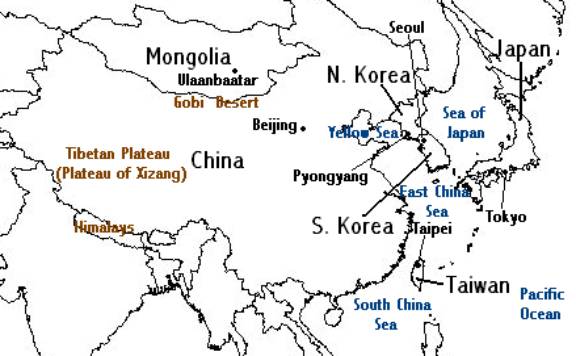
MAP
DRAWING CONCLUSIONS
· GDP shows the size of the economy: If the GDP is small, then the value of the goods and the services is low, so the economy is small. If the GDP is big, then the value of the goods and the services is high, so the economy is large.
· Per capita income shows the wealth of the country: Per capita income shows how wealthy the average person is. The higher the per capita income, the wealthier the people are, so the wealthier the country. The lower the per capita income, the poorer the people are, so the poorer the country.
· Population Pyramids:
o Stable – when the pyramid is almost rectangular: it means that the population is neither growing nor decreasing significantly
o Growing – when the pyramid looks like a pyramid with a narrow top and a wide base: it means that children are more numerous than adults
o Decreasing – when the pyramid is wide in the middle and very narrow at the base: it means that there are fewer children being born.
· When a region is densely populated it is usually urban, and when the region is less densely populated, it is more rural.
· In East Asia, the things present in the region greatly affect where people will live. People want to live in places that have fertile soil, natural resources, wetter climates, are urbanized, etc. Not all places in East Asia have these living conditions. So, more people live in these kinds of places while less people live in the places without these features.
· Characteristics of western China (mainly sparsely populated):
o Drier climates
o Poorer soils
o Few people
o Shorter growing season
o Rural China
o High plateaus
o Sheep grazing
· Characteristics of eastern China (mainly densely populated):
o Fertile soils
o Large cities
o Low lands
o River valleys
o Urban areas
o Denser population
o Wetter climates
o Manufacturing
o Longer growing season
· Buddhism: founded by Buddha (Prince Siddattha) in India, about 2500 years ago; Teachings consists of the Three Universal Truths, the Four Noble Truths, and the Eightfold Path
· Confucianism: founded by Confucius in China, 6th century BCE; Emphasizes the dignity of humanity and the importance of people behaving appropriately to their position in life; Originally advice for rulers
· Taoism: founded by Lao-tzu in China, 6th century BCE (may not have existed); Teaches that this is the ultimate reality or underlying spiritual force of the universe; Taoists try to become merged with the Way and so achieve liberation and become on of the Immortals; Meditation and contemplation are essential
· Shintoism: founded in Japan, at least by 1000 BCE; Based on the belief that spiritual powers exist in the natural world; Believe in kami; Worship at home or in temples but must be cleansed;
· Many of the East Asian religions can be practiced simultaneously. This is because most of them have similar beliefs: to live piously by doing good and meditating
· Symbols in Buddhism:
o The four sights – an old man, a sick man, a dead man, and a monk: symbolizes suffering
o Lotus growing from mud and becomes a beautiful flower: symbolizes how it’s possible to reach enlightenment from something impure things like humans.
o An eight-spoked wheel: symbolizes the Eightfold Path
o Long ears: wisdom of Buddhahood
o Third eye (from Hinduism): wisdom
· Because of China’s immense population, feeding it is difficult. Other problems emerged as well: lack of technology and military, etc. Many people had different view and ideas. At the time, Communism seemed like a good idea since the previous attempts failed.
· Ways leaders have tried to improve country:
o Use surplus in one region to feed another region with food shortage
o Brought Western idea to China
o The Great Leap Forward
o The Cultural Revolution + Red Guards
o The Four Modernizations
o Establish contract responsibility system: government rented land to individual farm families. Families provide a certain amount of crops at a set price. Then they could sell excess.
o Industrial Development: changing heavy industry to light industry (instead of producing things like iron, steel, etc. produce clothing, appliances, etc.)
o Set up Special Economic Zones
· China’s relation with Tibet: China sees Tibet as part of it, so it invaded and now it is apart. China thinks that the Dalai Lama is a threat to them so they forced him into exile in India.
· LAST 2 OF DRAWING CONCLUSION NOT DONE YET!