
Web page Designing
By Bibhor Baral, Bikram Shrestha, Rosy pradhan, Sagun Chalise,
Web page is a unit of information, often called document that is
available over the world wide web. Web page is simply a page that is
viewed through the internet. It stays in a web server. It is created using
HTML which defines the contents of a web page such as images, text,
hypertext links, video, audio files etc.
History
In 1969 the department of defense of USA started the network
called ARPANET (Advanced Research Projects Administration Network), which
later on gave birth to today's Internet.
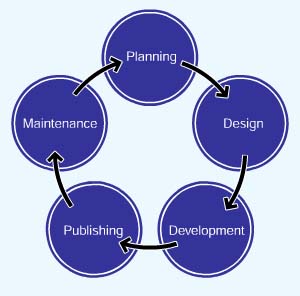
There are several stages of web page designing which are
described as follows.
1. The Creative Stage
This is the first stage of web page designing. In this stage author
will gather information, decide what subjects and materials to include on
the website. During the creative stage author should brainstorm about what
s/he want to put on the site, what is the site's goal and who is the
target audience.
2. The planning stage
The next stage is the planning stage. In this stage the author needs
to decide where to publish the site, and how to effectively organize it.
The planning stage is very important to a site's level of organization.
There are few rules, which should always be followed.
->Decide on which server we are going to host the site.
-> A site map should be drawn to visualize the relationship of
documents in advance.
3. The production stage
In this stage actual code is written, graphics and animation are created.
The graphics can be created with the help of software like paint, Ms Photoshop,
Macromedia Flash etc.
4. Implementation Stage
This is the final stage of web page designing. In this stage the
created documents is loaded to the server and tested for accuracy.
Generally the File transfer protocol is used for uploading web pages.
5. Maintenance stage
This stage includes updating the site. With the elapse of time some kind
of error might appear in the site or the public interest might change. So,
it is the job of the webmaster to have a frequent look on the site and
update it whenever it is required.
Thus, the web page development cycle goes on .